
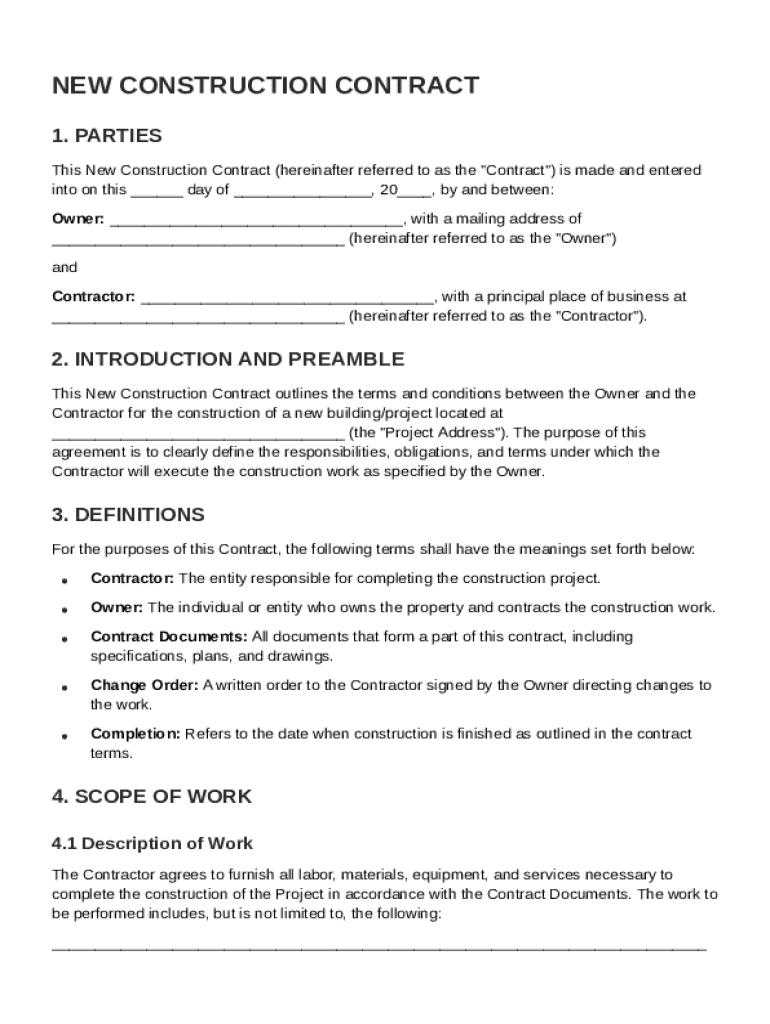







Definition and Meaning
A New Construction Contract Template is a customizable document that outlines the agreement between an owner and a contractor for the construction of a new building. This template serves as a detailed reference that stipulates the responsibilities, rights, and duties of each party involved in the construction process. By providing a clear framework, it helps reduce misunderstandings and conflicts by specifying key elements such as project scope, timelines, payment schedules, and more.
Core Elements of the Agreement
- Parties Involved: Identifies the owner, contractor, and any subcontractors, outlining their roles and responsibilities.
- Scope of Work: Details the specific construction tasks and objectives, including materials, workmanship, and design specifications.
- Payment Terms: Specifies the total contract price, payment schedule, and any terms related to deposits, progress payments, or retention fees.
- Project Timelines: Establishes the start and completion dates, along with milestones for various phases of the construction.
- Insurance and Liability: Describes the types of insurance required for the project and the party responsible for securing it.
Practical Application
The template is designed to be comprehensive yet flexible, allowing users to modify sections to better align with unique project requirements or local regulations. It is particularly useful for ensuring all potential variables are considered and agreed upon before construction begins.
How to Use the New Construction Contract Template
Using a New Construction Contract Template effectively ensures all necessary details are communicated and agreed upon. The following steps outline how to use the template:
- Identify Project Requirements: Clearly define the scope, timeline, and budget before drafting the contract.
- Customize the Template: Adjust the sections of the template to reflect specific project details, including parties involved, scope of work, and payment terms.
- Review with Legal Counsel: Have the drafted contract reviewed by legal professionals to confirm compliance with state laws and regulations.
- Signatures and Approvals: Ensure all parties review and sign the contract to demonstrate mutual agreement and understanding.
Real-World Example
Consider a scenario where a homeowner plans to build a custom home. Using the New Construction Contract Template, the homeowner can tailor each section to include specific architectural designs while defining the project timeline and payment schedule, ultimately providing clarity and protection for both parties.
How to Obtain the New Construction Contract Template
Acquiring a New Construction Contract Template involves selecting the right version that aligns with your project needs. Here’s a guide to obtaining it:
- Online Platforms: Reliable online platforms like DocHub offer diverse templates that can be easily downloaded or edited directly on the site.
- Legal Service Websites: Many legal service providers offer free or paid templates that have been vetted for quality.
- Consult with an Attorney: Attorneys specializing in construction law can provide templates customized to fit specific legal requirements.
Considerations for Selection
- Ensure that the template aligns with local legal standards to avoid compliance issues.
- Check for compatibility with online editing tools for ease of customization and distribution.
- Evaluate whether the template offers clear sections for critical elements like dispute resolution and termination conditions.
Steps to Complete the New Construction Contract Template
Completing the template involves several critical stages to ensure it serves its intended purpose satisfactorily:
- Gather Information: Collect all necessary details about the project, including contractor credentials, project scope, and financial terms.
- Draft Initial Contract: Use the template to fill in basic project information, highlighting key contractual terms.
- Review and Revise: Collaborate with all involved parties to review the draft, making necessary amendments and ensuring consensus.
- Finalize and Execute: Obtain signatures from all parties involved to formalize the agreement and secure its enforceability.
Case Study: Successful Contract Completion
In a residential construction project, the contract template facilitated a structured negotiation process, where the homeowner and contractor collaboratively fine-tuned project specifics, eliminating potential areas of dispute.
Key Elements of the New Construction Contract Template
A well-constructed template includes several vital components to ensure a comprehensive agreement. Key elements include:
- Dispute Resolution Clause: Outlines procedures for mediation or arbitration in case conflicts arise, thus offering a preemptive mechanism to resolve issues.
- Termination Conditions: Specifies scenarios under which the contract can be legally terminated by either party, ensuring clarity and protection.
- Change Order Protocol: Establishes how changes in work scope are managed, documented, and authorized, helping maintain project integrity.
Important Terms Related to New Construction Contract Template
Understanding specific terms is crucial to navigating the template effectively:
- Force Majeure: Refers to unforeseen events that may impede project progress, such as natural disasters.
- Liquidated Damages: Pre-determined compensation for delays in project completion not covered by justified extensions.
- Warranty Period: Timeframe post-completion during which the contractor must address any defects at no extra cost.
Legal Use of the New Construction Contract Template
The legal application of the template is integral for its enforceability and adherence to regulatory standards:
Compliance with Legal Standards
- Customize the template to align with federal, state, and local laws that govern construction contracts.
- Ensure that terms and conditions meet obligations laid out by relevant construction acts and regulations.
Legal Precedent
Contracts using standardized templates often stand better scrutiny in legal disputes due to their well-established frameworks and clarity in defining responsibilities.
State-Specific Rules for the New Construction Contract Template
Each state may have unique regulations impacting construction contracts:
- California: Requires specific disclosures pertaining to contractor licensing and consumer rights, often necessitating additional clauses.
- New York: Obligates contracts to incorporate provisions for worksite safety and compliance with local labor laws.
Example of State Impact
A contractor operating in Texas might need to include explicit terms addressing lien rights, which vary significantly from those in other states, ensuring they meet statutory guidelines.
Who Typically Uses the New Construction Contract Template
This template serves a wide variety of users including:
- Homeowners: Securing agreements with builders for new home construction.
- Contractors: Standardizing contracts with new clients to streamline project onboarding.
- Real Estate Developers: Managing various projects through uniform contract frameworks, simplifying oversight and compliance processes.


Scenario: Developer Use
For a real estate developer overseeing multiple projects, employing a standardized contract template enhances operational efficiency by reducing the time needed to negotiate individual contract terms.
Examples of Using the New Construction Contract Template
Practical examples illustrate how diverse stakeholders can benefit from using the template:
Residential Projects
- A family uses the template to formalize an agreement with a contractor constructing their dream home, ensuring every detail from foundation to rooftop is covered and agreed upon.
Commercial Developments
- An enterprise developer utilizes the template to define project phases for a new office complex, establishing clear expectations and payment terms that sync with investor timelines.
Custom Renovations
- Homeowners conducting extensive renovations employ the template to outline detailed architectural requirements and approve material selections, ensuring comprehensive project oversight.




