
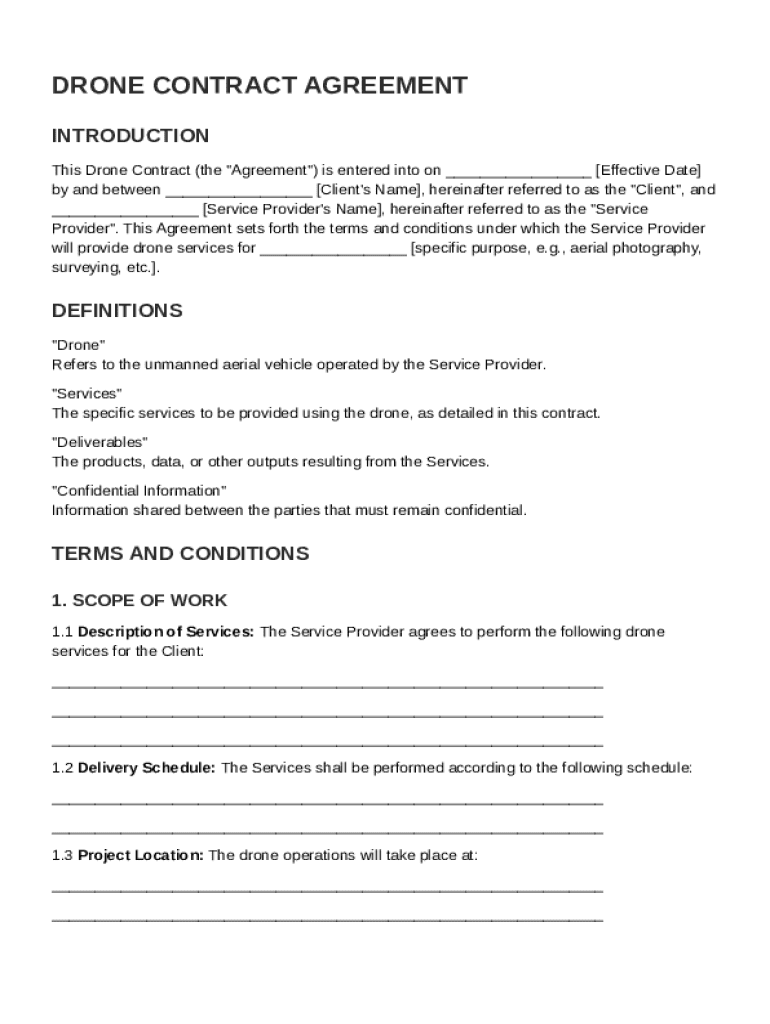







Definition & Meaning
The Drone Contract Template is a legal document that specifies the terms and conditions under which drone services are provided. It serves as a formal agreement between the Client, who requests the service, and the Service Provider, who delivers the service. This template establishes the framework for service delivery, ensuring both parties understand their duties, rights, and responsibilities. Essential components typically covered include compensation, the scope of work, confidentiality, liability, insurance requirements, termination clauses, governing law, and other miscellaneous provisions. By clearly delineating these elements, the template reduces misunderstandings and outlines a mutual understanding of expectations.
Key Elements of the Drone Contract Template
- Scope of Work: Defines what tasks the drone operator will perform, such as aerial photography, videography, mapping, or surveillance.
- Compensation: Details the payment terms, including rates, payment schedule, and any additional costs or fees.
- Responsibilities: Specifies the duties of both the Client and the Service Provider, including compliance with Federal Aviation Administration (FAA) regulations.
- Confidentiality: Ensures that any sensitive information exchanged is protected from unauthorized disclosure.
- Liability and Insurance: Covers who is responsible for damages or losses and what insurance policies are required or recommended.
- Termination Clauses: Outlines the conditions under which the contract can be terminated by either party.
- Governing Law: Determines which state laws apply to the contract in case of a dispute.
How to Use the Drone Contract Template
Using the Drone Contract Template involves a series of methodical steps to customize the document to your specific needs. This ensures the contract covers all necessary agreements between the participating parties.
- Identify Parties: Clearly define who the Client and Service Provider are, including their contact information and any relevant identifiers.
- Customize Scope of Work: Specify the exact services to be provided, highlighting any unique requirements or constraints.
- Define Compensation: Agree on payment terms, ensuring both parties have a mutual understanding of financial obligations.
- Detail Responsibilities: Outline the tasks and responsibilities for both parties, including equipment provision and regulatory compliance.
- Address Confidentiality: Include clauses to protect sensitive information shared between the parties.
- Liability and Insurance: Clearly articulate the allocation of risks, and specify the insurance coverage required.
- Include Termination Clauses: Define clear pathways and conditions under which the agreement can be legally dissolved.
- Review and Finalize: Both parties should review the contract to ensure clarity and completeness before signing.
Who Typically Uses the Drone Contract Template
The Drone Contract Template is commonly used by a range of businesses and professionals involved in the provision and procurement of drone services.
- Photography and Videography Companies: Utilize drones for capturing aerial footage, requiring clear contracts to manage client relationships.
- Surveying and Mapping Firms: Engage in creating detailed maps or plans from aerial data, benefiting from defined service agreements.
- Real Estate Companies: Often contract drone operators for high-quality property listing images.
- Agricultural Businesses: Use drones for crop monitoring and data collection, necessitating precise service terms.
- Infrastructure Inspectors: Depend on drone services for efficient inspections and require contracts to designate roles and expectations.


Important Terms Related to Drone Contract Template
Understanding the legal and technical terms associated with the Drone Contract Template is crucial for effective use.
- FAA Regulations: Rules governing drone operation in the U.S., impacting compliance requirements in contracts.
- Indemnification: A clause where one party agrees to compensate the other for certain losses or damages.
- Force Majeure: A provision that frees parties from liability due to unforeseeable events like natural disasters.
- Work for Hire: Term indicating that the completed work is owned by the Client, which is significant in intellectual property discussions.
- Subcontracting: The act of hiring another party to perform services originally agreed upon in the contract, which needs clarity in contracts.
Legal Use of the Drone Contract Template
The Drone Contract Template must be legally enforceable and compliant with federal, state, and local laws. It ensures that all parties are cleared regarding their responsibilities and liabilities.
- Compliance with Federal Laws: Include terms that ensure adherence to FAA guidelines and other relevant federal regulations.
- State-Specific Modifications: Adjust the template to reflect specific state laws that may affect the agreement or performance of drone services.
- Binding Agreement: Ensure that the contract is signed by authorized parties, making it legally binding and enforceable in court.
Steps to Complete the Drone Contract Template
Completing the Drone Contract Template requires careful attention to detail and a thorough understanding of the involved elements.
- Gather Information: Collect all necessary details about the services to be provided, naming all involved parties and their roles.
- Input Specifics: Enter detailed descriptions of service requirements, compensation agreements, and other essential contract elements.
- Legal Review: Have the contract reviewed by legal professionals to ensure compliance and protect all parties' interests.
- Finalize: Both parties must agree to the terms and append signatures to make the contract official.
- Distribute Copies: Ensure all parties receive a fully executed copy for their records.
Examples of Using the Drone Contract Template
Here are practical scenarios where the Drone Contract Template can be effectively utilized:
- Real Estate Marketing: A real estate firm hiring a drone company for aerial shots of properties uses the template to define the number and angle of shots, timing, and financial terms.
- Construction Site Monitoring: A construction company contracts a drone service provider to monitor site progress and safety compliance, detailing flight schedules and data sharing protocols in the contract.
- Crop Monitoring in Agriculture: An agricultural business drafts a contract with a drone service for weekly monitoring of field conditions, specifying data delivery formats and deadlines within the agreement.
State-Specific Rules for the Drone Contract Template
Drone operations and related contracts may be subject to varying state regulations, which are crucial to adjust for in the template.
- California: Strict privacy laws can impact how and where drones are operated, requiring privacy clauses.
- Texas: Requires emphasis on property owner rights concerning aerial footage.
- New York: May include specifics on noise ordinances affecting flight times within urban areas.
These variations mean that users need to modify the contract template accordingly to ensure full legal compliance.




