






Definition & Meaning
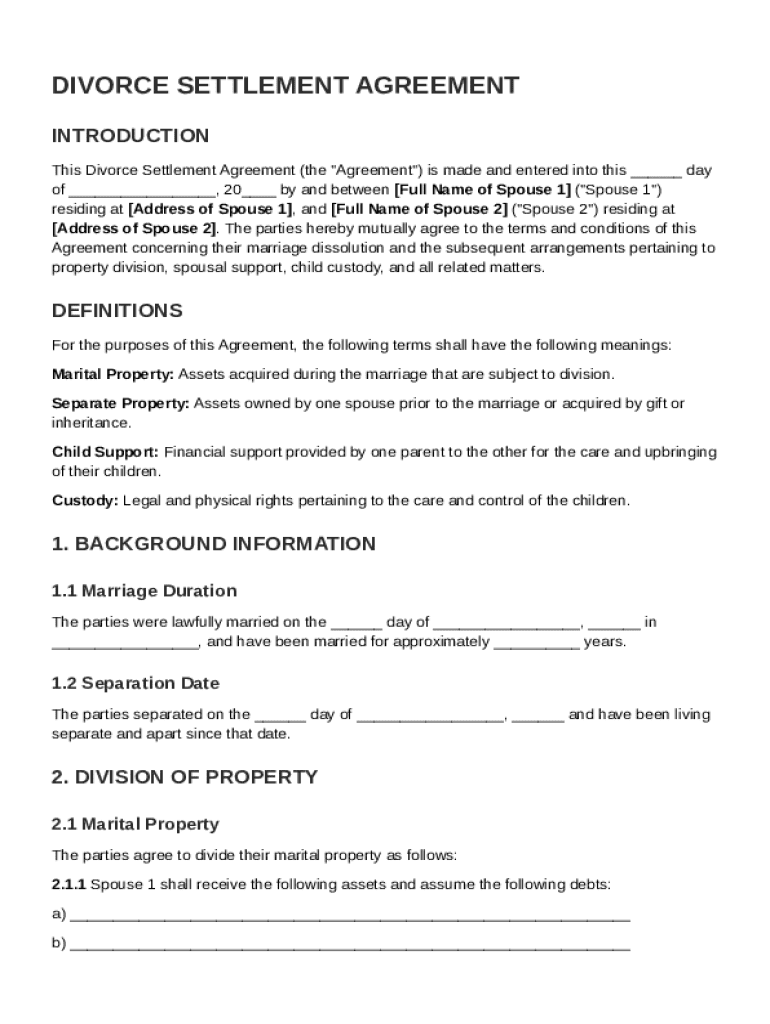
A Divorce Contract Template, often referred to as a Divorce Settlement Agreement, is a legal document outlining the agreements between two spouses as they dissolve their marriage. It defines the rights and responsibilities of each party, ensuring clarity and understanding during the process. The agreement typically encompasses the division of assets and debts, child custody arrangements, spousal support, and other relevant considerations integral to the dissolution of a marriage.
Key Elements of the Divorce Contract Template
The template includes several pivotal components necessary for a comprehensive settlement:
- Division of Property: Specifies how marital and separate properties will be divided between the parties involved.
- Child Custody and Support: Establishes custody arrangements and outlines the child support responsibilities of each parent.
- Spousal Support (Alimony): Details any agreement regarding alimony, including payment amounts and duration.
- Health Insurance Responsibilities: Identifies who will provide health insurance for children and potentially the spouse.
- Tax Considerations: Discusses how tax liabilities and benefits will be shared or attributed.
- Dispute Resolution: Offers methods for resolving disputes that may arise post-divorce, such as mediation or arbitration.
Steps to Complete the Divorce Contract Template
Completing the Divorce Contract Template involves several steps to ensure accuracy and legal compliance:
- Gather Required Information: Collect relevant financial documents, details about property, and information regarding children.
- Discuss and Negotiate Terms: Engage in discussions with your spouse to agree on critical terms such as property division and custody.
- Draft the Agreement: Utilize the template to draft the agreement, ensuring all terms are clear and agreed upon.
- Review and Revise: Both parties should review the document thoroughly and make necessary revisions.
- Sign and Notarize: Once both parties are satisfied, sign the agreement in the presence of a notary public to make it legally binding.
- Submit for Court Approval: Present the agreement to the court for review and approval as part of the divorce proceedings.
State-Specific Rules for the Divorce Contract Template
Divorce laws vary by state, influencing several aspects of the agreement:
- Property Division: Some states follow community property laws, while others adhere to equitable distribution principles.
- Alimony Calculations: States have differing guidelines on determining spousal support amounts and durations.
- Child Support Guidelines: These also vary significantly between states, impacting how payments are calculated and enforced.
Understanding these state-specific rules is crucial to drafting a compliant and enforceable agreement.
Legal Use of the Divorce Contract Template
The legal standing of a Divorce Contract Template is firmly established by adherence to state laws. Proper execution of the agreement by both parties ensures its enforceability in a court of law. Additionally, the document must accurately reflect mutual consent without any party being coerced into the agreement. Once signed and approved by the court, the agreement dictates the legal terms of the divorce.
Who Typically Uses the Divorce Contract Template
The template is most commonly used by spouses who have mutually agreed to the terms of their divorce without litigation. It serves those who prefer an amicable settlement process:
- Couples without significant conflicts: Those who maintain open communication and can negotiate terms directly.
- Families with children: Parents desiring clear agreements on custody, support, and parental responsibilities.
- Individuals seeking privacy: Couples wishing to keep personal details out of public court records.


Examples of Using the Divorce Contract Template
Real-world scenarios illustrate the utility of the Divorce Contract Template:
- Simplified Asset Division: Spouses can easily divide shared accounts and properties without court intervention in states allowing for mutual agreement.
- Parental Time-Sharing: The template can effectively outline custody schedules, ensuring both parents have clear and agreed-upon time with children.
- Debt Allocation: Couples can use the template to allocate responsibility for joint debts, avoiding future credit issues or disputes.
Digital vs. Paper Version
The template is available in both digital and paper formats, each with distinct advantages:
- Digital Version: Offers the convenience of easy editing and sharing, and may include fillable fields for efficient completion.
- Paper Version: Preferred by those who favor physical documents and handwritten signatures.
Choosing the format that best suits personal preferences and circumstances can streamline the divorce process.