
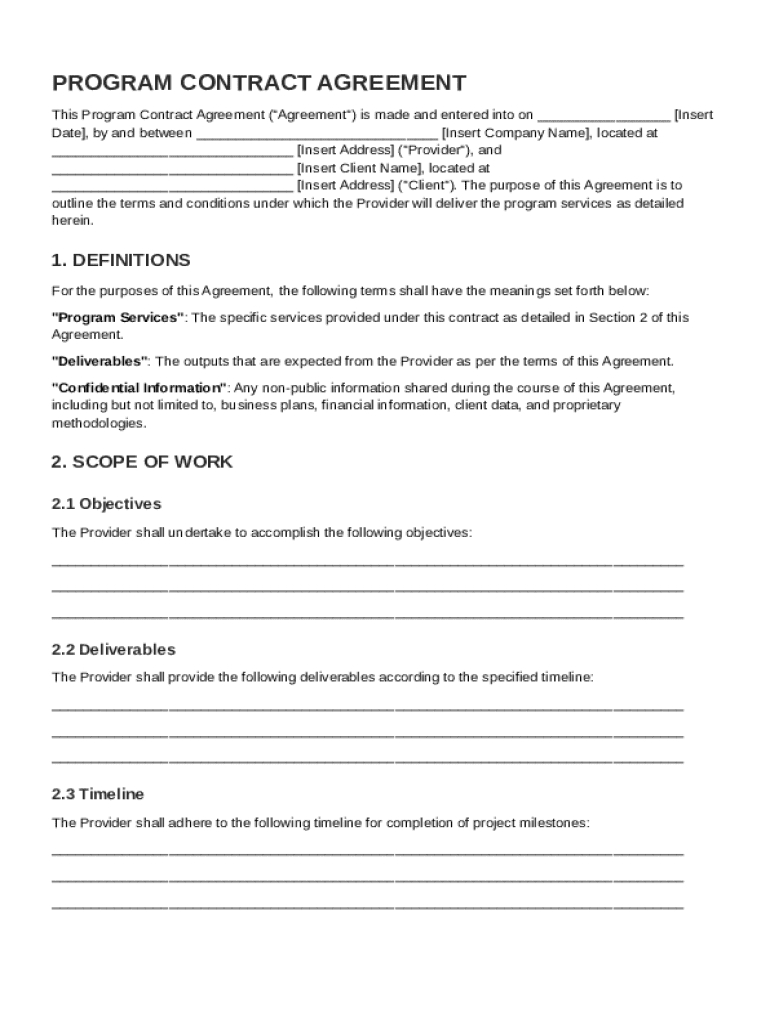







Definition & Purpose of the Program Contract Template
The Program Contract Template is a pre-structured document designed to outline the terms and conditions between a service provider and a client for the delivery of specific program services. This agreement ensures clarity and establishes mutual understanding by detailing various aspects, including definitions, scope of work, payment terms, and confidentiality obligations.
Key Components
- Definitions: Clearly outlines terminology used throughout the contract to avoid ambiguity.
- Scope of Work: Specifies the services to be provided, including timelines and expected deliverables.
- Payment Terms: Defines how and when payments will be made, including any penalties for late payments.
- Confidentiality Obligations: Ensures that both parties are aware of their responsibilities regarding sensitive information.
- Duration and Termination Clauses: States the contract's duration and conditions under which it can be terminated.
- Dispute Resolution Processes: Provides methods for resolving conflicts that may arise during the contract's execution.
- Miscellaneous Provisions: Includes additional terms that do not fall under the other categories but are essential for the contract's completeness.
Steps to Complete the Program Contract Template
Completing the Program Contract Template involves a series of clear and structured steps to ensure all necessary details are accurately captured.
- Review the Template: Start by thoroughly reading the entire template to understand its structure and required information.
- Fill in Basic Information: Enter the names and contact details of both parties involved in the contract.
- Define the Scope of Work: Clearly describe the services to be provided, including timelines and deliverables.
- Set Payment Terms: Specify the agreed-upon payment schedule and method.
- Establish Confidentiality Terms: Include clauses for handling confidential information and proprietary data.
- Outline Termination Conditions: Clearly describe the conditions under which the contract can be terminated by either party.
- Detail Dispute Resolution Methods: Include processes for addressing disputes, such as mediation or arbitration.
- Finalize and Review: After filling out all sections, review the entire document for accuracy before signing.
Key Elements of the Program Contract Template
The Program Contract Template contains several critical elements that ensure adherence to agreed-upon terms and conditions.
Scope of Work
The contract specifies the detailed description of the services, including any standards that must be met or adhered to.
Payment Terms
Outlines payment schedules, amounts, and methods, including any contingencies related to service completion.
Responsibilities and Obligations
Enumerates the duties of both service providers and clients, ensuring each party knows their roles and responsibilities.
Confidentiality Clause
Protects sensitive information by clearly defining what is considered confidential and the permissible uses of such information.
Amendments
Describes how changes to the contract will be handled and documented, ensuring both parties are aware of how to properly modify terms.
Legal Use of the Program Contract Template
To ensure legality, the Program Contract Template must adhere to certain legal standards and conventions.
- Adherence to Contract Law: The template should comply with basic contract law principles for validity.
- Legally Binding: E-signatures made within the template must comply with the ESIGN Act to be considered legally binding.
- Ensure Clarity: All terms and conditions should be written clearly to prevent misunderstandings.
- Inclusive Clauses: Consider including clauses that acknowledge state-specific laws and regulations.
Examples of Legal Scenarios
- A service provider uses the template to formalize a multi-service agreement with a corporate client, ensuring compliance with federal and state laws.
- A startup company employs the template to secure a legally binding service contract with a freelancer, including clear payment and confidentiality terms.
Who Typically Uses the Program Contract Template
The Program Contract Template is generally utilized by various entities that require structured agreements for service provision.

Common Users
- Service Providers: Businesses that offer services to clients and need a standardized format to formalize agreements.
- Corporate Clients: Companies outsourcing services to vendors and requiring a clear contract to define expectations.
- Freelancers and Consultants: Individuals who provide services on a contractual basis and need reliable templates to engage clientele.

Business Entity Types
- LLCs and Corporations: Often use the template to outline partnerships with service firms.
- Sole Proprietors: May adopt the template for services offered to other businesses or individuals.
Software Compatibility and Integration
DocHub offers seamless integration with various software and platforms, ensuring the Program Contract Template is easy to use within existing workflows.
Compatibility Highlights
- Google Workspace Integration: Sync directly with Google Drive and Gmail for importing and exporting documents.
- Cloud-Based Platforms: Support for Dropbox and OneDrive ensures easy accessibility and document management.
- E-signature Compliance: Facilitates legally binding electronic signatures, adhering to ESSIGN Act standards.
Software Use Cases
- A consultant uploads the template from Google Drive, completes the necessary fields, and saves the final version back to the cloud.
- A business manager sends a completed program contract for e-signature using the integrated DocHub features.
Real-World Scenarios for Using the Program Contract Template
Exploring practical applications of the Program Contract Template helps in understanding its versatility and necessity across different sectors.
Example Scenarios
- IT Services: An IT service provider uses the template to set expectations and service deliverables with a client seeking tech support services.
- Marketing Agencies: A marketing agency formalizes agreements with new clients to outline campaign strategies and projected outcomes using the template.
- Event Planning: An event planner drafts contracts using the template to delineate responsibilities and vendor deliverables for an upcoming event.
Benefits of Template Use
- Efficiency: Streamlines the contract drafting process through pre-structured sections.
- Clarity: Ensures mutual understanding with clearly defined terms and responsibilities.
- Flexibility: Adapts easily to different business needs and client expectations.
State-Specific Rules for the Program Contract Template
The legality and enforceability of the Program Contract Template are subject to variation by state; understanding these differences is crucial for compliance.
Key Considerations
- State-specific laws: Certain clauses may be affected by state-specific contract laws that influence agreements or dispute resolutions.
- Permitted Clauses: Some states have restrictions on non-compete clauses, impacting how these are drafted within the template.
- Notarization Requirements: A small number of states may require contracts of specific nature to be notarized for enforceability.
Examples by State
- In California, the template may need adjustments to comply with stringent confidentiality agreements.
- Texas businesses might need to include additional verbiage regarding termination clauses to align with local legal precedents.




