
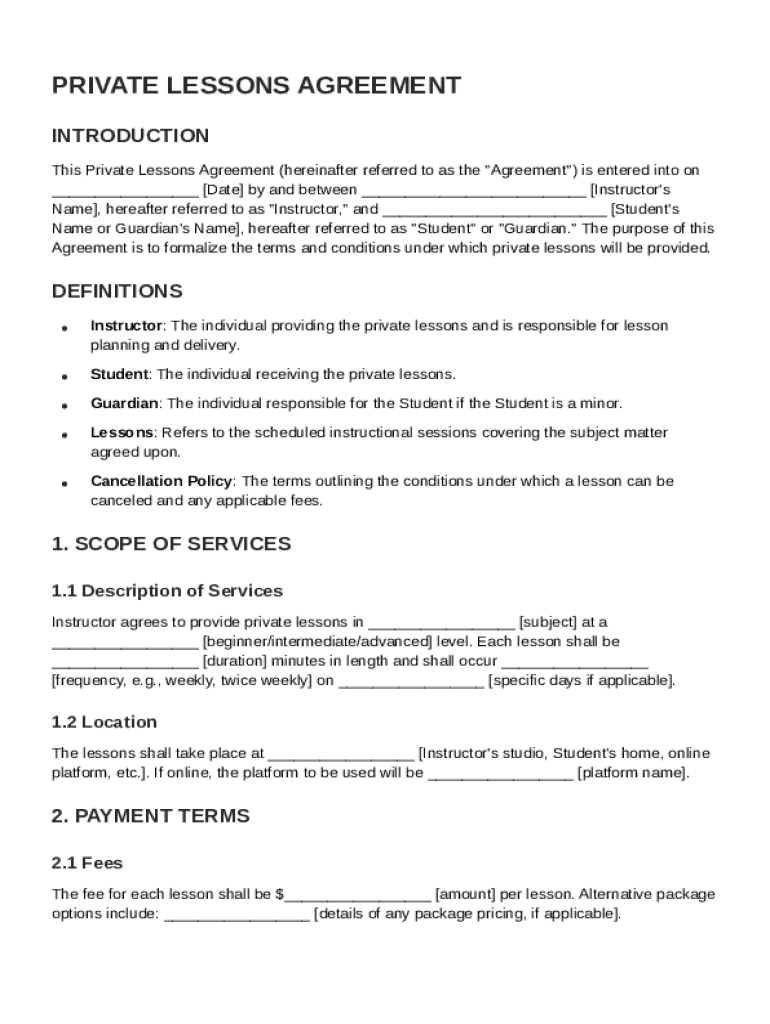







Definition & Meaning
A Private Lessons Contract Template serves as a structured agreement between a lesson provider, typically an instructor or tutor, and a student or their guardian. This legal document formalizes the terms under which private lessons are conducted, ensuring clarity and mutual understanding. The template covers crucial elements like the scope of services, payment arrangements, and schedule, which are pivotal in establishing expectations and responsibilities. For instructors, this document provides a blueprint to delineate their offerings clearly, while students gain insight into what they can reasonably anticipate from the engagement.
Role in Secure Transactions
Establishing a Private Lessons Contract Template aids in the creation of a secure transactional environment for both parties. By outlining specific terms and conditions, the contract mitigates misunderstandings and potential disputes. This template includes clauses on liability waivers, confidentiality agreements, and cancellation policies, offering legal protection and accountability. It is crafted to make sure all involved parties adhere to the project demands and timelines, enhancing trust and professionalism in educational transactions.
Examples and Implications
Consider a scenario where a music instructor offers piano lessons. Using a Private Lessons Contract Template, they can specify lesson durations, frequency, as well as performance expectations. Similarly, a language tutor might use this document to clarify lesson objectives and progress metrics, ensuring the student knows what skills will be prioritized and evaluated. These examples exemplify how the template brings transparency to the learning process, setting a foundation for measurable achievements.
Key Elements of the Private Lessons Contract Template
When creating a Private Lessons Contract, several elements need to be meticulously outlined to develop a comprehensive agreement:
Scope of Services
This section elucidates the specific services provided by the instructor. It covers the type of lessons, skill levels catered to, and any supplementary resources or support available. A detailed description helps in setting clear expectations regarding the educational deliverables.
Payment Terms
Clear delineation of payment structures is vital for financial transparency. This includes tuition rates, due dates, preferred payment methods, and late payment policies. Explicit terms protect both the instructor’s revenue stream and the student’s budget management.
Scheduling and Cancellation Policies
Flexibility and commitment are essential in lesson planning. This area of the contract predicts schedule allowances, required notice periods for cancellations, and any fees related to absences. Clear guidelines facilitate better time management and reduce scheduling conflicts.
Legal and General Provisions
Security-focused clauses, such as liability waivers and confidentiality agreements, ensure legally compliant conduct of lessons. They protect both parties’ rights and confidential information, securing the professional relationship against misuse or unauthorized sharing of sensitive materials.
Steps to Complete the Private Lessons Contract Template
Initial Preparation
- Identify Educational Needs: Determine the subject or skill area, student level, and specific goals of the lessons.
- Define Service Parameters: Establish the content, frequency, and duration of lessons, ensuring they align with students’ requirements.
Drafting the Contract
- Input Essential Details: Use the template to insert the instructor and student’s organizational information, along with a summary of lesson content.
- Outline Financials: Clearly specify payment details, including rate per lesson, due dates, and accepted payment formats.
Finalizing and Executing
- Review Terms with Stakeholders: Discuss terms with students or guardians to confirm mutual understanding.
- Acquire Signatures: Both parties should sign the document, preferably using an electronic signing platform like DocHub for legally binding records.
Important Terms Related to Private Lessons Contract Template
Common Terminologies
- Instructor: The individual providing educational services through lessons.
- Student/Guardian: The recipient of the lessons or their legal representative.
- Clause: A section of the contract dealing with a specific aspect of the service.
- Amendment Procedure: Steps to alter or update the contract terms post-signing.
Legal Vocabulary
- Liability Waiver: A form of protection for the instructor against certain harms.
- Confidentiality Clause: An agreement to keep certain shared information undisclosed.
Administrative Terms
- Cancellation Fees: Charges applicable when a scheduled lesson is canceled without sufficient notice.
- Payment Schedule: Predetermined timing for payments during the contract’s duration.
Legal Use of the Private Lessons Contract Template
Governing Laws
Private Lessons Contracts must adhere to specific legal standards and practices within the United States. While flexibility exists to customize the agreement, it should comply with local and federal regulations concerning educational service contracts.
Enforceability and Compliance
Through clauses like governing law and jurisdiction, the contract specifies under which legal system disputes will be resolved. Ensuring compliance entails incorporating legally necessary components to uphold enforceability in any formal dispute resolution situation.
Amendment and Termination
Both parties may agree on processes within the contract for making amendments, allowing for adjustments as necessary. Termination clauses can also specify conditions under which the contract can be legally ended without either party being liable for breach, ensuring a fair exit strategy is available.
Digital vs. Paper Version
Convenience and Security
Using a digital version of the Private Lessons Contract Template through platforms like DocHub offers convenience through online editing and signing capabilities. Digital copies ensure easy storage, retrieval, and drawing from cloud services, while providing enhanced security with encryption protocols.
Comparison of Formats
- Digital Format: Streamlined for quick edits, e-signatures, and updates. Provides better resource management for environmentally-conscious organizations.
- Paper Format: A tangible option for those preferring visual markup. Requires physical signatures and storage facility.
Examples of Using the Private Lessons Contract Template
Personalized Scenarios
- Academic Tutoring: An academic tutor may provide supplemental instruction in math or science, detailing objectives and outcome expectations within the contract.
- Music Instruction: For a violin teacher, the contract can formalize lesson frequency and recital preparation phases, creating structured progress landmarks.
- Art Lessons: When offering art tutorials, an instructor might use the contract to define project-based fees and material-dependent requirements.
Instructor Insights
Recognizing growth markers, an instructor can adjust lessons based on student progress or change clauses for different art forms or advanced techniques, supported legally by provisions in the contract.
Case Studies in Implementation
Common case studies reflect success in fostering commitment and accountability. Testimonials of improved clarity often highlight avoided misunderstandings or reinforced commitments to educational advancement plans.
Software Compatibility
Integration with DocHub
DocHub seamlessly integrates with digital storage solutions such as Google Drive and OneDrive, enhancing workflow optimization. Compatibility facilitates fluid document management, from drafting through revision and final signing processes.
Other Software Options
- Google Workspace: Facilitates collaboration through file-sharing capabilities, ensuring easy input from alternative parties involved in lesson administration.
- QuickBooks: Useful for managing financial elements of tutoring sessions, leveraging compatibility for invoicing and payment records.
Ultimately, leveraging a digital platform ensures students and instructors benefit from a polished, comprehensive approach to securing educational service agreements, enhancing both efficacy and understanding across all interactions.




