




01. Edit your form online
Type text, add images, blackout confidential details, add comments, highlights and more.

Type text, add images, blackout confidential details, add comments, highlights and more.

Draw your signature, type it, upload its image, or use your mobile device as a signature pad.

Send it via email, link, or fax. You can also download it, export it or print it out.
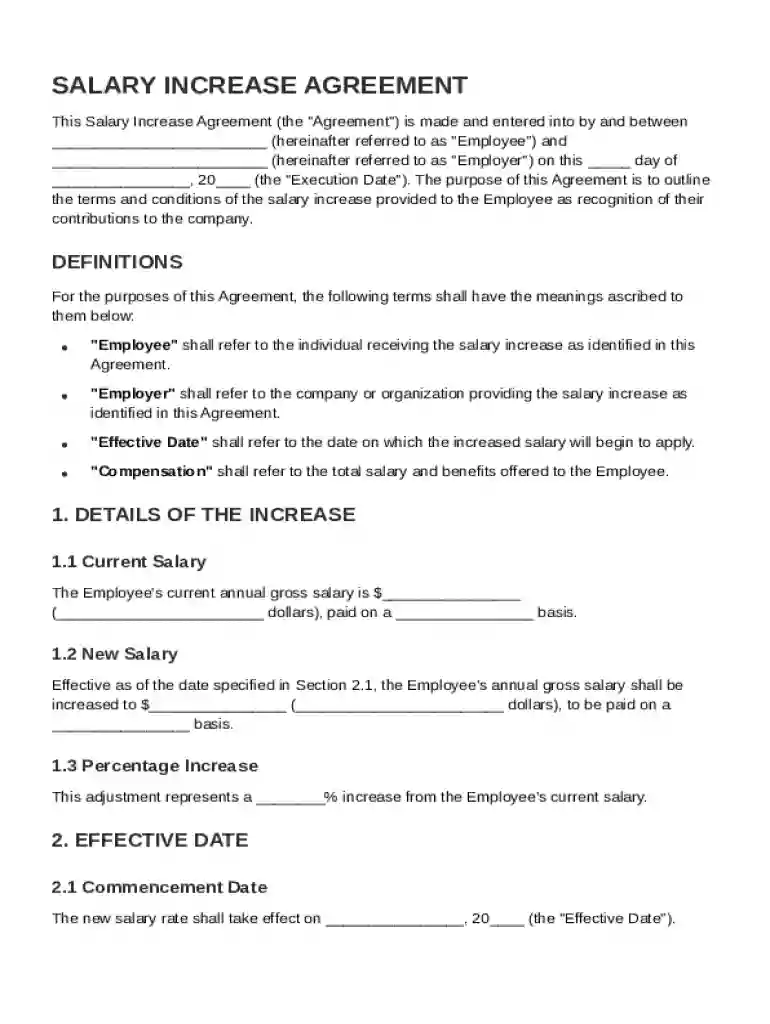
The Salary Increase Agreement Template is a standardized document used by employers to formalize salary adjustments for employees. It outlines the terms under which an employee's compensation is increased, including the current salary, the new salary, and the effective date of the change. The template serves as a formal recognition of the employee's contributions and often includes reasons for the salary increase, such as exceptional performance, completion of a critical project, or changes in market salary benchmarks. Additionally, it reaffirms the employee's role within the organization and maintains confidentiality regarding the agreement terms, ensuring that other employment conditions remain unchanged.
To effectively use the Salary Increase Agreement Template, follow these steps:
This process ensures that both parties have a mutual understanding and formal record of the salary adjustment.
The Salary Increase Agreement Template contains several critical components to ensure clarity and legal compliance:
These elements form the backbone of a well-structured salary increase agreement, ensuring that both parties are aware of their obligations and the specifics of the salary change.
Using the Salary Increase Agreement Template offers several advantages:
Incorporating this template into salary adjustments ensures that the process is smooth, transparent, and legally sound.
The Salary Increase Agreement Template is broadly used across different organizations and industries. Key users include:
By using this template, organizations can standardize their salary increase process, ensuring all such changes are consistent and well-documented.


Completing the Salary Increase Agreement Template involves several key steps:
This step-by-step approach facilitates the efficient completion of the salary increase agreement and minimizes potential errors.
The Salary Increase Agreement Template is a legally recognized document adhering to employment law standards. Key legal aspects include:
Ensuring the template's use aligns with legal standards offers security for both parties and prevents potential disputes.
While the general structure of a Salary Increase Agreement may remain consistent, it's crucial to acknowledge state-specific variations. Factors to consider include:
Understanding these regional differences is essential to ensure compliance and prevent potential legal issues related to employment terms.
At DocHub, your data security is our priority. We follow HIPAA, SOC2, GDPR, and other standards, so you can work on your documents with confidence.
Nov 17, 2016 salary increases and must necessarily be reflected in an increase in the employees regular hourly rate of pay rather than as an offset
The increase is temporary and the employees salary will be returned to the previous rate of pay at the completion of the temporary merit increase period. b.


