
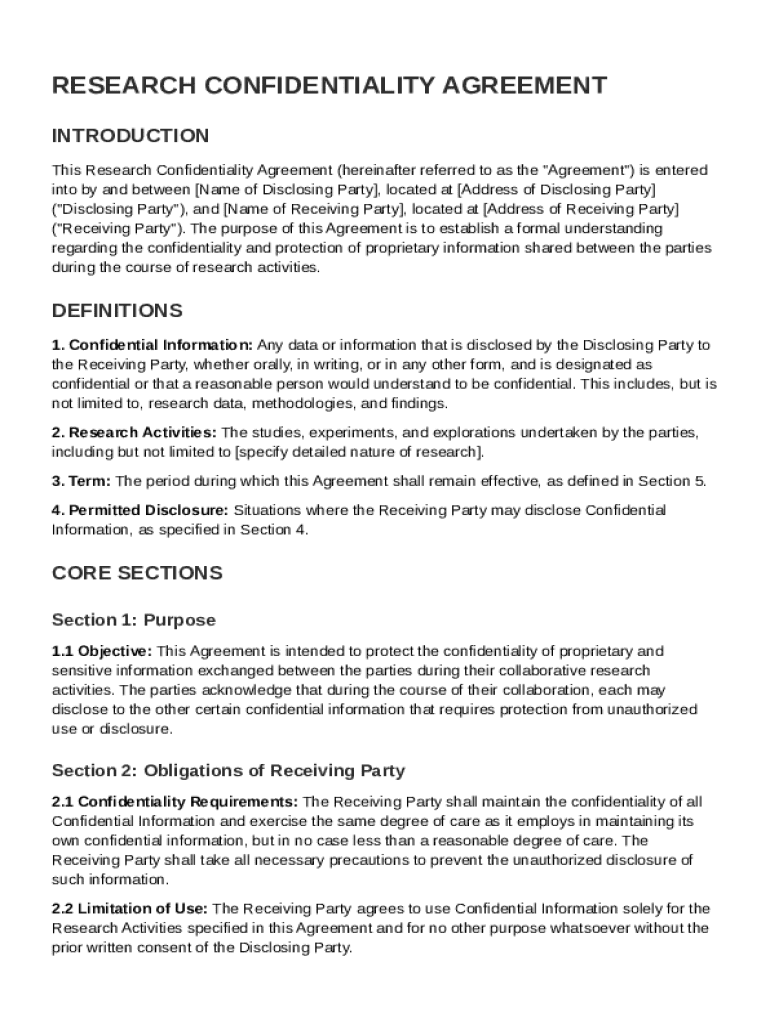







Definition and Meaning of a Research Confidentiality Agreement Template
A Research Confidentiality Agreement (RCA) is a formal document that establishes the terms under which confidential and proprietary information is shared between parties during research collaborations. This template helps protect the interests of both the disclosing and receiving parties by defining what constitutes confidential information, the obligations of each party, and the conditions under which information can be disclosed. This agreement is crucial to safeguarding sensitive data and intellectual property, facilitating trust and transparency in research collaborations.
How to Use the Research Confidentiality Agreement Template
To effectively utilize a Research Confidentiality Agreement Template, follow these steps:
-
Identify the Parties: Clearly outline the details of the disclosing and receiving parties, including names, titles, and contact information.
-
Define Confidential Information: Specify what constitutes confidential information in the context of the research project. This can include unpublished findings, proprietary processes, and personally identifiable information.
-
Outline Obligations: Detail the responsibilities of the receiving party in maintaining the confidentiality of the disclosed information. This typically involves not disclosing, duplicating, or using the information beyond the agreement's scope.
-
Include Exclusions: Identify types of information that may be excluded from confidentiality, such as information that is public knowledge or independently developed by the receiving party.
-
Set Duration: Define the period during which the information must remain confidential, which may extend beyond the termination of the research project.
-
Establish Permitted Disclosures: Specify circumstances under which the receiving party may be allowed to disclose the information with third parties, often requiring prior written consent from the disclosing party.
-
Provide for Return of Materials: Include terms for returning or destroying confidential materials upon termination of the agreement or completion of the research.
Steps to Complete the Research Confidentiality Agreement Template
Completing a Research Confidentiality Agreement Template involves the following steps:
-
Review the Template: Familiarize yourself with the template's structure, ensuring that it aligns with your research objectives and legal requirements.
-
Customize Sections: Modify sections to fit your specific needs, including the identification of parties, definitions, obligations, and exclusions.
-
Consult Legal Experts: Engage legal advisors to ensure the template meets compliance standards and protects your intellectual property rights.
-
Finalize Details: Confirm all details, such as the agreement's duration and permitted disclosures, are accurately reflected and mutually agreed upon.
-
Seek Mutual Agreement: Ensure both parties understand and agree to the terms by discussing potential implications and clarifying any uncertainties.
-
Sign and Execute: Upon final consensus, sign the agreement to make it legally binding. Store a copy for record-keeping and future reference.
Key Elements of the Research Confidentiality Agreement Template
Several key elements are essential to a comprehensive Research Confidentiality Agreement:
-
Parties Involved: Clearly identified disclosing and receiving parties with detailed contact information.
-
Definitions: Precise definitions of what constitutes confidential information.
-
Obligations and Restrictions: Specific duties of the receiving party regarding the use and disclosure of confidential information.
-
Exclusions from Confidentiality: Information that is not subject to confidentiality obligations.
-
Duration and Termination: Time frame during which the agreement is active and conditions under which it can be terminated.
-
Permitted Disclosures: Scenarios in which information can be shared with third parties.
-
Return of Materials: Procedures for the return or destruction of confidential information upon agreement completion or termination.
Legal Use of the Research Confidentiality Agreement Template
Using a Research Confidentiality Agreement Template legally involves ensuring that the agreement adheres to relevant laws and regulations, especially those concerning trade secrets and intellectual property rights. Legal advisors can provide insights into jurisdiction-specific requirements and aid in adapting the agreement to align with state and federal laws applicable to the specific research context.
Examples of Using the Research Confidentiality Agreement Template
Examples highlight the various applications of Research Confidentiality Agreements:
-
Academic Collaborations: Protecting unpublished research data and methodologies between universities and researchers.
-
Corporate Partnerships: Safeguarding proprietary research outcomes and innovations shared between companies engaged in joint ventures.
-
Consulting Arrangements: Securing sensitive information disclosed to consultants during project assessments.
Important Terms Related to Research Confidentiality Agreement
Understanding key terms is vital for effective use of a Research Confidentiality Agreement:
-
Disclosing Party: The entity or individual providing confidential information.
-
Receiving Party: The entity or individual receiving confidential information under specified obligations.
-
Intellectual Property: Creations of the mind, such as inventions and designs, protected by law.
-
Trade Secrets: Practices, designs, formulas, processes, or any information that provides a business competitive edge.
Each term carries significant weight in ensuring both parties' expectations are clearly documented and adhered to.
State-Specific Rules for the Research Confidentiality Agreement Template
Different states may have unique requirements and interpretations of confidentiality agreements. It's crucial to understand:
-
Governing Law: Specify which state's laws will apply to the agreement.
-
Enforcement and Remedies: Variations in how states address breaches, including potential legal remedies and enforcement procedures.
Engaging legal advisors familiar with local jurisdiction can help tailor the template to comply with state-specific rules while meeting the agreement's objectives.




