
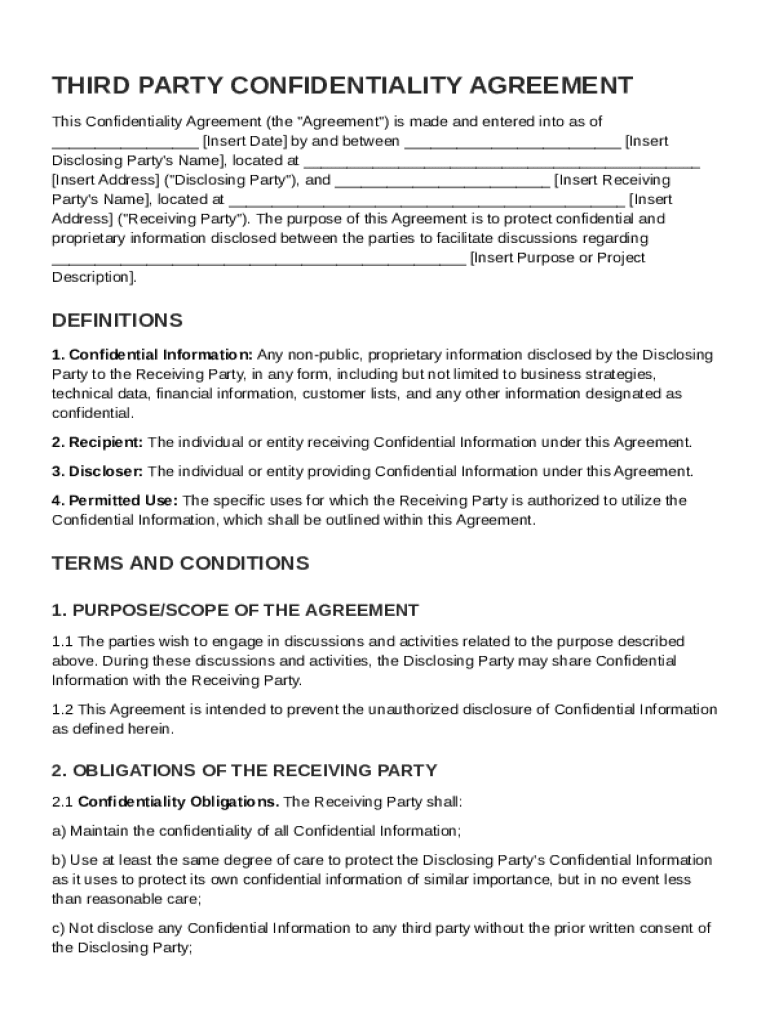







Definition & Meaning
A Third Party Confidentiality Agreement Template is a legal document designed to establish a formal arrangement between a Disclosing Party and a Receiving Party. This agreement outlines the terms that govern the handling of confidential and proprietary information shared during discussions, negotiations, or projects. The primary purpose is to ensure that sensitive information remains protected from unauthorized disclosure, maintaining the privacy and integrity of the parties involved. It is crucial in situations where businesses or individuals are collaborating and sharing information that must not be disclosed to competitors or the public.
Key Elements of the Third Party Confidentiality Agreement Template
The Third Party Confidentiality Agreement Template includes several vital components that provide the framework for effective confidentiality management:
-
Definitions: Establishes precise meanings for key terms such as "Confidential Information," "Disclosing Party," and "Receiving Party," ensuring all parties have a mutual understanding of what constitutes protected content.
-
Obligations of the Receiving Party: Details the responsibilities of the Receiving Party to protect the confidentiality of the information received, including not disclosing it to third parties without consent and only using it for the intended purposes.
-
Exceptions to Confidentiality: Specifies scenarios where confidentiality obligations do not apply, such as information that becomes public through no fault of the receiving party or when required by law.
-
Duration of Obligations: Outlines the time frame for which the confidentiality obligations remain in effect, often extending beyond the term of the agreement until the information is no longer deemed confidential.
-
Ownership of Information: Clarifies that the Disclosing Party retains ownership over their proprietary information, and the agreement does not grant any license or rights to the Receiving Party beyond what is necessary to fulfill its obligations.
-
Indemnification Clauses: Provides provisions where the Receiving Party agrees to indemnify and hold the Disclosing Party harmless in the event of a breach in confidentiality, covering any resulting losses or damages.
How to Use the Third Party Confidentiality Agreement Template
The Third Party Confidentiality Agreement Template can be effectively used through the following steps:
-
Review and Customize: Carefully review the template to ensure that all sections reflect the specific needs of your engagement. Modify any sections that require customization to fit the specific context of the project or partnership.
-
Identify Parties Involved: Clearly define who the Disclosing and Receiving Parties are, including any third parties that may also be bound by the agreement.
-
Detail the Scope of Confidentiality: Specify what information will be regarded as confidential and the purpose for which it is being shared. Establish boundaries for data usage to prevent misuse.
-
Signatures and Authorization: Ensure that all participating entities have authorized representatives sign the agreement to signify their understanding and acceptance of the terms.
-
Distribute Effectively: Circulate copies of the signed agreement to all involved parties and store the document securely for future reference.
Who Typically Uses the Third Party Confidentiality Agreement Template
Third Party Confidentiality Agreement Templates are employed by a variety of entities, including:
-
Businesses: Companies engaged in partnerships, mergers, or joint ventures use this agreement to safeguard trade secrets and strategic plans.
-
Consultants and Contractors: Independent professionals or firms working on projects requiring access to sensitive data often utilize these agreements to protect clients' proprietary information.
-
Research Institutions: Academic or commercial research entities frequently enter into confidentiality agreements when collaborating on innovative projects to safeguard intellectual property.


Importance of the Third Party Confidentiality Agreement Template
This template is essential because it:
-
Protects Sensitive Information: Ensures that proprietary data, business strategies, and confidential conversations are not disclosed to unauthorized individuals or entities.
-
Facilitates Trust: Builds a foundation of trust between parties, encouraging open communication and sharing of valuable insights or innovations without the fear of breach.
-
Prevents Legal Disputes: By setting clear expectations and responsibilities, these agreements can help avoid legal conflicts that arise from unauthorized disclosures or misunderstandings.
Steps to Complete the Third Party Confidentiality Agreement Template
To complete the Third Party Confidentiality Agreement Template, follow these detailed steps:
-
Input Basic Information: Complete the introductory sections with the names and addresses of the Disclosing and Receiving Parties.
-
Include Definitions: Define all key terms to ensure clarity and mutual understanding across parties.
-
Specify Confidential Information: Clearly delimit the scope of what is considered confidential to prevent ambiguity.
-
Outline Obligations and Responsibilities: State the duties of both parties concerning information handling and safeguarding protocols.
-
Detail Exceptions: Provide explicit exceptions to what is covered under the confidentiality clause.
-
Set Confidentiality Duration: Determine the period during which the obligations remain in effect.
-
Authorize and Finalize: Obtain signatures from authorized representatives and ensure all parties have executed the agreement legally.
Legal Use of the Third Party Confidentiality Agreement Template
The legal enforceability of a Third Party Confidentiality Agreement Template hinges on adherence to key legal standards:
-
Clear Terms: All terms must be clearly stated and mutually understandable by all parties involved.
-
Consideration: There should be a legitimate consideration—something of value exchanged between parties—as part of the agreement.
-
Alignment with Law: The agreement must conform to local laws and regulations, including intellectual property and trade secret protection laws.
State-Specific Rules for the Third Party Confidentiality Agreement Template
While the fundamental structure of a Third Party Confidentiality Agreement remains consistent, state-specific rules may apply. Some considerations include:
-
Legal Jurisdiction: Each state may have unique stipulations regarding the enforceability of confidentiality clauses, particularly in terms of restrictive covenants or trade secrets.
-
Duration Limits: Some jurisdictions might impose constraints on the permissible duration of confidentiality obligations.
-
Public Policy Concerns: Specific states may place greater emphasis on ensuring that confidentiality agreements do not unreasonably restrict trade or employment opportunities.




