
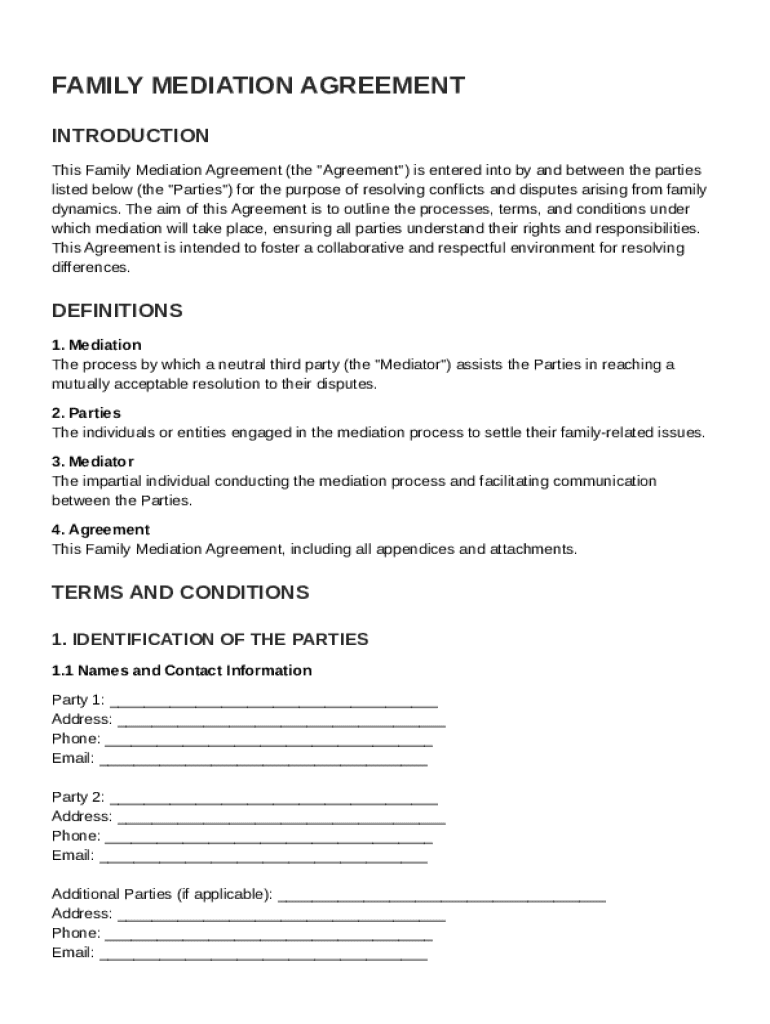







Definition and Purpose of the Family Mediation Agreement Template
The Family Mediation Agreement Template serves as a structured document for resolving family disputes outside of court. This template facilitates a confidential and collaborative process, enabling families to address issues amicably. It outlines the roles of involved parties, including the mediator, who facilitates discussions without providing legal advice. The primary goal is to create a mutually agreed-upon resolution that considers the interests and needs of all parties involved. Mediation is typically less adversarial than court proceedings and empowers families to have control over the outcome. This template is particularly useful for disputes related to custody, property division, and familial responsibilities.
How to Use the Family Mediation Agreement Template
Using the Family Mediation Agreement Template involves several steps to ensure completeness and clarity. First, all parties should carefully read the document to understand the terms. The template typically begins with identifying information, including the names of the parties involved and the mediator. Next, it outlines the dispute's context and goals for mediation. Parties should complete their respective sections, ensuring all details are correct. Any areas requiring mutual decisions must be discussed, and agreements documented clearly within the template. The template may include specific clauses such as confidentiality agreements and fee structures, which require thorough review and consent by all parties. Once completed, each section should be signed by the relevant parties to ensure agreement and binding effect.
Key Sections to Complete
- Parties’ Identification: Include full names and contact details.
- Mediator’s Role: Define responsibilities and limitations.
- Confidentiality Clause: Ensure understanding of privacy obligations.
- Session Details: Outline frequency, location, and expected duration.
- Agreement Summary: Record resolutions reached during mediation.
Steps to Complete the Family Mediation Agreement Template
Completing the Family Mediation Agreement Template involves a step-by-step approach to capture all necessary information. Start by gathering personal details and contact information for all parties, ensuring accuracy. Next, the parties must consent to the appointed mediator's role, acknowledging their impartiality and constraints on legal advice. Agree on and articulate the mediation's objectives, which could include custody arrangements, property distribution, or financial considerations. Review and agree on conditions such as session frequency, venue, and mediation duration. If applicable, append any supplementary agreements or conditions, and finalize the document with signatures from all parties, reaffirming their commitment to abide by the terms set forth.
- Gather personal information.
- Consent to mediator's role.
- Define mediation objectives.
- Agree on session logistics.
- Finalize with signatures.
Legal Use of the Family Mediation Agreement Template
The Family Mediation Agreement Template is legally used to formalize the terms agreed upon during family mediation. This legal document is governed by the laws of the specific jurisdiction where the mediation takes place. By outlining the mediator's role and parties' obligations, the agreement provides a legal framework that encourages voluntary dispute resolution. Importantly, it clarifies that the mediator is not providing legal advice and suggests that parties seek independent legal counsel to ensure their rights are fully protected. In some cases, the family mediation agreement may be submitted to a court to be recognized as a formal court order. It’s essential to ensure the agreement complies with state-specific laws to withstand any legal scrutiny.
Key Elements of the Family Mediation Agreement Template
The template includes crucial components that structure the mediation process effectively. Initially, it defines the roles of the mediator and the participants, ensuring everyone understands their responsibilities. Confidentiality is a core element, ensuring that discussions remain private and encouraging open communication. Fees and payment structures are detailed to prevent misunderstandings. Ground rules are established to maintain decorum during sessions. Additionally, it outlines conditions for terminating mediation if required. Each section works together to create a cohesive document that guides the mediation process and supports conflict resolution.
- Roles and responsibilities
- Confidentiality expectations
- Fee structures
- Mediation ground rules
- Termination conditions
State-Specific Rules for the Family Mediation Agreement Template
The application and specificity of the Family Mediation Agreement Template can vary significantly by state, as jurisdictions impose unique requirements on mediation agreements. For example, some states may mandate specific language concerning child custody arrangements or financial agreements. It’s imperative for involved parties to familiarize themselves with these state-specific legal requirements to ensure the mediation agreement is valid and enforceable. Consulting with an expert or utilizing state resources can provide needed guidance specific to regional legal standards. Engaging with a legal advisor familiar with the jurisdictional laws can help adapt the template accordingly and avoid future legal complications.
Examples of State-specific Considerations
- Child custody requirements
- Property division language
- Specific financial disclosure norms
- Mandatory legal language inclusion
Examples of Using the Family Mediation Agreement Template
The Family Mediation Agreement Template is versatile and can be applied across various scenarios. One common usage is during divorce proceedings, where it can help in negotiating child custody and financial settlement terms without litigation. In blended families, it might be used to navigate stepparent roles and responsibilities. Another example includes addressing senior care arrangements or the distribution of a family estate, where differing opinions can lead to family strife. Each of these circumstances benefits from the structured and non-confrontational approach that the mediation agreement offers, reducing stress and fostering cooperation and mutual satisfaction.
Real-World Applications
- Divorce settlements (custody, alimony)
- Blended family dynamics
- Senior care planning
- Estate dispute resolution
Important Terms Related to the Family Mediation Agreement Template
Understanding specific terms in the Family Mediation Agreement Template is crucial for clarity and effective communication. Terms such as "mediator," "confidentiality," and "consent to terms" are fundamental. The "mediator" facilitates dialogue without influencing decisions, whereas "confidentiality" ensures discussions remain private and not used outside of mediation. "Consent to terms" implies all parties accept and agree to uphold the conditions outlined. Familiarity with these terms is essential, as it strengthens the parties’ ability to engage constructively and with full awareness of their rights and obligations. Other important terms may include "jurisdiction," "settlement," and "waiver of rights," which hold specific meanings affecting the agreement's legal standing and application.
Glossary of Critical Terms
- Mediator: An impartial facilitator of communication.
- Confidentiality: Privacy of mediation discussions.
- Consent to Terms: Agreement by parties to outlined conditions.
- Jurisdiction: Legal authority governing the agreement.
- Settlement: Concluded agreement through mediation.
- Waiver of Rights: Voluntary relinquishment of specific legal claims.




