




01. Edit your form online
Type text, add images, blackout confidential details, add comments, highlights and more.

Type text, add images, blackout confidential details, add comments, highlights and more.

Draw your signature, type it, upload its image, or use your mobile device as a signature pad.

Send it via email, link, or fax. You can also download it, export it or print it out.
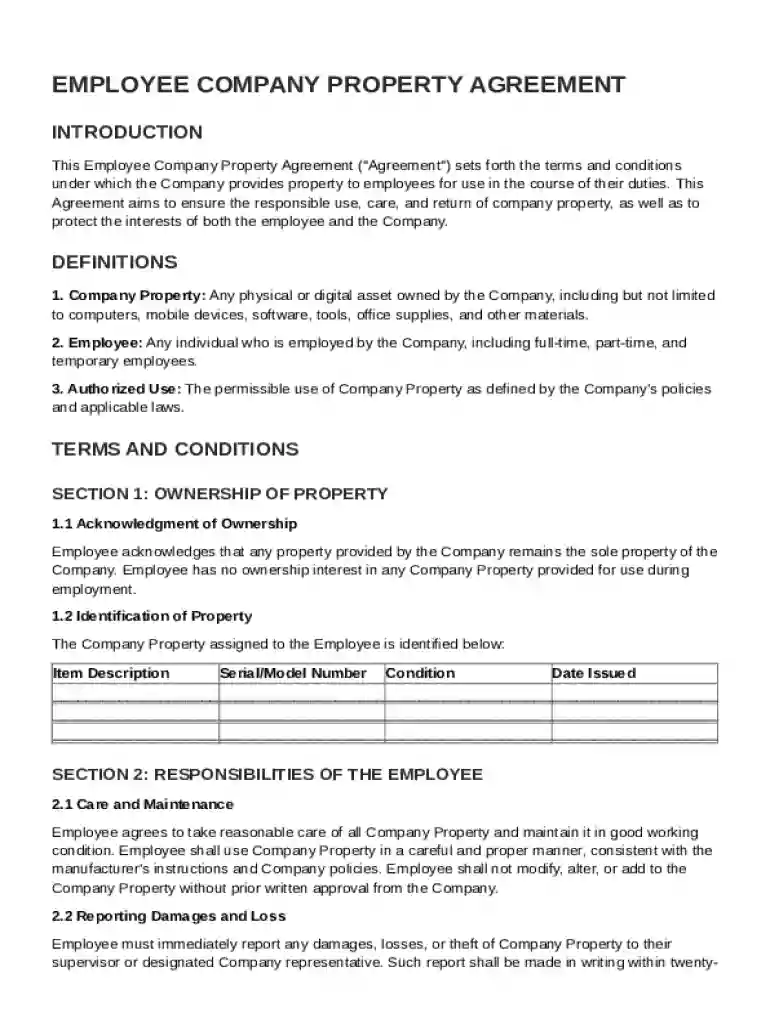
The Employee Company Property Agreement Template is a legal document that outlines the terms and conditions regarding the use of company property by employees. This agreement provides a framework to define what constitutes company property, establish the responsibilities of the employee in caring for and maintaining the property, and stipulate the authorized uses of such property. It also addresses the responsibilities involved in returning the property upon termination of employment. At its core, the agreement serves to protect the company's assets by making it clear that all company property remains under the company's ownership. Additionally, it outlines potential penalties and disciplinary actions for non-compliance, such as legal repercussions or employment-related sanctions.
To effectively draft an Employee Company Property Agreement, several key components must be included to ensure thorough coverage of all pertinent areas:
Identification of Company Property: Clearly list and define all items that are considered company property. This may include physical assets like computers, office supplies, vehicles, or intellectual property such as software and proprietary information.
Employee Responsibilities: Employees must understand their responsibilities in terms of caring for, maintaining, and utilizing the provided company property. This section should specify standards for use and any maintenance protocols.
Authorized Use: Define the acceptable and intended uses of the company property. Specify any restrictions, such as personal use, that may apply to ensure the property's use aligns with business goals.
Return of Property: Detail the process for returning property upon termination or resignation, including timelines and the condition in which the property should be returned.
Consequences for Theft or Damage: Outline actions that will be taken in cases where property is damaged, lost, or stolen due to neglect or misuse. This can include monetary compensation, disciplinary measures, or legal proceedings.
The process of utilizing the Employee Company Property Agreement Template involves several key steps:
Customization: Begin by customizing the template to reflect the specific needs and policies of your organization. Adjust language and terms to be consistent with your company's operational and legal standards.
Legal Review: Have the agreement reviewed by legal experts to ensure it complies with applicable regulations and thoroughly protects the company's interests.
Communication: Clearly communicate the terms of the agreement to employees, ensuring they understand their responsibilities and the importance of compliance.
Signatures: Obtain signed agreements from each employee. This should be a part of the onboarding process for new hires or completed during policy updates for existing employees.
Documentation: Keep signed agreements securely stored within employee records for reference in the event of disputes or compliance checks.
The legal foundation of the Employee Company Property Agreement is essential for its enforceability and to protect the company's interests:
Compliance with Local Laws: Ensure the agreement aligns with state and federal laws governing employment and property rights. This includes any laws specific to specific industries or roles.
Legally Binding Nature: A properly executed agreement is legally binding, and it signifies the employee's acceptance of the terms as a condition of their employment.
Dispute Resolution: Include clauses for dispute resolution to manage conflicts arising from the misuse or misunderstanding of the agreement's terms. This may involve mediation or arbitration before pursuing litigation.
To efficiently complete the Employee Company Property Agreement Template, follow this sequence:
Title and Company Information: Clearly indicate the title of the agreement and include the company's name and contact information.
Listing Company Property: Detail each item of property covered by the agreement, providing unique identifiers such as serial numbers where applicable.
Employee Duties: Outline the responsibilities of the employee, ensuring that expectations are clear regarding property maintenance, use, and return.
Authorization Section: Specify the conditions under which the property may be used, including scenarios that require prior authorization or supervision.
Consequences for Breach: Detail any disciplinary actions or legal steps that will be taken in the event of non-compliance with the agreement.
Signature Blocks: Provide spaces for both the employee and an authorized company representative to sign and date the document.
Understanding the terminology within the Employee Company Property Agreement is crucial for clarity and legal comprehension:
Proprietary Information: Refers to confidential information owned by the company that is not to be disclosed or used outside the scope of the agreement.
Custodian: The individual responsible for the care and return of the company property, typically the employee using it.
Asset: Any resource, tangible or intangible, that holds value to the company and is covered under the agreement.
Non-compliance: Failure to adhere to the terms outlined in the agreement, which can result in disciplinary actions.
Various real-world scenarios highlight the application of the Employee Company Property Agreement:
Office Equipment Management: In technology firms, agreements can regulate employee use of laptops, ensuring devices are maintained and returned when an employee departs.
Vehicle Use in Delivery Companies: Delivery drivers might be required to sign agreements detailing the use of company-owned vehicles, contributing to the control of voluntary liability during accidents.
Remote Work Technology: For remote workers, agreements cover the use of company-owned tech, focusing on cybersecurity and proper maintenance practices.
Each example emphasizes the need to tailor the agreement to specific industries and usage scenarios, ensuring maximum clarity and compliance.
At DocHub, your data security is our priority. We follow HIPAA, SOC2, GDPR, and other standards, so you can work on your documents with confidence.
IMPORTANT-READ CAREFULLY: This Limited License Agreement (LLA) is made between you (either an individual person or a single.
This includes automobile, truck, and other travel expenses; vehicle maintenance and repair costs; vehicle and other license fees and permits; insurance premiums


