
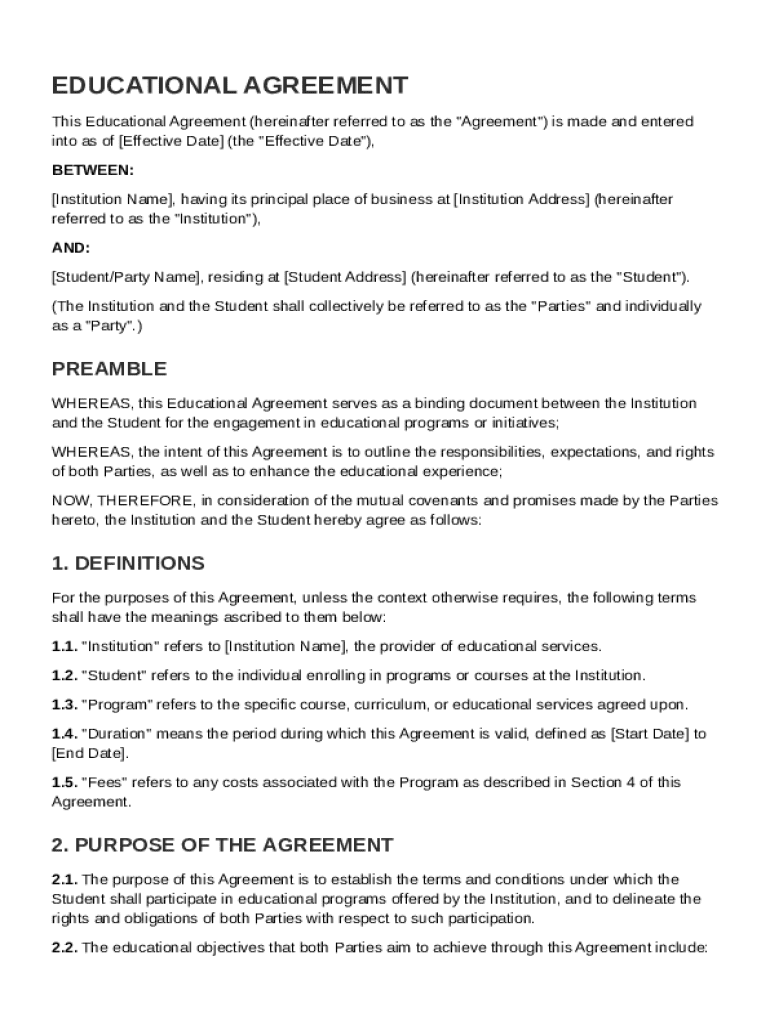







Definition and Meaning of the Educational Agreement Template
The Educational Agreement Template is a formal document that establishes the terms and conditions between an educational institution and a student. It is designed to outline the roles, responsibilities, and expectations of both parties clearly. Typically, it includes the academic objectives the student is expected to achieve, the fee structures associated with their program, and any associated payment terms. This document serves as a blueprint for the educational relationship and helps to ensure compliance with institutional policies and regulations. By formalizing these elements, the agreement provides a strong foundation for an effective educational experience and helps to prevent disputes.
How to Use the Educational Agreement Template
Using the Educational Agreement Template involves several key steps to ensure all necessary information is accurately captured, reflecting the specific circumstances of the educational arrangement.
-
Review the Template: Start by carefully reading through the entire template. Note sections that require specific information or customization to fit the unique context of the educational program.
-
Customizing Sections: Tailor the template to include the specific details of the educational arrangement, such as course titles, fee structures, and academic expectations.
-
Inserting Additional Clauses: You may need to insert additional clauses relevant to the particular program or student, such as provisions around internship requirements or performance expectations.
-
Consultation: Consider consulting with a legal professional or educational advisor to ensure the agreement complies with applicable laws and institutional policies.
-
Review and Sign: Once all the required information is included, review the document for accuracy. Both parties — typically the institution and the student — should sign the agreement to formalize the relationship.
Key Elements of the Educational Agreement Template
The Educational Agreement Template includes several critical components that are essential to defining the terms of the educational partnership.
-
Parties Involved: Clearly identify the educational institution and the student involved in the agreement.
-
Program Details: Specify the details of the educational program, including the curriculum, duration, and any certification or degree offered upon completion.
-
Financial Obligations: Outline the fee structures, payment schedules, and any financial aid or scholarship information.
-
Responsibilities and Expectations: Articulate the academic and conduct expectations for the student, along with the institution's obligations, such as providing adequate resources and support.
-
Dispute Resolution: Include procedures for resolving any disputes that may arise, such as mediation or arbitration processes.
Legal Use of the Educational Agreement Template
The Educational Agreement Template holds legal significance as it formalizes the understanding between the educational institution and the student. It must adhere to relevant state and federal laws governing educational contracts and protect the rights of both parties.
-
Compliance with Laws: Ensure the agreement complies with the Family Educational Rights and Privacy Act (FERPA) and other relevant educational laws.
-
Binding Nature: Understand that once signed, the agreement is a binding contract and any breaches could lead to legal action.
-
Privacy Considerations: Include clauses that protect the confidentiality of student records and any proprietary information of the institution.
Steps to Complete the Educational Agreement Template
Completing the Educational Agreement Template requires a methodical approach to ensure all details are correct and thorough.
-
Gather Information: Collect necessary information about the student, program, and institution to complete the template accurately.
-
Fill Out Sections: Fill in each section of the template with the relevant data, ensuring clarity and precision.
-
Review for Accuracy: Go through the completed template to check for errors or omissions that could affect the agreement's validity.
-
Final Approval: Both the institution’s legal office and the student should review the document for final approval.
-
Execute the Agreement: Facilitate the signing process to execute the agreement officially, ensuring copies are retained by both parties.
Who Typically Uses the Educational Agreement Template
The Educational Agreement Template is typically utilized by a variety of stakeholders within the educational sector, including:
-
Educational Institutions: Universities, colleges, and other academic bodies use it to formalize agreements with students.
-
Students: Individuals enrolling in academic programs use it to understand their roles and responsibilities.
-
Legal Professionals: Lawyers specializing in educational law might use this template to draft contracts for clients.
-
Educational Administrators: School administrators use it for compliance with institutional policies and to streamline operational processes.


Digital vs. Paper Versions of the Educational Agreement Template
In today’s digital age, the Educational Agreement Template can be utilized in both digital and paper formats, each having distinct advantages.
-
Digital Version: Offers convenience and efficiency, allowing for easy editing, sharing, and storage. It enables electronic signatures to streamline the signing process.
-
Paper Version: Some may prefer a physical copy for its tangibility and traditional nature, which can be filed and referenced manually.
The choice between digital and paper versions often depends on the institution's resources, technological capabilities, and preference for digital document management systems.
State-Specific Rules for the Educational Agreement Template
Different U.S. states may have varying regulations and requirements that could affect the use of the Educational Agreement Template.
-
State Regulations: Certain states may have specific educational laws and standards that need to be incorporated into the agreement, including minimum credit completion, tuition caps, and refund policies.
-
Regional Accreditation: Consider how regional accreditation requirements might impact the agreement's terms.
-
Local Language Requirements: Some states might require sections of the agreement to be in languages other than English to accommodate non-English speaking populations.
Institutions must tailor the template to meet state-specific legal requirements to ensure it is enforceable in the relevant jurisdiction.




