




01. Edit your form online
Type text, add images, blackout confidential details, add comments, highlights and more.

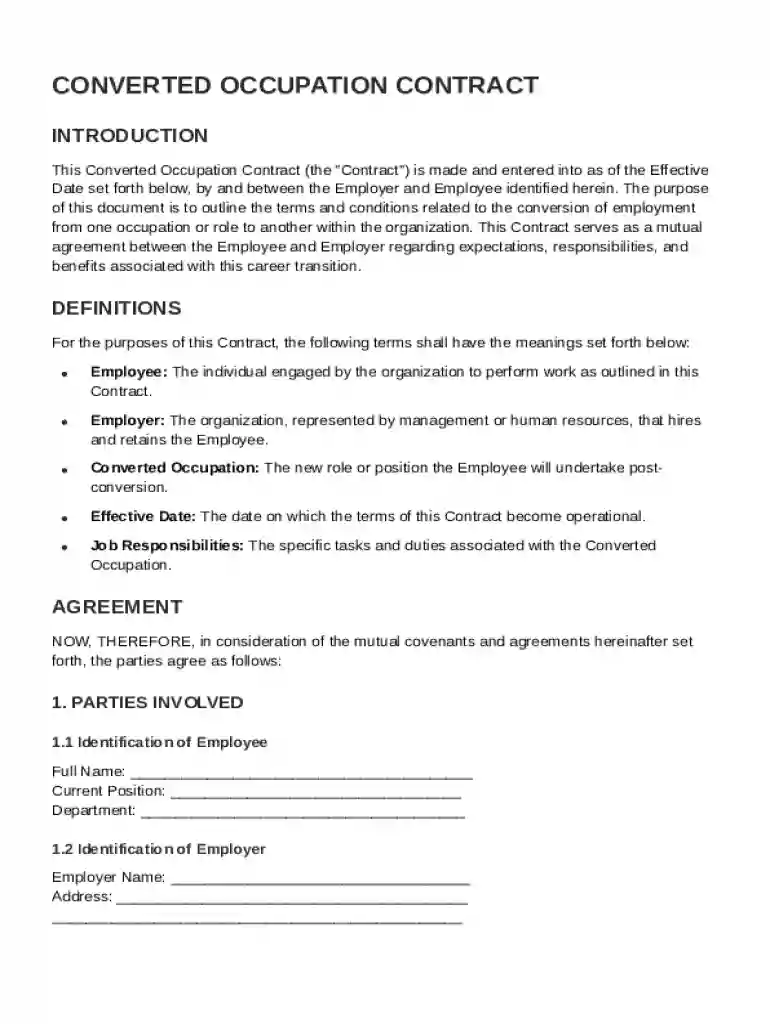
Type text, add images, blackout confidential details, add comments, highlights and more.

Draw your signature, type it, upload its image, or use your mobile device as a signature pad.

Send it via email, link, or fax. You can also download it, export it or print it out.
The Converted Occupation Contract Template is a formal document used to outline the process through which an Employee transitions to a new position within the same organization. It specifies the terms and conditions agreed upon by both the Employer and Employee during this career change. Key components include job responsibilities of the new role, compensation alterations, and confidentiality agreements. This contract serves as a mutual assurance of rights and obligations, facilitating a smooth and legally compliant occupation conversion.
Utilizing the Converted Occupation Contract Template involves several key steps to ensure all relevant information is accurately captured and agreed upon by both parties.
Initial Review: Begin by examining the template to understand each section's purpose and what information needs to be provided.
Fill Out Employee Details: Include both current and new job titles, departments, and effective transition date.
Review Job Responsibilities: Carefully detail the roles and obligations associated with the new position, confirming understanding and agreement from the Employee.
Discuss Compensation Adjustments: Document any changes in salary, benefits, or bonuses that accompany the new role.
Training Requirements: Note any training programs the Employee must complete before fully assuming their new responsibilities.
Signatures: Finalize by acquiring signatures from both Employer and Employee, affirming their understanding and acceptance of the contract terms.
Familiarity with terms relevant to the Converted Occupation Contract Template is crucial for proper understanding and application.
Several critical components form the foundation of the Converted Occupation Contract Template:
The document ensures both parties' rights and responsibilities are legally binding and recognized under applicable laws. It protects both Employer and Employee by:
The primary users of the Converted Occupation Contract Template are employers and human resources professionals within organizations experiencing internal positional shifts. Typically, these include:


Completing the template is a structured process that involves carefully following each step to ensure accuracy:
Gather Employee Information: Collect all necessary data about the Employee and their current role.
Complete Role Details Section: Define the new position's title, responsibilities, and expected start date.
Discuss and Document Compensation: Negotiate and confirm any salary adjustments with the Employee.
Outline Training and Performance Expectations: List any required trainings and set clear performance metrics.
Incorporate Legal Clauses: Add jurisdiction-specific legal terms and conditions.
Review and Sign: Ensure both parties review the contract for accuracy and sign to indicate agreement.
Certain business entities particularly benefit from using a Converted Occupation Contract Template, often those experiencing regular employee transitions, such as:
At DocHub, your data security is our priority. We follow HIPAA, SOC2, GDPR, and other standards, so you can work on your documents with confidence.



The amendments to the JCT Standard Building Contract. (without Quantities) 2016, set out in the Schedule of. Amendments attached to this Contract are hereby
Jan 7, 2010 The Design Builder is under contract to supply both design services and construction services for the completion of the project and place
Aug 3, 2022 PARTS OF CONTRACT. The Location Map; Notice to Contractors; Bid Instructions;. Documents to be Submitted with Bid; Contract Documents; Documents


