
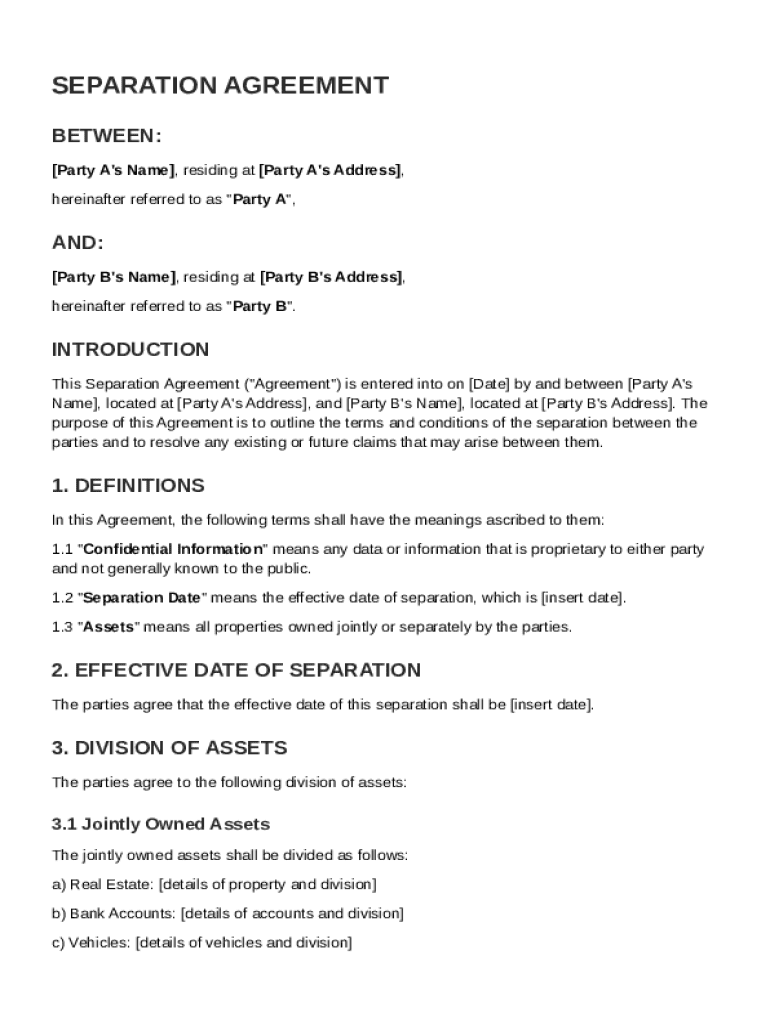







Key Elements of the Separation Agreement Template
The Separation Agreement Template is a comprehensive document that delineates the terms and conditions regarding the separation between two parties. This template typically includes several critical components that ensure clarity and legal standing. Here are the key elements often found in such an agreement:
-
Definitions and Parties Involved: Clearly defines the individuals or entities involved, referred to as Party A and Party B, as well as any relevant terminology used throughout the agreement.
-
Effective Date: Specifies the date on which the terms of the separation become legally effective.
-
Division of Assets: Details how shared assets and properties will be divided between the parties, ensuring fairness and clarity.
-
Financial Obligations: Outlines responsibilities concerning spousal support and the division of debts and liabilities.
-
Confidentiality Clauses: Includes terms that ensure either or both parties keep specific information private and confidential.
-
Release of Claims: A provision where parties release one another from potential claims related to the separation.
-
Governing Law: Establishes which state’s laws will govern the agreement.
-
Amendments and Severability: Provides instructions on how modifications to the agreement can be made, and ensures that if parts of the agreement are invalid, other sections remain in effect.
-
Binding Effect: A clause verifying that the agreement binds the parties and their successors.
These elements collectively provide a structured approach to manage a separation while preventing future disputes.
Legal Use of the Separation Agreement Template
Using a Separation Agreement Template legally requires adherence to certain guidelines and standards to ensure that its terms are enforceable. Here’s how:
-
Customization for Specifics: The template must be tailored to suit the unique circumstances of the parties involved. This includes inserting specific details about assets, debts, and obligations.
-
Compliance with State Laws: The agreement should comply with state-specific requirements to maintain its validity and enforceability. Each state has its own set of rules that may affect the agreement's terms.
-
Mutual Consent: Both parties must agree to the terms without coercion. It is vital for legitimacy that both parties have voluntarily consented to the agreement.
-
Legal Review: Both parties are encouraged to have separate legal counsel review the agreement to ensure that it meets all legal standards and that their rights are protected.
-
Signatures and Notarization: For the agreement to be legally binding, both parties should sign it, and in some jurisdictions, notarization may add an extra layer of validity.
-
Document Retention: Parties should keep copies of the signed agreement in a secure location for future reference.
These measures guarantee that the separation agreement serves its purpose effectively in resolving potential disputes.
Steps to Complete the Separation Agreement Template
Completing a Separation Agreement Template involves several sequential steps to ensure it meets the legal and personal needs of the involved parties. Here’s a detailed guide:
-
Identify the Parties: Begin by detailing the names and contact information of the parties involved, ensuring complete accuracy.
-
Detail Assets & Liabilities: List all shared assets and debts, assigning ownership or responsibility for each to either Party A or Party B.
-
Define Terms and Conditions: Include detailed terms for spousal support, child custody if applicable, and other relevant conditions.
-
Specify Governing Law: Indicate which state’s laws will govern the agreement, considering both parties’ residence.
-
Draft Clauses for Confidentiality & Release: Outline confidentiality terms and any release of claims to protect both parties’ interests.
-
Review and Modify: Have both parties review the draft. It may require multiple reviews and edits until both parties agree.
-
Legal Consultation: Each party should seek advice from independent legal counsel to review the drafted agreement.
-
Finalize and Sign: Once both parties are satisfied, they should sign the document in the presence of a notary public if necessary.
-
Copy Distribution: Both parties should receive a fully executed copy of the agreement for their records.
Each step ensures that the agreement is thorough and reflects the decisions and consent of both parties accurately.
How to Use the Separation Agreement Template
The efficient use of a Separation Agreement Template requires understanding its structure and customizing it as needed. Here’s the approach:
-
Start with a Template: Obtain a standard template, verified for compliance with legal norms.
-
Customize the Content: Modify sections to reflect personal details, asset divisions, and specific terms agreed upon by both parties.
-
Consult Legal Experts: Legal counsel should review modifications to meet state-specific legal requirements and personal needs.
-
Utilize Digital Platforms: Platforms like DocHub can simplify the editing, signing, and sharing processes, reducing the need for physical meetings and enhancing collaboration.
-
Regular Updates: If circumstances change, the agreement should be revisited and updated accordingly, following the agreed procedure for amendments.
Using the template efficiently ensures it serves its intended purpose of facilitating a smooth and dispute-free separation.
Important Terms Related to Separation Agreement Template
Understanding specific legal terms associated with a Separation Agreement Template provides clarity and guidance. Here are some terms that often appear:
-
Severability: This ensures that if a part of the agreement is invalid or unenforceable, the rest remains effective.
-
Counterpart Execution: Allows the agreement to be signed in parts, which together make up a complete document.
-
Spousal Support: Also known as alimony, this refers to financial support paid by one party to another post-separation.
-
Binding Effect: Confirms that the agreement is binding on the parties and their heirs or successors.
-
Fiduciary Duties: Obligations of good faith and fair dealing that one party owes to another, which can continue or change post-separation.
Familiarity with these terms aids in better comprehension and use of the agreement.
State-Specific Rules for the Separation Agreement Template
The validity of a Separation Agreement often depends on adherence to state-specific regulations. Some variations include:
-
Community Property States: In states like California, community property laws dictate an equal division of marital property, affecting separation terms.
-
Equitable Distribution States: Most states distribute assets fairly but not necessarily equally, based on factors like each party's contribution and needs.
-
Child Custody and Support: States have differing guidelines for child custody arrangements, impacting agreements involving children.
-
Required Disclosures: Some states may have specific disclosure requirements concerning financial statements and income.
-
Signing and Notarization Rules: Variations exist on whether notarization is compulsory, influencing the execution process.
Understanding these specific rules ensures compliance and legal enforceability of the agreement within the relevant jurisdiction.
Examples of Using the Separation Agreement Template
Real-world scenarios help elucidate the practical application of a Separation Agreement Template:
-
Asset Division Disputes: An agreement resolves potential disputes by clearly delineating asset ownership post-separation.
-
Complex Financial Portfolios: Couples with extensive investments benefit by outlining the division method for stocks, bonds, and other securities.
-
Child Custody Arrangements: Tailors parenting schedules and custody arrangements, minimizing conflicts in co-parenting scenarios.
-
Protection of Business Interests: When one party owns a business, the agreement can specify terms to protect its ongoing operation separate from personal disputes.
These examples illustrate the versatility of the template, ensuring individualized solutions to separation challenges.
Software Compatibility with Separation Agreement Templates
Ensuring compatibility with document management software enhances the usability of Separation Agreement Templates:
-
DocHub: Edit, annotate, and manage separation agreements in real-time, facilitating seamless collaboration and distribution.
-
Google Drive Integration: Directly import and export agreements, ensuring easy access and safe storage within the Google ecosystem.
-
Cross-Platform Functionality: Utilize the template on both desktops and mobile devices, ensuring accessibility across various devices.
-
Version Control and Tracking: Platforms can provide audit trails and version histories, vital for tracking changes and maintaining a secure record.
Compatibility with advanced features ensures the template remains a practical solution for document management tasks.




