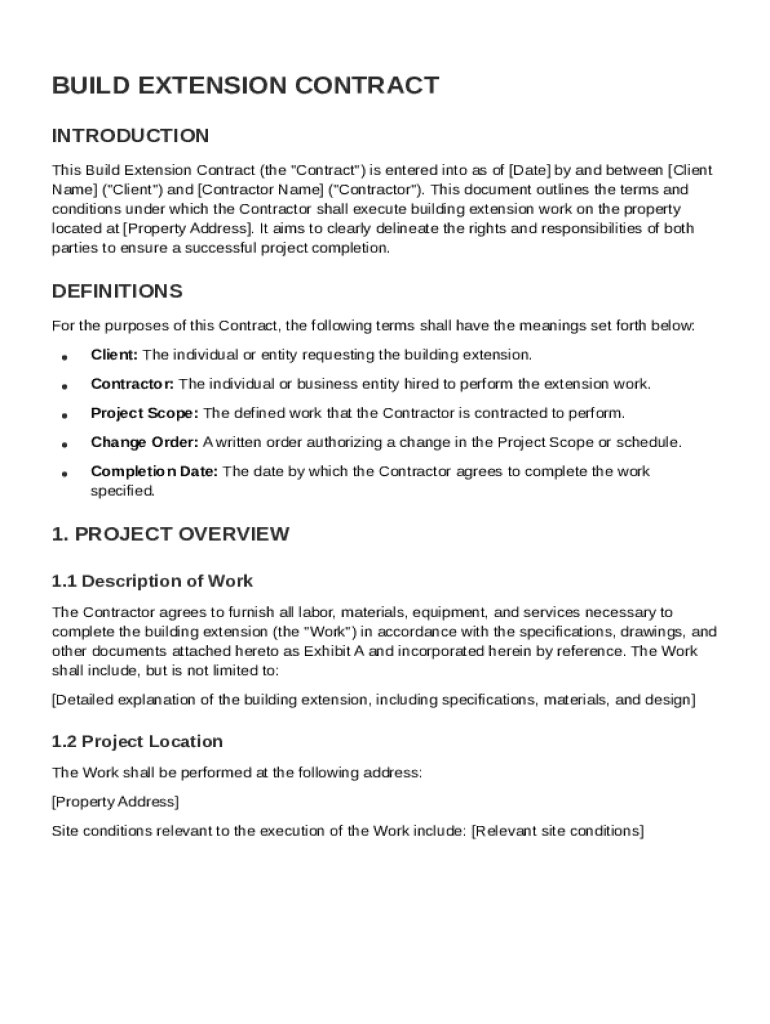







Definition & Meaning
The Build Extension Contract Template is a formal agreement used between a client and a contractor to delineate the details of a property extension project. This document serves as an official record specifying the scope of work, payment terms, project timeline, and responsibilities of both parties involved. By documenting these elements, the contract aims to clarify expectations and pave the way for a smooth project execution. The contract also helps protect both client and contractor interests by establishing a legal framework for handling changes, disputes, and termination processes.
How to Use the Build Extension Contract Template
Using the Build Extension Contract Template involves several essential steps to ensure full utilization and legal compliance. Initially, both parties need to review the document thoroughly to customize it according to the specific project. Information such as project location, duration, payment schedule, and work responsibilities should be filled in accurately. After completing the customization, it is crucial to have both parties sign the document, creating an official binding agreement. Finally, store the completed contract securely, ensuring all parties involved have access to signed copies for future reference.
Steps for Customizing
- Fill in specific project details such as location and extension size.
- Specify the payment terms, including advance payments, milestones, and final settlement.
- Detail the expected start and completion dates along with any key deadlines.
- Outline the responsibilities and deliverables for both the client and the contractor.
Key Elements of the Build Extension Contract Template
The Build Extension Contract Template comprises several fundamental components that must be accurately detailed to ensure clarity and effectiveness. These elements include:
- Project Scope: Detailed description of the work to be done, including plans and specifications.
- Payment Terms: Explanation of total cost, deposit requirements, and payment schedule.
- Timeline: Proposed start date, estimated completion date, and interim deadlines.
- Responsibilities: Duties and obligations of both client and contractor.
- Change Orders: Process for managing alterations to the project scope or timeline.
- Permitting Requirements: Necessary approvals and permits from local authorities.
- Warranties: Assurance regarding the workmanship quality and materials used.
Legal Use of the Build Extension Contract Template
Legally, the Build Extension Contract Template serves as a binding agreement that obligates both parties to comply with the detailed terms. Adherence to this contract can prevent potential disputes and facilitate legal recourse if either party defaults. It defines the liabilities and indemnifications under various circumstances, documenting the agreed-upon measures for dispute resolution and the jurisdiction's governing law. For legality, both parties’ signatures are paramount, and seeking legal counsel to review the contract is advisable for amendments or additional clauses.
Dispute Resolution Methods
- Mediation: Involves an impartial third party to resolve disputes amicably.
- Arbitration: Engaging an independent arbitrator to make a binding decision.
- Litigation: Legal proceedings in court for unresolved disputes.
State-Specific Rules for the Build Extension Contract Template
Contractual agreements, including Build Extension Contracts, are subject to state-specific rules and regulations that vary across the United States. Different states have distinct requirements regarding construction timelines, permits, liens, contractor licensing, and consumer protections. It is essential to adapt the Build Extension Contract Template to comply with these regional laws, ensuring full legal adherence. Consulting legal experts familiar with these variations can prevent potential legal conflicts and aid in tailoring the template accordingly.
Examples of Using the Build Extension Contract Template
Real-world scenarios can illustrate the practicality of this contract template. For instance, a homeowner in New York engages a contractor for an extension to add a guest room. The contract outlines a specific start and completion date with phased payments linked to project milestones, ensuring both parties hold up their end of the agreement. In another case, a company expanding its office space uses the template to specify the quality and type of materials used, minimizing disputes over project deliverables.
Steps to Complete the Build Extension Contract Template
Completing the Build Extension Contract Template entails a step-by-step approach focused on accuracy and detail. Here is a recommended sequence:
- Gather all necessary information related to the project, including plans and estimates.
- Insert this information into the template, following the sequence of sections.
- Review the filled-out details with all involved parties to confirm accuracy.
- Make necessary adjustments based on collective feedback and legal advice.
- Obtain signatures from both parties to finalize and validate the contract.
- Distribute signed copies to all stakeholders and retain one for official records.
Versions or Alternatives to the Build Extension Contract Template
Beyond the standard Build Extension Contract Template, different variants or related forms might be applicable based on project size or type. For smaller home enhancements, a simplified version focusing on fewer legal stipulations may suffice. Conversely, larger commercial projects might require more comprehensive documents incorporating additional clauses related to workplace safety, environmental compliance, or subcontracting. Alternatives might also include electronic contract platforms offering templates specific to particular industries or jurisdictions.