






Definition and Meaning
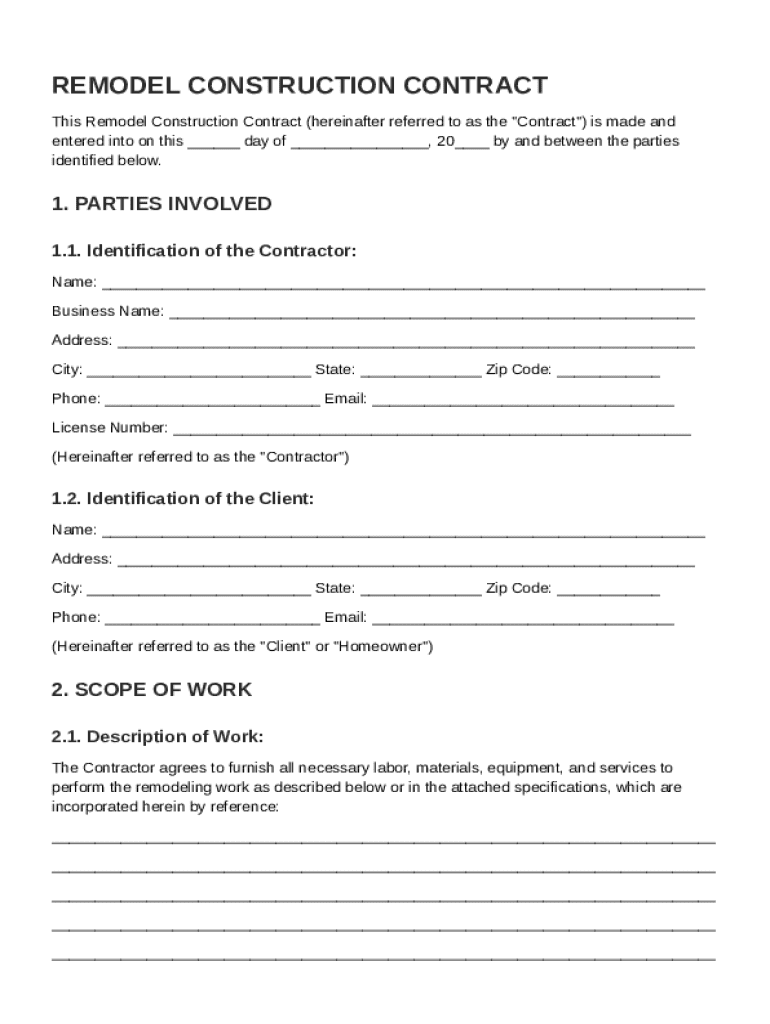
A remodel construction contract template is a standardized document used by contractors and clients to outline the terms and conditions of a remodeling project. This template serves as a formal agreement that covers various aspects, such as the scope of work, payment schedules, timelines, and responsibilities. By using this template, both parties can ensure clarity and mutual understanding, reducing the chances of disputes and ensuring that the project proceeds as planned. Typically, the document is detailed and includes sections that highlight important clauses related to legal and practical elements of the remodeling process.
Key Elements of the Remodel Construction Contract Template
The remodel construction contract template is composed of several critical sections designed to cover all facets of a remodeling agreement. Among these, the scope of work is paramount, detailing the specific tasks and deliverables expected during the project. Payment terms are also a central feature, outlining when and how payments will be made. Additionally, the inclusion of change orders allows for modifications to the original plan, ensuring that any deviations are documented and agreed upon. Legal clauses regarding liability and insurance protect both parties, and termination clauses provide a clear process for ending the contract if necessary.
- Scope of work: Detailed list of project tasks and deliverables.
- Payment terms: Schedule of payments and methods accepted.
- Change orders: Procedures for modifying original project plans.
- Liability and insurance: Protection clauses for both parties.
- Termination clauses: Conditions under which the contract can be ended.
Steps to Complete the Remodel Construction Contract Template
Completing the remodel construction contract template involves several key steps to ensure accuracy and mutual agreement. First, both parties should thoroughly review each section of the contract, ensuring that all terms and conditions are clear and understood. Next, specific details about the project, such as the scope of work and payment schedules, should be accurately filled in. It’s essential to outline any contingencies or plan changes comprehensively, including procedures for handling unexpected delays or costs. Finally, both the contractor and client should review the entire document together and sign it, confirming their agreement with the stated terms.
- Review all sections of the contract.
- Fill in project-specific details like scope and payment schedules.
- Outline contingencies and procedures for delays or changes.
- Review the complete document together with the other party.
- Sign the contract to confirm mutual agreement.
How to Use the Remodel Construction Contract Template
Utilizing the remodel construction contract template effectively requires attention to detail and clear communication with involved parties. Initially, customize the template according to the specific project needs, ensuring all applicable sections are tailored to fit the job at hand. Once customization is complete, it is crucial to discuss the document with the other party involved, making sure that each term is understood and agreed upon. This fosters a collaborative environment and minimizes misunderstandings. Finally, once both parties are satisfied with the content, the document should be finalized and signed, making it a binding agreement.
Important Terms Related to the Remodel Construction Contract Template
Understanding the terminology used within a remodel construction contract template is crucial for effective utilization. Key terms include "scope of work," which refers to the specific tasks and objectives agreed upon for the project, and "change orders," which are formal requests to make changes to the initial terms or scope. "Payment terms" denote when and how financial transactions will occur, and "liability" pertains to the responsibilities and risks assumed by each party. Lastly, "dispute resolution" details the methods agreed upon to handle any conflicts that may arise.
- Scope of work: Defined tasks and deliverables.
- Change orders: Requests for changes to the agreement.
- Payment terms: Schedule and methods for payments.
- Liability: Responsibilities and risks of each party.
- Dispute resolution: Agreed methods for resolving conflicts.
Legal Use of the Remodel Construction Contract Template
The legal use of the remodel construction contract template is pivotal in ensuring compliance with relevant laws and regulations. This document serves as a legally binding agreement, outlining rights and obligations for both the contractor and the client. It is crucial that the contract complies with federal and state regulations, which may require consulting with a legal professional to ensure all legal requirements are met. Including clauses on liability, insurance, and dispute resolution is essential to protect the interests of both parties and to provide a clear legal framework for resolving potential disputes.
Who Typically Uses the Remodel Construction Contract Template
The remodel construction contract template is commonly used by a range of stakeholders involved in building and renovation projects. Contractors use the template to formalize agreements with clients, ensuring that the project expectations and requirements are thoroughly documented. Homeowners or property managers frequently engage in these contracts when they require remodeling services for residential, commercial, or industrial properties. Additionally, real estate developers may rely on these templates to manage large-scale renovation projects, ensuring consistency and clarity across multiple contractual agreements.


State-specific Rules for the Remodel Construction Contract Template
When using a remodel construction contract template, it’s important to consider state-specific rules that may influence contract terms and enforceability. Different states have unique requirements regarding construction contracts, particularly around licensing, permits, and mandatory disclosures. For example, some states may require specific language regarding warranties or consumer protection clauses, while others might have stringent rules about payment terms and lien waivers. Consulting with a local legal expert familiar with state laws can provide valuable guidance, ensuring all regional requirements are adequately addressed.
Examples of Using the Remodel Construction Contract Template
Practical examples of using the remodel construction contract template help illustrate its utility in various scenarios. In a residential bathroom renovation, a homeowner might use the template to delineate the scope of work, including new fixtures, tile installation, and plumbing adjustments. Commercial projects, such as an office remodel, often involve complex tasks like electrical rewiring and space reconfiguration, all of which would be itemized in the contract. In both cases, terms like payment schedules, timelines, and penalties for delays can be precisely defined, offering both parties clear expectations and protections throughout the project lifecycle.