01. Edit your form online
Type text, add images, blackout confidential details, add comments, highlights and more.

Type text, add images, blackout confidential details, add comments, highlights and more.

Draw your signature, type it, upload its image, or use your mobile device as a signature pad.

Send it via email, link, or fax. You can also download it, export it or print it out.
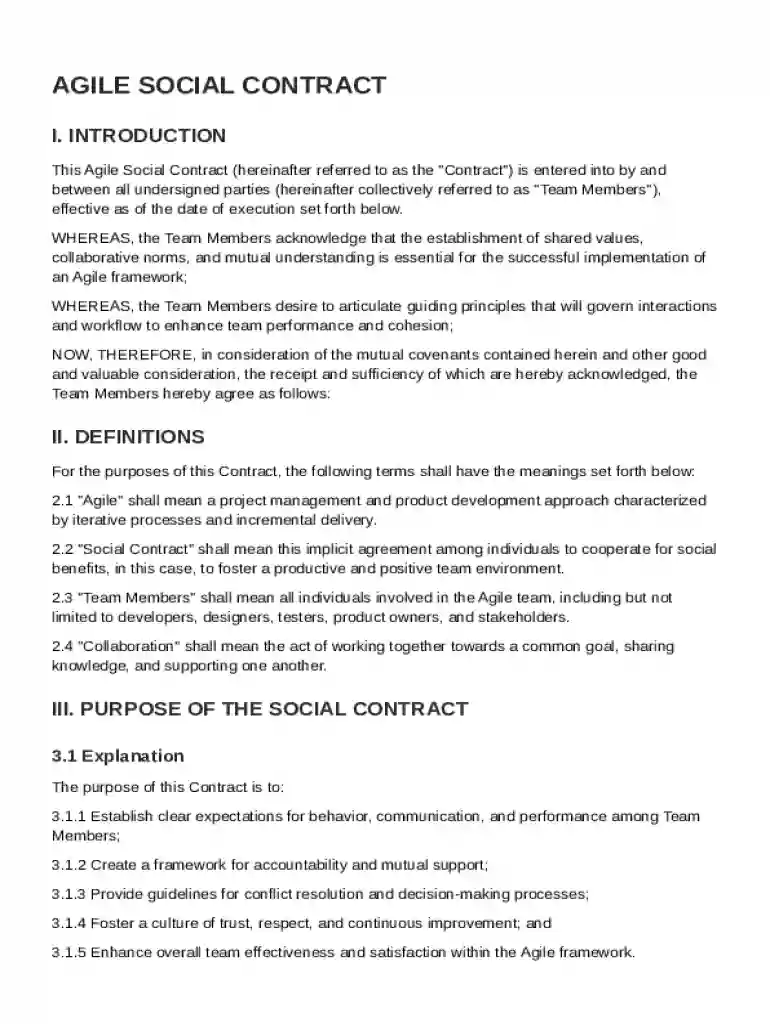
The Agile Social Contract Template is a document designed to establish an understanding of collaboration principles within an Agile team. It emphasizes shared values such as trust, transparency, respect, accountability, and innovation. This contract sets guidelines for communication, conflict resolution, collaborative practices, continuous improvement, and responsibilities. It acts as a mutual agreement among team members to foster a productive and cohesive work environment, encouraging regular reviews and amendments to adapt to team dynamics.
Using the Agile Social Contract Template effectively involves several key steps:
Drafting the Contract: Team members should come together to draft the initial contract. This involves discussing and agreeing on core values, communication methods, and conflict resolution strategies.
Customization: The template should be customized to reflect the specific needs and nature of the team. This can include adding specific project goals, preferred tools for communication, and particular roles within the team.
Review and Iteration: Once the contract is drafted, it should be reviewed regularly. Teams might choose to revisit the contract at the end of each sprint or project phase to ensure it remains relevant.
Formalization: After approval from all team members, the contract is formalized and signed by each member, acknowledging their commitment to adhere to its guidelines.
Continuous Feedback: Encourage team members to provide feedback on the contract's effectiveness. Use this feedback to make necessary adjustments.
Completing the template involves a structured process:
Identify Core Principles: List the key principles that are vital to your team’s functionality, such as mutual respect, open communication, and accountability.
Define Responsibilities: Assign clear roles and responsibilities to each team member. This minimizes misunderstandings and increases efficiency.
Set Communication Norms: Establish how and when communication will occur, including which platforms will be used for daily check-ins, sprint reviews, and retrospectives.
Outline Conflict Resolution Methods: Provide a standardized approach for resolving conflicts. This might include steps for mediation and decision-making.
Incorporate Continuous Improvement: Encourage feedback loops and regular reviews to adapt the contract as the team evolves.
Formal Agreement: Have all team members sign the document to formalize their agreement.
The Agile Social Contract Template typically comprises several key elements:
The Agile Social Contract Template is widely used by:


Practical examples of using the template include:
Understanding relevant terms enhances the use of the template:
While the template is primarily a framework for team collaboration, its legal aspects include:
At DocHub, your data security is our priority. We follow HIPAA, SOC2, GDPR, and other standards, so you can work on your documents with confidence.