
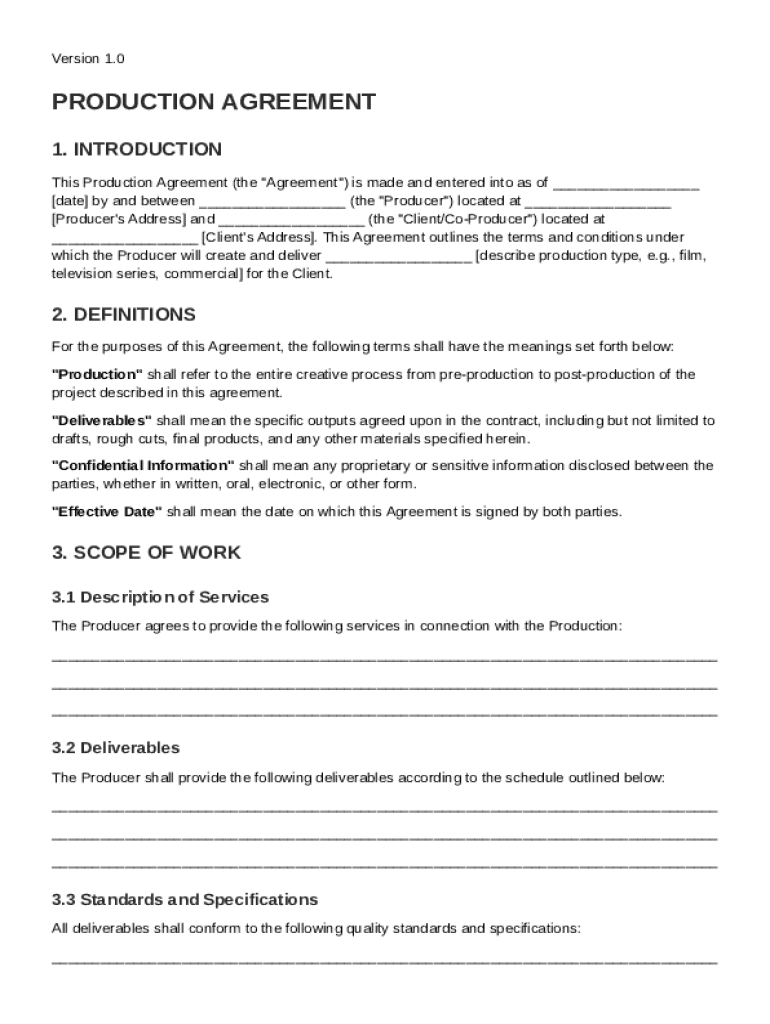







Key Elements of the Production Agreement Template
A production agreement serves as a comprehensive contract that outlines the responsibilities and obligations of each party involved in a production project. This template includes several essential components:
- Definitions: Clarifies the terminology used throughout the agreement to ensure all parties have a mutual understanding.
- Scope of Work: Details the specific tasks and responsibilities each party will undertake during the production process.
- Payment Terms: Describes the financial aspects, including fee structures, payment schedules, and conditions under which fees may be withheld.
- Rights and Ownership: Outlines who retains intellectual property rights and how they can be used post-production.
These elements ensure clear communication and help preclude potential disputes by setting well-defined parameters for the project.
How to Use the Production Agreement Template
Using the production agreement template effectively involves several key steps:
- Review Each Section: Familiarize yourself with each part of the template to understand its purpose and how it relates to your production.
- Provide Detailed Information: Fill in specifics such as names, responsibilities, and deadlines for each party involved.
- Customize for Your Needs: Adjust sections to fit the particularities of your project, including adding or removing clauses as necessary.
- Seek Professional Advice: Consider consulting with a legal professional to ensure the agreement complies with relevant laws and provides proper protection.
By following these steps, you ensure that the template serves as a solid foundation for your production agreement.
Steps to Complete the Production Agreement Template
Completing the production agreement template can be streamlined by breaking it into manageable steps:
- Collect Relevant Information: Gather all necessary details like party names, contact information, and project descriptions.
- Fill Out the Template: Begin inputting the collected information into the appropriate sections of the template.
- Review and Revise: Carefully review each section for accuracy and completeness, making adjustments as needed.
- Finalize the Agreement: Once all parties agree on the terms, finalize the document with signatures and dates.
This process ensures the agreement is thorough and ready for implementation.
Who Typically Uses the Production Agreement Template
The production agreement template is a versatile tool used by a wide array of individuals and entities involved in production processes:
- Independent Producers: Often use these templates to formalize agreements with clients or collaborators.
- Production Companies: Utilize them for internal projects and third-party collaborations to ensure consistent contract standards.
- Freelancers and Contractors: Employ the template to establish clear terms for their roles in larger production efforts.
Each group uses the template to protect their interests and outline collaboration terms clearly.


Important Terms Related to Production Agreement Template
Understanding the key terms within a production agreement can help clarify expectations:
- Producer: The entity responsible for overseeing the production process.
- Client or Co-Producer: The party or parties collaborating with the producer.
- Deliverables: Specific production outputs that are promised within the agreement.
- Confidentiality: Agreements to restrict information sharing outside the involved parties.
These terms help ensure all parties are aligned regarding production expectations and responsibilities.
Legal Use of the Production Agreement Template
The legal validity of a production agreement template is contingent upon meeting several criteria:
- Mutual Consent: All parties should agree to the terms voluntarily without coercion.
- Consideration: Each party receives value, such as services, rights, or payments, in exchange for their contributions.
- Capacity: All signers must have the legal ability to enter a contractual agreement, typically requiring them to be of legal age and sound mind.
- Legality: The agreement’s purpose and terms must not violate any laws or regulations.
Ensuring these conditions are met helps uphold the agreement's enforceability in legal contexts.
State-Specific Rules for the Production Agreement Template
Production agreements can be subject to state-specific variations in legal requirements:
- Intellectual Property Laws: Some states have unique regulations regarding IP rights that could necessitate alterations to the standard templates.
- Jurisdiction Clauses: Identifies which state’s laws will apply in cases of disputes.
- Contractual Validity Requirements: Different states may have unique stipulations regarding contract execution and recognition.
Researching the applicable rules in your jurisdiction ensures that the agreement remains compliant across state lines.
Examples of Using the Production Agreement Template
In practice, production agreements play crucial roles across various scenarios:
- Film Productions: Producers and directors outline budget constraints, distribution rights, and crew responsibilities.
- Music Collaborations: Artists and producers specify rights to recordings and distribution channels.
- Advertising Campaigns: Agencies set terms for content creation, media placement, and client feedback mechanisms.
By adapting the template to these scenarios, agreements serve as effective communication and documentation tools in diverse production environments.




