Definition & Meaning
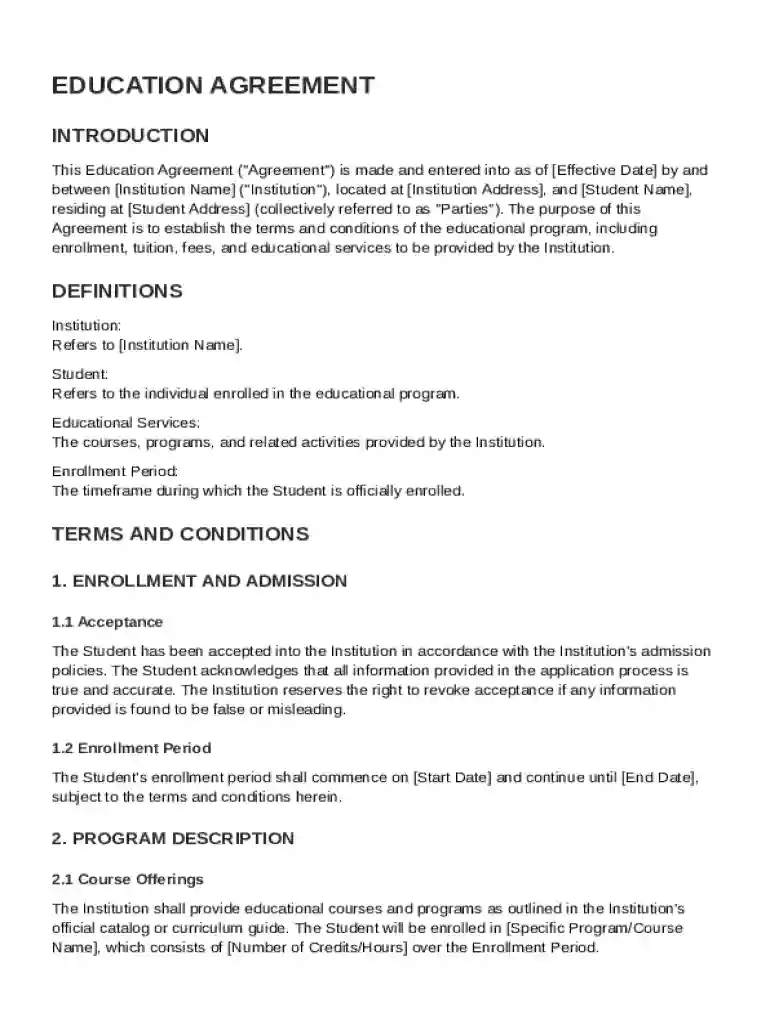
The Education Agreement Template is a formal document establishing the relationship between an educational institution and a student. It outlines the terms and conditions for enrollment, including tuition, fees, academic requirements, rights and responsibilities, termination of the agreement, dispute resolution, and miscellaneous provisions. This template serves as the foundational framework ensuring both parties understand their obligations, thereby avoiding potential conflicts.
Importance in Educational Settings
- Clarity: Ensures that expectations for educational services and commitments are clearly defined.
- Legal Protection: Provides legal recourse and protection for both students and institutions.
- Standardization: Helps maintain consistency in agreements across similar programs or institutions.
Key Elements of the Education Agreement Template
Understanding the core elements of the Education Agreement Template is essential for executing effective agreements. These elements ensure that all critical aspects are covered and conform to educational standards.
Enrollment Details
- Program Description: Defines the academic program, including course offerings and duration.
- Admission Requirements: Lists entry prerequisites such as academic qualifications and necessary prior learning.
Financial Obligations
- Tuition and Fees: Breaks down the total cost of attendance, including all mandatory fees.
- Payment Terms: Details payment schedules and accepted payment methods, enabling students to plan finances.
Academic Requirements
- Performance Standards: Outlines performance and grading criteria students must meet to maintain good standing.
- Attendance Policy: Specifies attendance requirements and consequences of non-compliance.
How to Use the Education Agreement Template
Utilizing the Education Agreement Template effectively ensures consistency and completeness in agreements. Following structured processes is crucial for seamless implementation.
Step-by-Step Process
- Initial Review: Examine the template to understand its structure and elements.
- Customization: Modify the template to suit specific institutional needs and regulations.
- Information Collection: Gather necessary data from involved parties, ensuring accuracy.
- Drafting: Fill in the template with relevant details, maintaining clarity and precision.
Common Adjustments
- Program-Specific Inclusions: Customize for unique program offerings or institutional requirements.
- Legal Terms: Adapt language to adhere to local legal norms and institutional policy.
Legal Use of the Education Agreement Template
Adhering to legal standards in drafting Education Agreements is crucial for their enforceability and validity. Ensure compliance with applicable laws and institutional policies.
Regulatory Compliance
- Federal and State Laws: Align with educational laws and standards at both federal and state levels.
- Accreditation Standards: Reflect accreditation requirements in the agreement terms.
Protection Measures
- Dispute Resolution: Incorporate arbitration or mediation clauses for conflict resolution.
- Termination Clauses: Clearly define conditions under which the agreement can be terminated.
Steps to Complete the Education Agreement Template
Completing the Education Agreement Template involves precise and systematic filling of information. Ensuring accuracy at each step is vital for creating a valid agreement.
Detailed Process
- Information Verification: Double-check all student and institutional details for accuracy.
- Completing Sections: Methodically fill out each section, ensuring no omissions.
- Stakeholder Review: Allow both parties to review and suggest amendments.
- Finalization and Signing: Finalize the agreement and gather authorized signatures.
Tips for Accuracy
- Cross-Check Data: Verify that all data aligns with institutional records.
- Clear Formatting: Ensure the document is well-organized and free from errors.
State-Specific Rules for the Education Agreement Template
Understanding and adhering to state-specific education regulations is vital for legal compliance. Each state may impose unique requirements that necessitate adaptations in the agreement.
Common Variations
- In-State vs. Out-of-State Fees: Modify tuition clauses based on residency status.
- Specific Academic Standards: Adhere to state-mandated curricula or testing standards.
Practical Examples
- California: Additional requirements for inclusion of diversity and inclusion policies.
- New York: Specific privacy considerations under state and local laws.
Digital vs. Paper Version
Choosing between digital and paper formats for the Education Agreement Template depends on institutional capabilities and preferences. Both versions have distinct advantages and considerations.
Comparison
- Digital Version: Allows for easier management, storage, and access; ideal for remote interactions.
- Paper Version: Preferred for institutions prioritizing physical documentation and signatures.
Considerations for Transition
- Security: Ensure digital documents are secured with encryption and access control.
- Accessibility: Provide access through multiple platforms to accommodate diverse student needs.
Examples of Using the Education Agreement Template
Practical examples illustrate the effective application of the Education Agreement Template in real-world scenarios, offering valuable insights for educators and administrators.
Case Studies
- Community Colleges: Simplifying enrollment processes while ensuring compliance with educational standards.
- Private Institutions: Adapting the template for bespoke academic programs and tuition structures.
Lessons Learned
- Flexibility and Adaptability: The ability to customize the template has enhanced efficiency and satisfaction in multiple settings.
- Stakeholder Engagement: Involving students and faculty in the agreement process ensures comprehensiveness and clarity.
By focusing on the most relevant sections, the comprehensive use of the Education Agreement Template can significantly streamline educational processes, ensuring clarity and compliance across various institutional contexts.