






Definition and Meaning
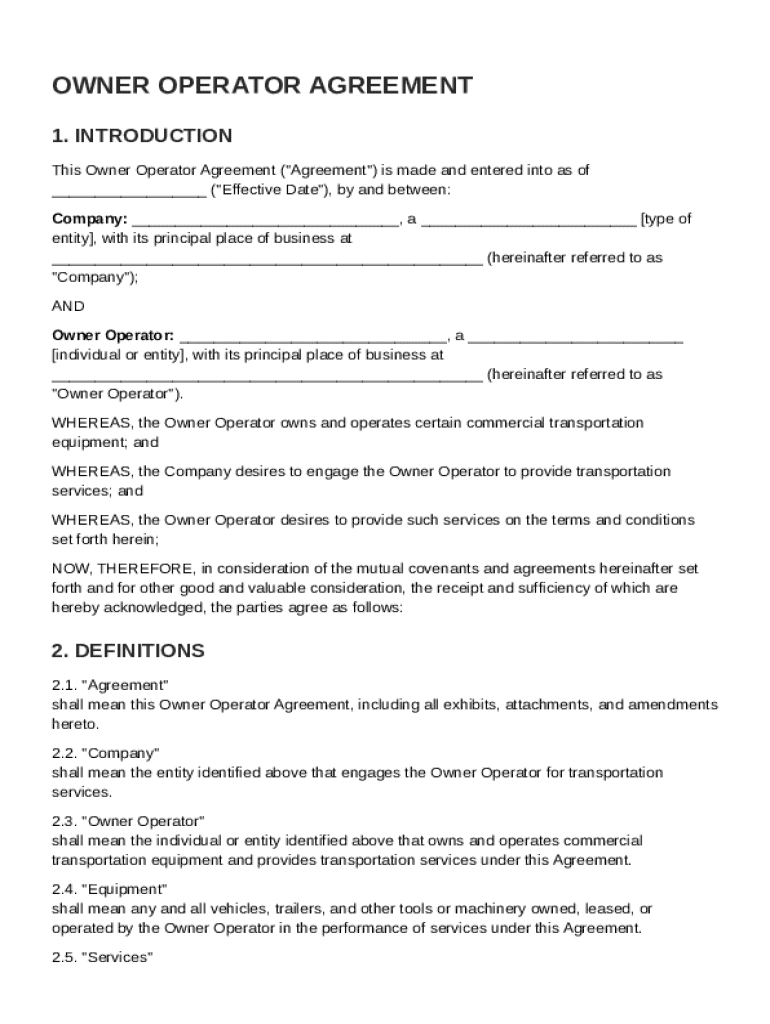
The Owner Operator Agreement Template is a formal document outlining the terms and conditions under which an owner-operator provides transportation services to a company. This agreement defines the relationship between the two parties, establishing the owner-operator as an independent contractor. It specifies essential aspects such as compensation, responsibilities, insurance requirements, and confidentiality obligations. The document ensures compliance with industry regulations and sets forth the terms for equipment maintenance, providing clarity and protection for both parties involved.
Key Sections of the Agreement
- Scope of Engagement: Details the nature of services provided.
- Compensation Structure: Highlights methods like revenue share or mileage-based payments.
- Responsibilities: Describes duties of both company and owner-operator.
- Insurance and Indemnification: Outlines insurance coverage requirements and indemnification clauses.
- Dispute Resolution: Provides procedures for resolving disagreements.
- Confidentiality Obligations: Ensures sensitive information is protected.
Key Elements of the Owner Operator Agreement Template
Creating a comprehensive Owner Operator Agreement requires a focus on several critical elements. Each component plays a vital role in crafting a complete and enforceable agreement.
Fundamental Components
- Definitions: Clear terminology that outlines roles and expectations.
- Compensation Terms: Detailed breakdown of payment methods and schedules.
- Legal Compliance: Clauses for adherence to federal and state laws.
- Termination Conditions: Rules and conditions for ending the agreement.
- Amendment Procedures: Steps for making changes to the agreement.
Practical Considerations
- Service Specifications: List specific services offered by the owner-operator.
- Performance Standards: Criteria for acceptable delivery and conduct.
- Record-Keeping Requirements: Documentation necessary for audits or inspections.
Steps to Complete the Owner Operator Agreement Template
Properly completing the Owner Operator Agreement Template ensures transparency and mutual understanding. Follow these steps to fill out the form accurately.
Step-by-Step Instructions
- Gather Necessary Information: Assemble all relevant personal and business details, including parties' names, addresses, and contact information.
- Define the Scope of Services: Clearly delineate the services an owner-operator will provide and the expected deliverables.
- Outline Compensation: Specify how and when payments will be made, choosing between set payment structures.
- Confirm Insurance Requirements: Ensure appropriate insurance policies are in place as mandated by the agreement.
- Agree on Termination Terms: Lay out conditions under which the agreement can be legally terminated by either party.
- Include Compliance Clauses: Add any additional state-specific regulations that need to be followed.
- Sign the Document: Both parties should sign to validate the agreement, possibly including witness signatures if needed.
Common Mistakes
- Omissions: Forgetting significant details such as additional charges or specific duties.
- Ambiguities: Using language that may be open to interpretation.
- Non-compliance: Failing to adhere to required regulatory standards.
Legal Use of the Owner Operator Agreement Template
The legality of the Owner Operator Agreement Template is a crucial aspect, ensuring that the independent contractor relationship is both lawful and enforceable. The document should conform to federal regulations like the Federal Motor Carrier Safety Administration (FMCSA) standards, as well as state laws.
Legal Considerations
- Independent Contractor Status: Clarity on the non-employee relationship to avoid classification as an employee.
- Insurance Compliance: Confirmation that the owner-operator holds all necessary insurances.
- Regulatory Adherence: Ensuring that all operations comply with transportation and labor laws.
Potential Legal Challenges
- Misclassification Claims: Risk of legal action if the owner-operator is treated as an employee.
- Breach of Contract: Potential disputes if terms of service or compensation are not honored.
Software Compatibility and Digital Access
The Owner Operator Agreement Template can be accessed and completed using various digital platforms and software, ensuring ease of use and flexibility.
Compatible Platforms
- DocHub: Allows direct editing and signing without additional software.
- Google Workspace: Integration with Google Drive for seamless document management.
- Popular Office Suites: Compatible with standard document formats such as DOC and PDF.
Advantages of Digital Use
- Real-time Collaboration: Multiple parties can edit and review documents simultaneously.
- Secure Storage: Utilize cloud services for safe and reliable access.
- Efficient Signing Process: Use electronic signature tools for quick document finalization.
Examples of Using the Owner Operator Agreement Template
Understanding how the Owner Operator Agreement is applied in real-world scenarios can provide insight into its practical usage and benefits.
Case Study: Logistics Company
A logistics company employs owner-operators for regional delivery routes. The agreement specifies mileage-based compensation and includes clauses for specific equipment standards and upkeep.
Example: Long-Haul Operations
An independent owner-operator contracts with a freight brokerage, using the template to outline responsibilities, indemnification clauses, and conflict resolution protocols.
Practical Applications
- Local Deliveries: Using the agreement to outline short-term service contracts.
- Freight Transportation: Defining terms for long-haul shipments and logistical support.
State-Specific Rules for the Owner Operator Agreement Template
Adherence to both federal and state-specific regulations is vital when drafting an Owner Operator Agreement. States may have unique requirements affecting the agreement's validity.
Variations by State
- California: Consider additional state labor laws affecting independent contractors.
- New Jersey: Specific guidelines on transportation insurance coverage.
- Texas: Distinct dispute resolution preferences and license requirements.
Adapting the Template
- Include State Laws: Incorporate any relevant regional legislation.
- Review by Legal Counsel: Consult with an attorney familiar with state-specific laws to ensure comprehensive coverage.
Important Terms Related to Owner Operator Agreement Template
Familiarity with essential terminology ensures a mutual understanding of the agreement's language and provisions.
Glossary of Terms
- Independent Contractor: A non-employee hired to perform specific tasks under agreed terms.
- Revenue Share: Payment structure based on a percentage of earnings from services rendered.
- Indemnification: A clause ensuring protection against loss or damage claims.
- Confidentiality Agreement: An understanding to protect sensitive information from unauthorized disclosure.
Contextual Relevance
- Insurance Requirements: Minimum coverages specified for asset and liability protection.
- Compensation Clauses: Define payment methods and timelines clearly.
Application
Using the Owner Operator Agreement Template is integral to constructing effective and enforceable agreements within the transportation sector. Mastery of these components leads to transparent and secure partnerships.