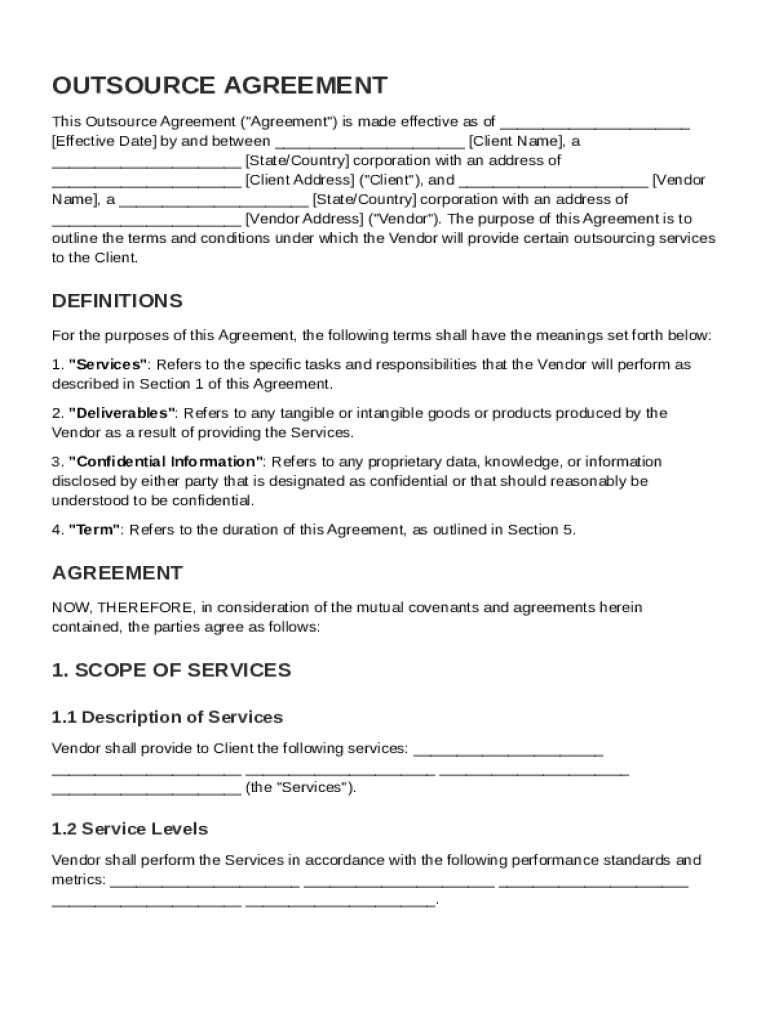







Definition and Meaning of the Outsource Agreement Template
An Outsource Agreement Template serves as a foundational document that delineates the terms and conditions under which outsourcing services are provided by a vendor to a client. This agreement typically includes detailed sections such as definitions of key terms, the scope of services, payment arrangements, deliverables, confidentiality obligations, intellectual property rights, and liability clauses. It is designed to establish mutual responsibilities and provide legal protections for all parties involved in the outsourcing arrangement.
Practical Examples and Use Cases
- Information Technology Services: Companies often use outsourcing agreements when hiring third-party vendors to manage IT infrastructure or provide tech support.
- Human Resources: Businesses may outsource payroll processing or recruitment services to streamline operations.
- Manufacturing: A company may outsource production of certain components to reduce costs and focus on core business functions.
Key Elements of the Outsource Agreement Template
The template covers several critical aspects to ensure a comprehensive understanding between the vendor and the client.
Scope of Services
- Service Description: Clear detailing of what services the vendor will deliver.
- Duration: Timeline for service provision.
- Deliverables: Specific outputs expected from the vendor.
Payment Terms
- Pricing Structure: Outline of fees, including fixed costs, hourly rates, or project-based pricing.
- Payment Schedule: Timing and methods of payment.
Confidentiality Obligations
- Nondisclosure Clauses: Protection of sensitive information exchanged during the partnership.
- Data Security Measures: Protocols to safeguard client data.
Legal Use of the Outsource Agreement Template
Outsource agreements must comply with relevant legal standards to ensure enforceability and compliance with applicable laws.
Compliance and Validity
- Regulatory Standards: Adherence to industry-specific regulations and laws.
- Intellectual Property Rights: Defined ownership of concepts and materials developed during the service period.
Edge Cases and Variations
- International Agreements: Adjustments to comply with international trade laws when services cross borders.
- State Regulations: Consideration of state-specific legal requirements in multi-state contracts.
Steps to Complete the Outsource Agreement Template
A step-by-step process is essential to fill out the template correctly and ensure all necessary details are addressed.
Step-by-Step Instructions
- Identify Parties: Clearly state the names and addresses of both the vendor and the client.
- Define Scope: Outline detailed descriptions of the services, including timelines and key deliverables.
- Agree on Payment Terms: Specify the payment structure and schedule.
- Establish Confidentiality: Include nondisclosure agreements and data protection clauses.
- Review Legal Clauses: Ensure all legal elements, such as termination terms and dispute resolution, are appropriately covered.
- Final Review: Have both parties review the completed document to ensure accuracy and completeness before signing.
Examples of Using the Outsource Agreement Template
The template can be applied across different industries and scenarios to effectively manage outsourcing relationships.
Real-World Scenarios
- Tech Startups: Using the agreement to outsource software development to a specialized firm.
- Healthcare: Outsourcing medical billing to a professional processing company.
- Finance: Engaging an external firm to manage account auditing services.
Who Typically Uses the Outsource Agreement Template
Understanding who employs these templates can provide insights into their utility and applicability.


Common Users
- Small Businesses: Outsource non-core activities to focus on growth.
- Large Corporations: Streamline operations and improve efficiency by partnering with specialized vendors.
- Government Agencies: Contract-specific tasks like data management to third-party providers.

Important Terms Related to Outsource Agreement Template
Familiarity with key terminology is crucial for both understanding and negotiating outsourcing agreements effectively.
Key Terms and Definitions
- Vendor: The service provider in the outsourcing agreement.
- Client: The organization outsourcing specific services.
- Scope of Work: The comprehensive outline of services covered under the agreement.
- Indemnification: Clause stating that the vendor will compensate the client for any loss or damage.
State-Specific Rules for the Outsource Agreement Template
Variations in state laws can influence the creation and enforcement of outsourcing agreements.
State Differences and Considerations
- California: Unique employment laws affecting service contracts.
- New York: Specific tax implications for cross-border services.
- Texas: Variations in liability and damage clause enforcement.
Understanding these nuances ensures that the template is adapted correctly to meet state requirements, reducing the risk of legal challenges.