






Definition & Meaning
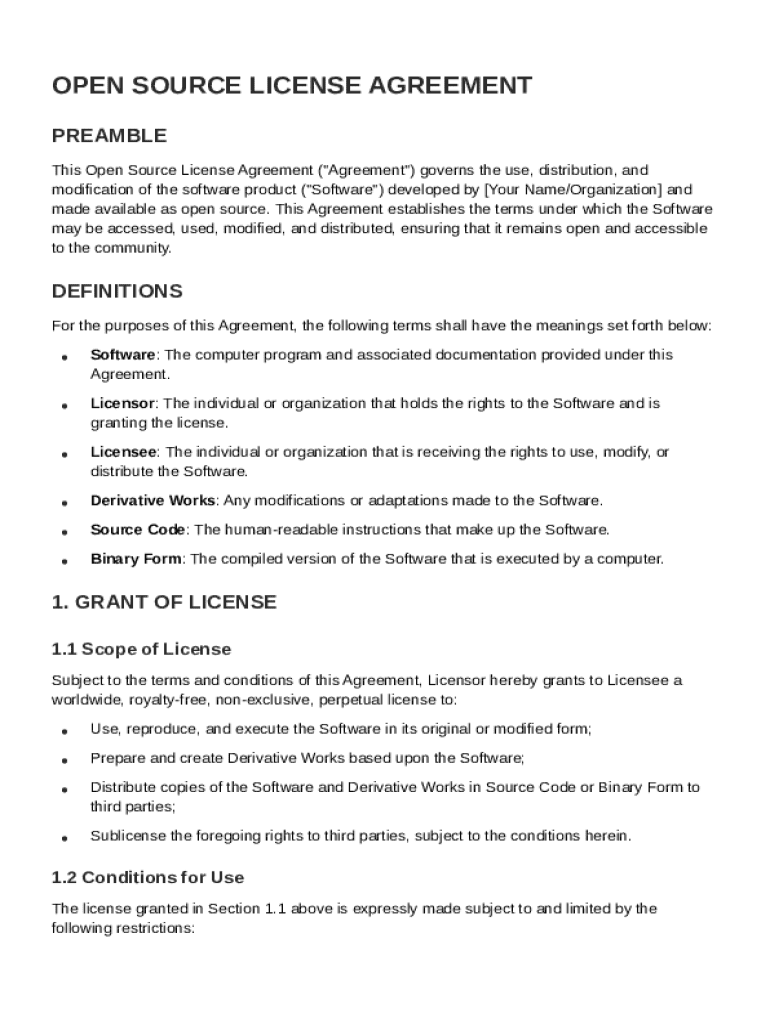
An Open Source License Agreement Template is a structured document that outlines the specific terms under which open source software can be used, modified, and distributed. It serves as a foundation for both software developers, often referred to as Licensors, and users or Licensees, ensuring that all parties have a clear understanding of their rights and obligations. This template typically includes permissions for redistribution, creation of derivative works, and conditions tied to the attribution of the original source. The agreement plays a crucial role in maintaining software accessibility while imposing necessary legal frameworks to protect both creators and users.
Types of Open Source Licenses
- Permissive Licenses: Allow users significant freedom with minimal restrictions, such as the MIT License.
- Copyleft Licenses: Require that derivative works also distribute the source code, e.g., GNU General Public License.
- Proprietary Licenses: Limit how the software can be used and modified, often not considered open source.
These licenses ensure that users can benefit from innovation and collaboration while maintaining the original creator's rights.
Key Elements of the Open Source License Agreement Template
The Open Source License Agreement Template is composed of multiple critical components, ensuring comprehensive coverage of rights and responsibilities. These elements typically include:
- License Grant: Defines the rights given to Licensees, often outlining permissions for use, distribution, and creation of derivative works.
- Attribution Requirements: Specifies how the original creator should be credited when the software is used or modified.
- Warranty Disclaimer: Denies any guarantees about the software's functionality or suitability for particular purposes.
- Liability Limitations: Limits the Licensor's liability related to any damages arising from the use of the software.
- Termination Conditions: Provides scenarios under which the license might be revoked or terminated if conditions are not met.
- Governing Law: Indicates the jurisdiction's laws that will apply in case of any legal disputes arising from the agreement.
Each section is designed to uphold open source principles while protecting both the Licensor's and Licensee's interests.
How to Use the Open Source License Agreement Template
To effectively utilize an Open Source License Agreement Template, individuals or organizations should follow specific steps. Here is how to approach this process:
- Review Existing Agreements: Examine sample templates and existing licenses to understand the common clauses and their implications.
- Customize the Template: Modify the standard template to reflect specific requirements or conditions pertinent to your software project.
- Highlight Unique Elements: Clearly indicate any unusual or project-specific terms that fall outside standard open-source licensing.
- Seek Legal Advice: Consult with a legal expert experienced in intellectual property law to ensure the customized agreement is legally sound.
This process ensures that all legal bases are covered and that the template reflects the specific needs of the software project in question.
Steps to Complete the Open Source License Agreement Template
Filling out an Open Source License Agreement Template involves several detailed steps to ensure accuracy and compliance:
- Identify Parties: Specify the Licensor and Licensee, providing detailed information on each.
- Define Scope of Use: Clearly state the range of permitted uses for the software, including distribution and modification rights.
- List Conditions: Include any specific obligations such as attribution requirements or limitations on commercial use.
- Outline Disclaimers: Add disclaimers related to warranty or liability, protecting against potential legal claims.
- Sign and Date: The agreement should be signed and dated by all involved parties, signifying mutual acknowledgment of the terms.
- Archive the Document: Ensure that both parties retain an official copy of the completed agreement for future reference.
The process aims to provide clarity and prevent potential legal disputes by establishing clear, mutual expectations.
Legal Use of the Open Source License Agreement Template
To legally use an Open Source License Agreement Template, it's imperative to understand its constraints and permissions. Here are key considerations:
- Compliance with Open Source Principles: Adherence to the open-source definition is necessary, which often includes mandates for free redistribution and source code availability.
- Respect for Original Licensors: Ensure credit is appropriately given through required attribution provisions where specified.
- Adaptation and Modification Regulations: Carefully balance the rights to modify software against any requirements to share modifications with the community.
The legal framework of the template must be respected to ensure the software project remains above legal board and aligned with open-source ethics.
Important Terms Related to Open Source License Agreement Template
Understanding key terminology is essential when working with an Open Source License Agreement Template. Here are critical terms frequently employed:
- Licensor: The original creator or entity providing the software.
- Licensee: The user of the software who is granted rights under the agreement.
- Derivative Work: Modifications or additions to the original software.
- Attribution: Acknowledgment given to the original creator as prescribed by the license.
These terms form the backbone of comprehension necessary to correctly interpret and implement the agreement's conditions.
Who Typically Uses the Open Source License Agreement Template
The utilization of an Open Source License Agreement Template spans a diverse range of users across various sectors:
- Software Developers: Individuals or organizations that create open-source software seeking to protect intellectual property while promoting wide distribution.
- Technology Companies: Firms that contribute to or build upon open-source projects within commercial or non-commercial contexts.
- Educational Institutions: Universities and colleges involved in research and development often utilize open-source agreements to share resources.
- Non-profits and NGOs: Organizations focused on community and educational technology dissemination.
These users leverage the template to foster innovation, collaboration, and transparency in software development.


Software Compatibility
An Open Source License Agreement Template is designed to be versatile and applicable across numerous software platforms. Here are compatibility considerations:
- Document Editing Software: The template should be compatible with popular document editing tools, such as Microsoft Word and Google Docs, for ease of customization and dissemination.
- Code Hosting Platforms: Integration with platforms like GitHub and GitLab allows for automatic attachment of licenses to projects, streamlining adoption.
Compatibility ensures that the template is broadly applicable, facilitating its use by diverse communities and projects.