






Definition and Meaning of Proof of Concept Agreement Template
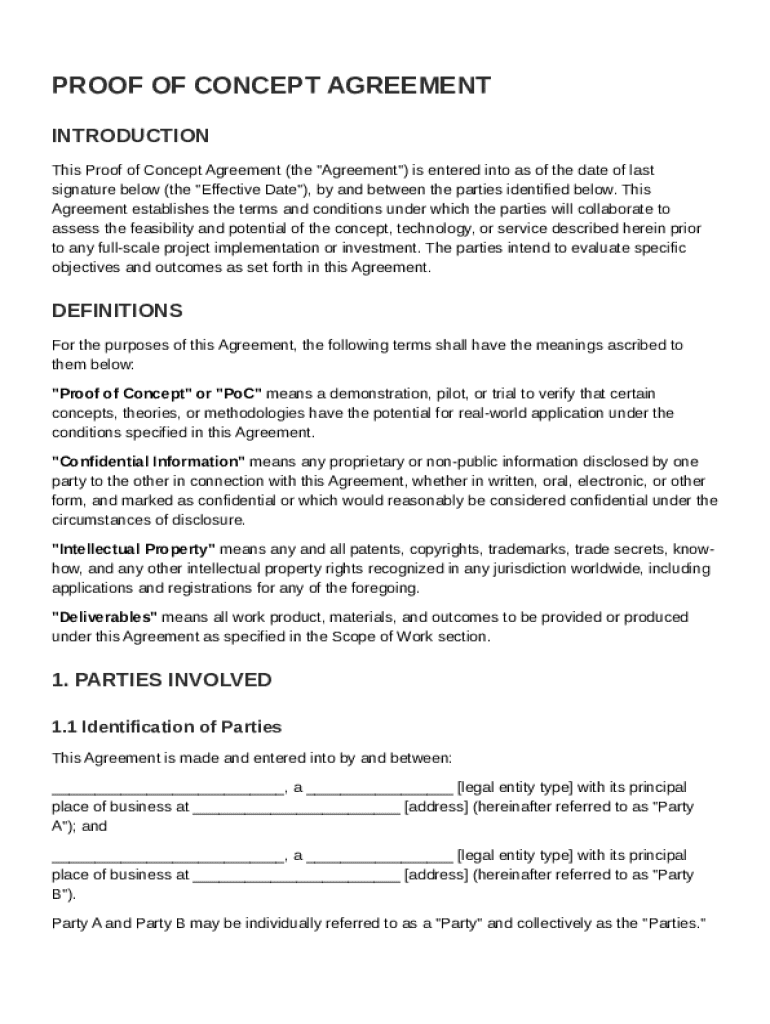
A Proof of Concept Agreement Template is a structured document used to outline the terms and conditions for an exploratory collaboration between two parties. Its primary purpose is to assess the feasibility of a particular concept, technology, or service before committing to a full-scale implementation. The agreement typically includes essential terms such as 'Proof of Concept', 'Confidential Information', and 'Intellectual Property'. Through this framework, both parties aim to systematically evaluate the viability and potential of a project, ensuring a mutual understanding of objectives, responsibilities, and outcomes.
How to Use the Proof of Concept Agreement Template
To effectively use the Proof of Concept Agreement Template, follow these steps:
-
Identify Parties: Clearly identify the parties involved in the agreement. This includes specifying the representative names, companies, and contact details.
-
Define Objectives: Outline the specific goals and purposes of the proof of concept. Describe the technology or service being evaluated, along with the expected outcomes.
-
Set Scope of Work: Address the scope of work by detailing the tasks, responsibilities, and milestones for each party. This helps establish clear expectations and measurable deliverables.
-
Outline Confidentiality: Explain the confidentiality obligations, specifying how sensitive information should be handled and protected throughout the course of the project.
-
Determine Evaluation Criteria: Agree on the criteria for evaluating the success of the proof of concept. This could include performance metrics, timelines, and budgetary constraints.
Key Elements of the Proof of Concept Agreement Template
The template covers several key elements to ensure comprehensive coverage:
- Objectives and Scope: A section detailing the purpose of the proof of concept and the specific activities to be undertaken.
- Timeline: Clear deadlines for each phase of the project, including start and end dates.
- Budget: Financial arrangements and projections associated with the pilot project.
- Confidentiality Clauses: Provisions to safeguard proprietary information exchanged between parties.
- Intellectual Property Rights: An outline of the ownership and usage rights of any intellectual property developed during the project.
- Termination Clauses: Conditions under which the agreement can be terminated prematurely by either party.
Important Terms Related to Proof of Concept Agreement Template
Understanding certain terminology is crucial for both parties involved:
- Proof of Concept (PoC): An exercise to test the feasibility of a concept or theory in a real-world scenario.
- Intellectual Property (IP): Refers to creations from the project that are legally recognized as proprietary assets.
- Confidential Information: Sensitive data that is not to be disclosed outside the collaborative process.
- Deliverables: Specific outputs that must be achieved and presented at certain stages of the project.
Legal Use of the Proof of Concept Agreement Template
The legal validity of a Proof of Concept Agreement hinges on several elements:
- Compliance with Laws: The agreement must adhere to applicable local, state, and federal laws within the United States.
- Binding Nature: Both parties must acknowledge the legally binding nature of the agreement once signed.
- Dispute Resolution: Incorporate provisions for resolving disputes, such as through mediation or arbitration, to manage potential conflicts.
Examples of Using the Proof of Concept Agreement Template
Consider these scenarios to illustrate practical applications:
- Technology Evaluation: An IT company collaborates with a startup to test a new software application, using the agreement to define deliverables and success benchmarks.
- Product Feasibility: A manufacturing firm and a research partner explore the viability of a new material, aligning goals on data collection and analysis methods.
- Service Trial: A healthcare provider assesses a new patient management system with a tech vendor, relying on the agreement to stipulate data security measures.
Versions or Alternatives to the Proof of Concept Agreement Template
Exploration of other related documents might include:
- Memorandum of Understanding (MoU): Often used for preliminary agreements that outline intentions without being legally binding.
- Non-Disclosure Agreement (NDA): Focuses specifically on confidentiality aspects and is employed alongside the PoC for additional security.
- Service Level Agreement (SLA): Defines service standards and delivery expectations once a proof of concept proves successful and transitions to a full-scale service.
Business Types That Benefit Most from Proof of Concept Agreement Template
Certain industries and business models are particularly well-suited for utilizing the template:
- Startups: Frequently use the template to pilot innovative ideas and technologies with potential partners.
- Tech Firms: Regularly engage in preliminary testing of new software and tools, requiring structured agreements to navigate intellectual property concerns.
- Biotech Companies: Utilize the agreement to conduct trials and feasibility studies, ensuring both compliance and confidentiality are maintained.
Who Typically Uses the Proof of Concept Agreement Template
Several roles within an organization may rely on this agreement:
- Project Managers: Responsible for overseeing and managing the proof of concept process, ensuring all criteria are met.
- Legal Advisors: Ensure that the agreement complies with legal standards and effectively protects the interests of their organization.
- R&D Teams: Engage in the practical application of the agreement to trial novel ideas, technologies, or methodologies within controlled environments.