




Definition & Purpose of the Behavior For Parents Contract Template
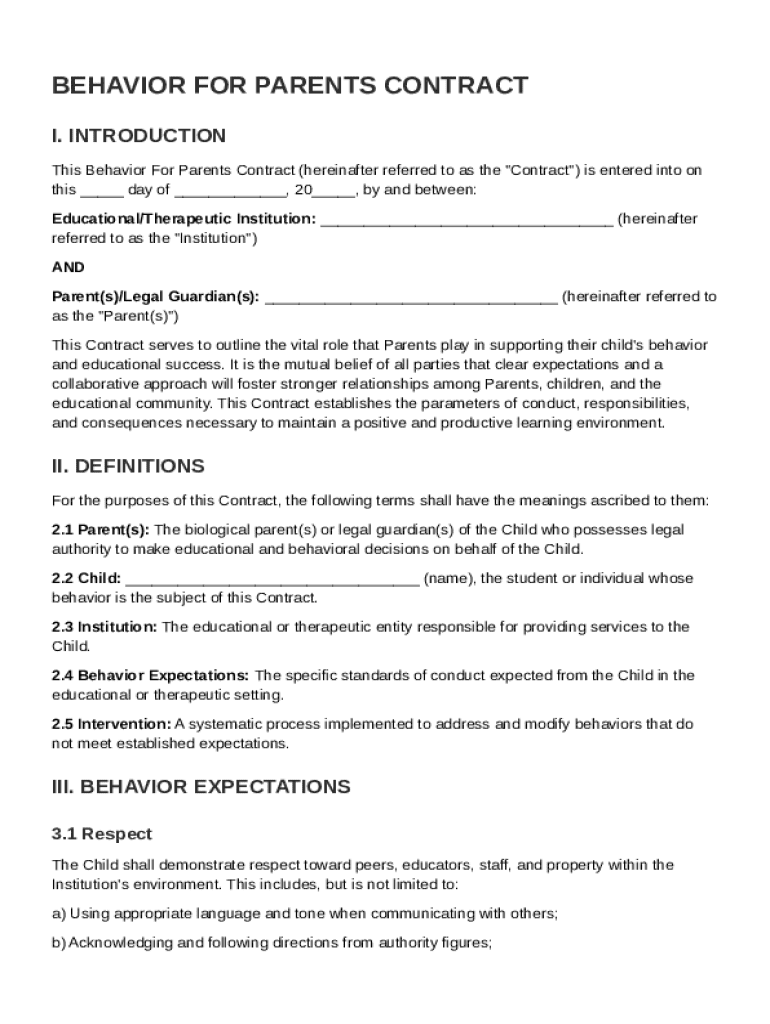
The Behavior For Parents Contract Template is a formal document designed to outline the mutual responsibilities of parents and educational institutions in promoting a child's behavioral and educational success. This contract is instrumental in establishing clear guidelines for behavior, ensuring both the child and parents understand their roles in maintaining a conducive learning environment. Key elements include expected behaviors from the child, such as respect and compliance, and parental responsibilities like communication and support. By setting these expectations, the contract helps prevent conflicts and provides a framework for resolving disputes, fostering collaboration between parents and schools.
How to Use the Behavior For Parents Contract Template
Using the Behavior For Parents Contract Template involves several essential steps to ensure it is effective and comprehensive. First, parents and school representatives should familiarize themselves with the template and customize it to reflect the specific needs and expectations of their institution. The customization may include defining specific behavior standards and communication channels. Once tailored, all parties should review the document together, discussing each section to ensure mutual understanding and agreement. Finally, participants should sign the contract, indicating their commitment to uphold the stipulated responsibilities and expectations throughout the child's enrollment.
Steps to Complete the Behavior For Parents Contract Template
Completing the Behavior For Parents Contract Template requires thorough attention to detail to ensure completeness and accuracy. Begin by identifying the parties involved, typically the parents or guardians and the school officials. Next, fill out the sections detailing the child's behavior expectations, using language that is clear and age-appropriate to avoid ambiguity. Then, specify the parental responsibilities, including support methods and participation in school activities. After defining the consequences for unmet behavioral standards and the dispute resolution process, ensure every party understands these terms before signing. A signed copy should be provided to each party, ensuring everyone retains a complete understanding of their responsibilities.
Key Elements of the Behavior For Parents Contract Template
The effectiveness of the Behavior For Parents Contract Template lies in its well-defined key elements. Critical components include:
- Behavior Expectations: Specific behaviors that the child is expected to exhibit, such as respect and responsibility.
- Parental Responsibilities: Duties like maintaining communication with teachers, supporting the school's educational goals, and participating in relevant activities.
- Consequence Framework: Clearly articulated consequences for the child's failure to meet behavior expectations.
- Resolution Mechanism: A collaborative process to address any disputes or conflicts that arise, usually involving meetings between parents and educators.
Ensuring all these elements are included and explicitly detailed is crucial for the contract's success.
Legal Considerations for the Behavior For Parents Contract Template
While the Behavior For Parents Contract Template is not a legally binding document in the same way as a court order, it serves as an agreement with legal implications if it includes or violates any statutory mandates relevant to education and parental rights. Schools and parents must ensure compliance with applicable local, state, and federal laws, such as those related to student privacy and educational rights. It is advisable for parties to consult with legal counsel when formulating the contract to confirm it aligns with legal standards and educational policies.
Who Typically Uses the Behavior For Parents Contract Template
The primary users of the Behavior For Parents Contract Template are educational institutions and parents or guardians of students attending these institutions. Schools, ranging from elementary to high school levels, often employ such contracts to ensure consistent behavior management policies that support educational success. In some cases, specialized programs or institutions catering to children with behavioral challenges utilize these contracts to establish and maintain behavior standards. Overall, any educational body seeking to clearly outline expectations and responsibilities between themselves and the parents of their students can effectively use this template.

Examples of Using the Behavior For Parents Contract Template
Real-world scenarios where the Behavior For Parents Contract Template proves invaluable include cases where consistent miscommunication between parents and schools occurs. For instance, a school experiencing repeated issues with classroom behavior might implement this template to formalize parent-teacher agreements, ensuring mutual understanding and accountability. Another scenario involves parents who frequently miss school meetings; incorporating attendance into the contract can highlight its importance and prompt better participation. In both examples, the contract helps establish clearer expectations and provides a reference point to navigate future interactions constructively.
State-Specific Rules for the Behavior For Parents Contract Template
State-specific rules can impact the formation and execution of a Behavior For Parents Contract Template. Depending on the state's regulations, allowances might differ concerning privacy laws, disciplinary actions, and parental rights in education. For example, states with stringent privacy protections may require additional measures in the contract to safeguard student information. Schools are often responsible for adhering to these rules, tailoring the contract to align with state legislation. Thus, it is crucial to review local education policies and regulations when developing or implementing the contract, ensuring it is compliant with all legal requirements applicable in the state where the educational institution operates.