







Definition and Meaning
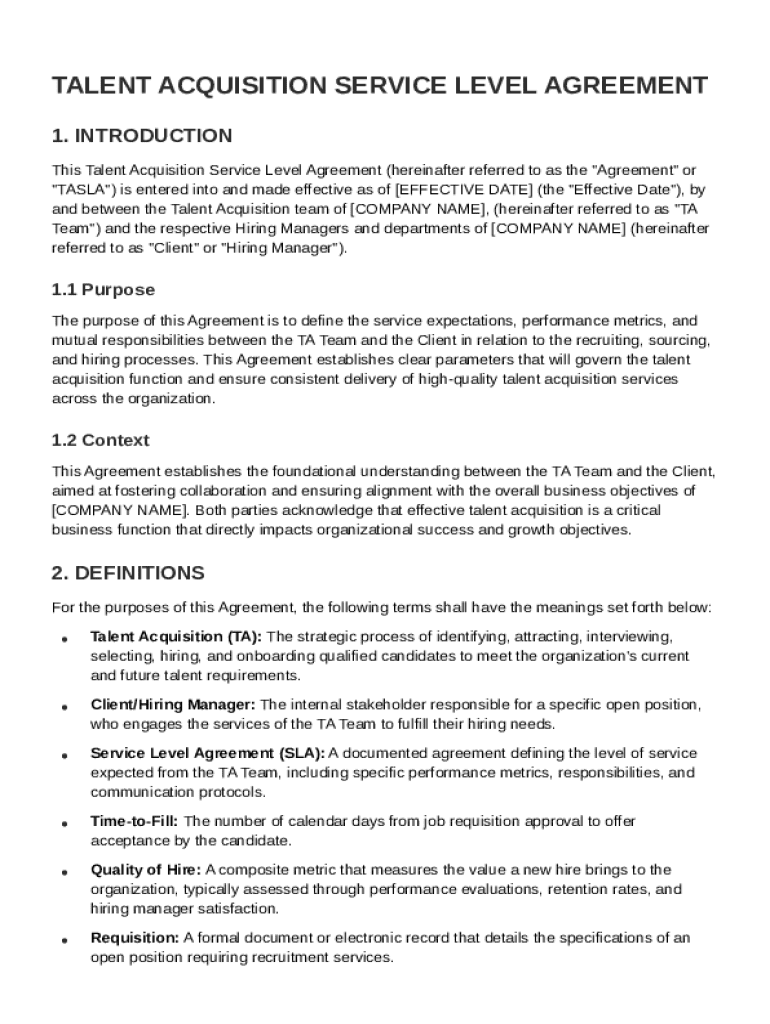
A Talent Acquisition Service Level Agreement (TASLA) is a formal document that outlines the roles, responsibilities, and expectations between a company's Talent Acquisition team and its Hiring Managers. It establishes clear guidelines for recruitment processes and helps ensure all parties are aligned on goals such as time-to-fill, quality of hire, and candidate experience. By providing a structured approach, TASLA promotes effective collaboration and accountability, thus enhancing overall recruitment efficiency.
Key Elements of the Talent Acquisition Service Level Agreement Template
A well-defined TASLA template typically includes several crucial elements that provide transparency and set standards for all stakeholders:
- Service Level Metrics: Define key performance indicators (KPIs) such as time-to-fill and quality of hire benchmarks.
- Roles and Responsibilities: Detail specific duties for Talent Acquisition personnel and Hiring Managers.
- Communication Protocols: Outline expectations for regular updates and communication channels.
- Dispute Resolution: Procedures to address any disagreements or performance issues.
- Review Frequency: Establish intervals for reviewing and updating the agreement to align with organizational changes.
How to Use the Talent Acquisition Service Level Agreement Template
Using a TASLA template effectively requires a systematic approach:
- Initial Customization: Adjust the template to fit the specific needs of your organization, including brand-specific terminology and metrics.
- Stakeholder Involvement: Involve relevant team members in the customization process to ensure a consensus.
- Implementation: Distribute the finalized agreement among all parties, ensuring everyone understands their roles.
- Monitoring: Track performance against the defined metrics and adjust practices as necessary for continuous improvement.
Steps to Complete the Talent Acquisition Service Level Agreement Template
Completing the TASLA template involves a few key steps:
- Gather Required Information: Collect data on current recruitment processes, performance metrics, and team roles.
- Draft Content: Fill out each section of the template with the relevant organizational information.
- Review and Adjust: Ensure that all details align with company goals and policies.
- Obtain Approvals: Get sign-off from all parties involved to confirm agreement and commitment.
- Documentation and Distribution: Archive the agreement and disseminate copies to all relevant stakeholders, ensuring it is easily accessible.
Who Typically Uses the Talent Acquisition Service Level Agreement Template
A TASLA template is primarily used by the following groups:
- Talent Acquisition Teams: To set expectations and guide daily recruitment activities.
- Hiring Managers: To understand and participate effectively in the hiring process.
- Human Resources Directors: To oversee the recruitment process and ensure alignment with strategic goals.
- Executives: To review and ensure that recruitment efforts support overall company objectives.


Legal Use of the Talent Acquisition Service Level Agreement Template
The TASLA serves as a binding document that outlines mutual obligations, but should not be confused with a legal contract. However, it can play a critical role in:
- Ensuring Compliance: Aligning recruitment activities with labor laws and ethical standards.
- Risk Management: Minimizing the potential for misunderstandings through clear documentation of roles and expectations.
- Evidence of Due Diligence: Providing proof of consistent recruitment practices in the event of legal scrutiny.
State-Specific Rules for the Talent Acquisition Service Level Agreement Template
While the TASLA provides a framework applicable across many contexts, one should consider state-specific rules that may impact its implementation:
- Labor Laws: Different states have distinct labor laws that must be adhered to in the hiring process.
- Diversity Policies: State-specific regulations may influence how companies manage equal opportunity and diversity initiatives.
- Regulatory Requirements: Certain industries may be subject to additional compliance standards depending on the state in which they operate.
Examples of Using the Talent Acquisition Service Level Agreement Template
Practical examples demonstrate how a TASLA benefits organizations:
- Scenario 1: A multinational company standardizes its recruitment processes across different states using the TASLA, reducing time-to-fill and improving candidate quality.
- Scenario 2: A tech startup implements a TASLA to manage rapid growth, ensuring consistent recruitment practices that align with its unique company culture.
- Scenario 3: A healthcare provider uses TASLA to comply with industry-specific recruitment regulations and maintain top talent within their organization.
Digital vs. Paper Version
Regarding format, organizations choose between digital and paper versions considering several factors:
- Digital Version: Preferred for its ease of access, ability to track changes, and integration with recruitment software.
- Paper Version: Used in situations where digital access is limited or when a physical copy is needed for record-keeping purposes.
- Hybrid Approach: Combining both formats can offer flexibility and security, ensuring accessibility for all users regardless of their preferences.




