
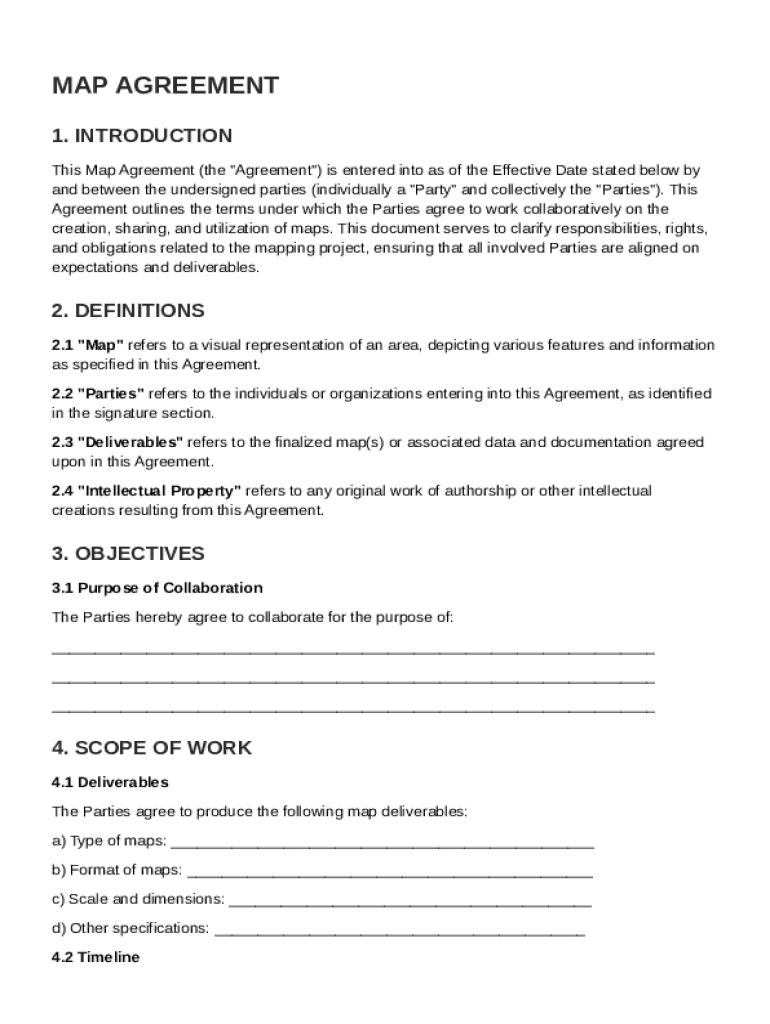







Definition & Meaning
The Map Agreement Template is a structured document designed to define the terms and conditions governing the creation, sharing, and utilization of maps between parties. This template formalizes the understanding and responsibilities related to map development, ensuring all parties involved are aligned on objectives, deliverables, and usage rights. It is essential in establishing intellectual property rights, confidentiality clauses, and indemnification obligations, thereby protecting the interests of all stakeholders.
Key Elements of the Map Agreement Template
A comprehensive Map Agreement Template typically includes several critical elements that ensure clarity and mutual understanding among the involved parties:
- Scope of Work: This section outlines the specific activities and deliverables expected from each party, detailing any collaborative efforts required for successful map creation.
- Objectives: Clearly defined goals that the agreement seeks to achieve, helping all parties to understand the purpose and desired outcomes.
- Intellectual Property Rights: Specifies the ownership of the map and any related data, including rights to reproduce, distribute, and modify the final product.
- Confidentiality Obligations: Establishes the need to protect sensitive information exchanged during the collaboration, with specific clauses on what constitutes confidential material.
- Indemnification Clauses: Details the liability and responsibility of each party in cases of legal disputes or claims resulting from the map's use or misuse.
- Termination Conditions: Outlines scenarios and processes for terminating the agreement, ensuring a structured exit strategy for all parties involved.
Steps to Complete the Map Agreement Template
Completing the Map Agreement Template involves a sequence of well-defined steps to ensure thorough and accurate documentation:
- Identify Parties: Clearly list all parties participating in the agreement, including contact information and roles in the map creation process.
- Define Scope and Objectives: Collaboratively determine the scope of work and set achievable objectives that align with all participants' expectations.
- Detail Deliverables: Specify each party's responsibilities, including timelines for deliverables and any milestone checks.
- Assign Intellectual Property Rights: Clarify ownership rights and permitted uses of the map, ensuring all parties understand their rights and limitations.
- Establish Confidentiality Terms: Draft confidentiality clauses to protect proprietary information and define the handling of sensitive data.
- Outline Indemnification and Termination Clauses: Include specific terms for liabilities, potential legal claims, and conditions for agreement termination.
- Review and Sign: Allow all parties ample time to review the final draft, suggest amendments if necessary, and sign the document to formalize the agreement.
Legal Use of the Map Agreement Template
Using a Map Agreement Template appropriately within a legal context is crucial for its binding nature and effectiveness:
- Compliance with Laws: Ensure the agreement complies with relevant federal and state laws, especially concerning intellectual property and privacy.
- Legally Binding Signatures: Incorporate legally binding electronic signatures to authenticate the document, making it enforceable under the ESIGN Act.
- Dispute Resolution: Include a governing law clause indicating which state's laws will control and the preferred method of dispute resolution, such as mediation or arbitration.
- Jurisdiction: Clearly state the jurisdiction where any legal proceedings will occur, facilitating clarity in legal accountability and enforcement.
Who Typically Uses the Map Agreement Template
The Map Agreement Template is widely utilized by various professionals and organizations engaged in mapping projects:
- Government Agencies: Often use these templates for public works and urban planning projects where mapping is required.
- Environmental Consultants: Employ the template to structure partnerships when working on geographic and mapping analyses.
- Cartographers and GIS Specialists: Use it to formalize agreements with clients involving mapping software and geographic data representation.
- Real Estate Developers: Utilize the agreement to outline collaborative efforts in developing and sharing property maps.
- Academic Researchers: Engage it to detail terms of map creation and data sharing in joint research projects involving geographic information systems.


Important Terms Related to Map Agreement Template
Understanding the essential terminology used within the Map Agreement Template ensures clarity and precise interpretation:
- Deliverables: The specific outputs or results that a party has agreed to produce within the scope of the agreement.
- Parties: The individuals or entities entering into the contractual agreement, each with defined roles and responsibilities.
- Intellectual Property (IP): Legal rights concerning creations of the mind, such as inventions and designs used in mapping.
- Non-Disclosure Agreement (NDA): A legal contract protecting confidential information shared among parties.
- Indemnity: A contractual obligation to compensate another party for certain damages or losses.
Examples of Using the Map Agreement Template
The application of a Map Agreement Template can be seen in various practical scenarios:
- Urban Redevelopment Plans: Cities commission mapping professionals to create detailed urban maps, ensuring transparent collaboration through a formal agreement.
- Emergency Response Mapping: Collaborative maps are developed for natural disaster response, involving federal agencies and NGOs, with an agreement detailing every participant's role.
- Academic Research in Geography: Researchers from different universities use the template to outline shared responsibilities in compiling thematic maps for joint studies.
- Construction and Real Estate Development: Developers utilize the template to manage mapping projects that provide insights into land usage, zoning, and topographical data.
- Telecommunications Infrastructure: Telecom companies engage mapping specialists to develop infrastructure maps, formalizing the arrangement with a comprehensive agreement.
Software Compatibility
The Map Agreement Template can be efficiently managed using various document editing tools that ensure secure and seamless workflow integration:
- DocHub: Provides extensive editing and collaboration features, including real-time synchronization, allowing multi-user engagement and integration with cloud-based services like Google Drive.
- Adobe Acrobat: A widely used PDF management tool, supporting advanced editing and secure document sharing.
- Microsoft Word: Offers compatibility for creating and editing templates, with options for collaborative editing via OneDrive.
- Google Docs: Allows for cloud-based creation and editing of agreements, fostering collaboration and ease of sharing within Google's ecosystem.




