






Key Elements of the Record Contract Template
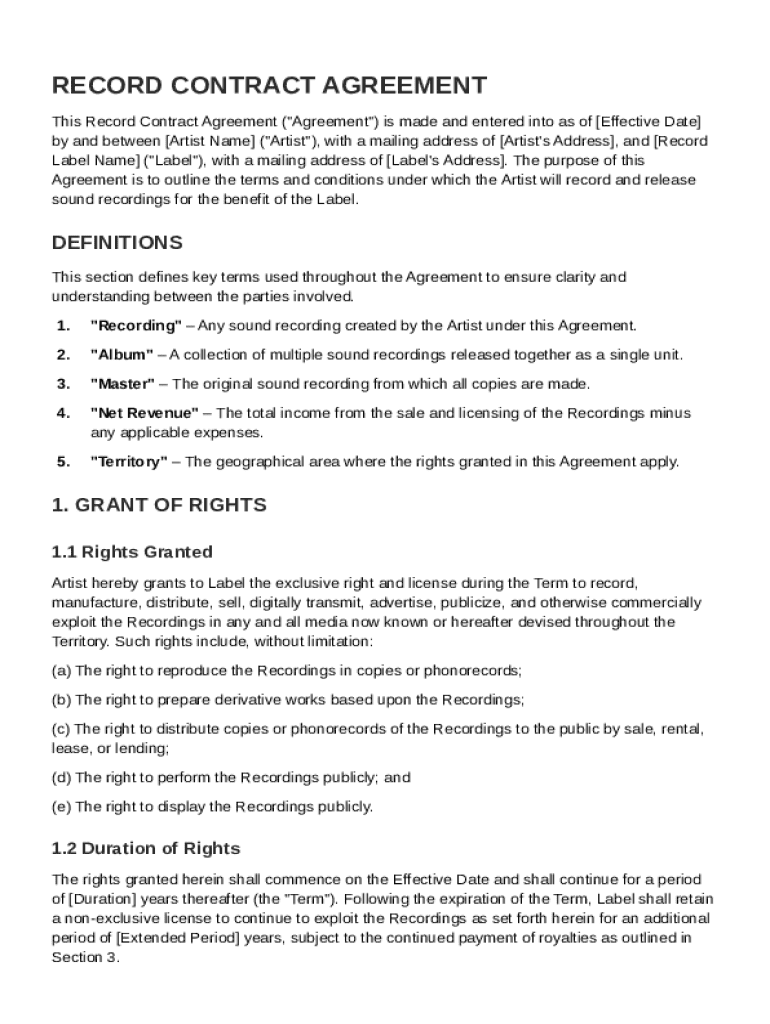
The Record Contract Template contains multiple critical components designed to establish a clear agreement between an Artist and a Record Label.
-
Exclusive Rights Grant: This section details the rights the Artist grants to the Label, covering aspects like rights to distribute, sell, or license the sound recordings made under the agreement.
-
Recording Obligations: Specifies the minimum number of albums or songs that must be recorded, including deadlines and quality standards required by the Label.
-
Compensation Structure: This includes advances provided to the Artist, as well as the breakdown of royalty payments based on sales, streaming, and other usage.
-
Marketing Responsibilities: Outlines the promotional activities and marketing support the Label will provide, detailing the scope and expected reach of these efforts.
-
Ownership of Masters: Clearly defines who holds ownership of the master recordings, usually an important point of negotiation.
-
Warranties and Representations: Each party guarantees that they have the right to enter into the agreement and that the content provided does not infringe on the rights of third parties.
-
Termination Conditions: Sets forth the circumstances under which either party can terminate the agreement, including actions like breach of contract or failure to meet recording obligations.
Steps to Complete the Record Contract Template
Completing the Record Contract Template involves several structured steps to ensure all necessary details are captured.
-
Gather Information: Collect relevant details concerning parties involved, recording and production schedules, financial terms, and any obligations or restrictions.
-
Define Rights and Obligations:
- Determine the extent of rights being granted to the Label.
- Outline specific recording commitments and deadlines.
- Include any bespoke terms that might pertain to marketing or touring.
-
Negotiate Financial Terms:
- Agree on monetary advances and royalties.
- Detail compensation mechanisms and payment timelines.
- Discuss potential bonuses based on sales or other performance metrics.
-
Draft Additional Provisions:
- Include sections on severability, governing law, and dispute resolution if applicable.
- Ensure confidentiality provisions are adapted to maintain secrecy of sensitive information.
-
Review and Revise:
- Have legal advisors for both parties review terms to ensure fairness and alignment with industry standards.
- Revise sections to address any potential ambiguities.
-
Sign and Execute:
- Once all parties agree on the terms, signatures are required to enforce the agreement legally.
- Consider using an electronic signature service for timely processing.
How to Use the Record Contract Template
For accurate use, specific practical steps need to be adhered to when filling out the Record Contract Template.
-
Initial Review: Before customization, review the template’s default language to familiarize yourself with general terms that apply to most agreements.
-
Customization: Modify clauses to reflect unique arrangements, such as exclusive versus non-exclusive agreements, territory limits, or specific marketing initiatives.
-
Compliance Check: Ensure all local laws and industry standards are met, especially for copyright assignments and royalty calculations.
-
Professional Assistance: Involve legal experts to help refine the language and ensure all contractual obligations are legally viable.
Legal Use of the Record Contract Template
Ensuring legal compliancy when using the Record Contract Template is crucial to protect both parties' interests.
-
Adhere to Legal Standards: Make sure that the contract respects the local copyright and contract laws relevant to the parties' jurisdictions.
-
Legally Binding: To render the document enforceable, all amendments should be initialed by both parties, and the final document must be signed by authorized signatories.
-
Dispute Resolution: Clearly state the process for handling disagreements, whether through arbitration, mediation, or court litigation, and specify the jurisdiction.
-
Ensuring Enforceability: Include necessary provisions, such as consideration, which are required for the contract to be legally enforceable under U.S. law.
Important Terms Related to the Record Contract Template
A thorough understanding of key terms is vital when working with the Record Contract Template.
-
Advance: The upfront payment made to the Artist before the sales revenue is realized, often recoupable from future earnings.
-
Royalties: The percentage of revenue earned from the use of the recordings that is paid to the Artist.
-
Recoupment: The process by which the Label recovers its advance or other expenses from the Artist’s royalties.
-
Master Recording: The original recording of a song, which is typically owned by the Label unless otherwise negotiated.
-
Cross-Collateralization: A provision allowing the Label to recoup losses from one album by using the revenue from another.
Examples of Using the Record Contract Template
The versatility of the Record Contract Template allows for its use in various scenarios beyond traditional recording agreements.
-
Single-Track Deal: Use the template to create an agreement focused on one high-impact track instead of a full album.
-
360 Deal Option: Include comprehensive terms covering not only recordings but also live performances, merchandise, and publishing rights.
-
Collaborative Projects: Adapt the template for agreements involving bands or ensembles, addressing how royalties and rights are distributed among members.
Who Typically Uses the Record Contract Template
The Record Contract Template is primarily utilized by individuals and entities involved in the music production ecosystem.
-
Record Labels: To formalize agreements with Artists for new music projects and establish clear expectations.
-
Music Lawyers: As part of drafting and negotiating contracts on behalf of their clients.
-
Independent Artists: To ensure they are fully aware of their rights and obligations when signing with a Label or other entity.
-
Artist Managers: To facilitate smooth negotiations and ensure the artist’s interests are protected in contract terms.

State-by-State Differences
Record contracts may sometimes need adjustments based on specific state laws.
-
California: Known for its Talent Agencies Act, contracts may require compliance checks related to artist representation and commissions.
-
New York: Offers specific protections for minor artists and may require modifications in a template if the artist is underage.
-
Tennessee: As a hub for the country music industry, agreements might include provisions unique to Nashville operations.
-
Texas: Given its business-friendly laws, contracts might entail differential considerations concerning tax obligations and royalty structures.
Digital vs. Paper Version
Evaluating the merits and challenges of using digital versus paper versions of the Record Contract Template can influence the execution process.
-
Digital Versions: Offer ease of use, storage, and sharing capabilities through platforms like DocHub. Include electronic signatures and real-time collaboration features.
-
Paper Versions: Necessary for settings requiring traditionally notarized documents or when presenting contracts in in-person meetings. However, they come with risks of damages and misplacements and lack real-time update features.
-
Hybrid Approach: Utilize both forms for maximum flexibility and accessibility, ensuring both solid physical records and dynamic interaction.