






Definition & Meaning
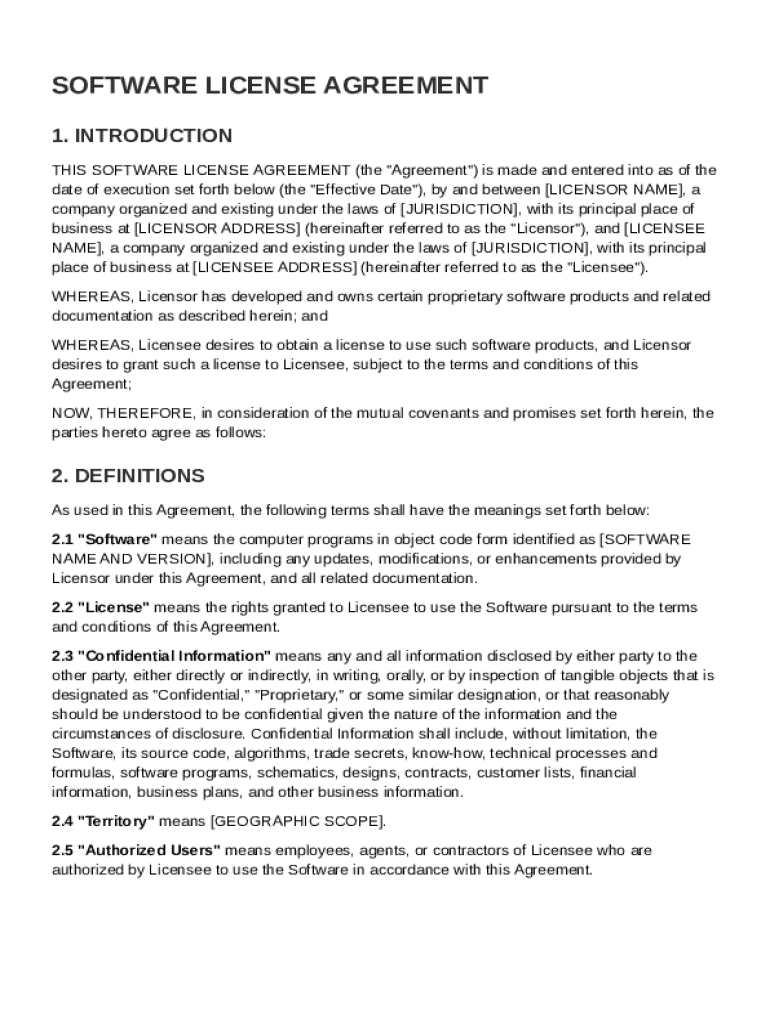
A Software Agreement Template is a legally binding document that establishes the terms and conditions under which a licensee can use proprietary software owned by a licensor. It is essential for formalizing the relationship between the licensor and the licensee, ensuring both parties have clear expectations regarding software usage. This template typically encompasses definitions of key terms to clarify specific words or concepts within the agreement. For example, it might define 'Licensed Software' as the specific software product being used under the agreement and 'Licensee' as the individual or entity authorized to use the software.
Key Elements of the Software Agreement Template
The template contains several key components integral to its comprehensive coverage. These include the license grant and restrictions, which delineate the scope of use allowed under the agreement and any limitations on use. Payment terms are also a crucial aspect, detailing the financial obligations of the licensee, such as fees or royalties, and outlining the payment schedule and methods. Another critical element is the section on intellectual property rights, which asserts the licensor's ownership of the software and any related materials. Furthermore, maintenance and support obligations identify the extent to which the licensor will provide updates, bug fixes, or other technical assistance.
Additional Provisions
Other important sections within the template include confidentiality requirements, which impose obligations on both parties to protect sensitive information from unauthorized disclosure. Termination conditions spell out the circumstances under which the agreement can be concluded prematurely, whether on grounds of breach or mutual agreement. Liability limitations enumerate the extent to which either party can be held responsible for various incidents, often seeking to limit exposure to damages.
Legal Use of the Software Agreement Template
The Software Agreement Template is designed for lawful deployment, ensuring all stipulated conditions conform to applicable regulations and industry standards. It underscores that the software is licensed to the licensee rather than sold, maintaining the licensor's rights over the intellectual property. Compliance with laws such as the ESIGN Act helps make any electronic signatures affixed to the agreement legally binding. This feature is particularly relevant for ensuring that agreements executed digitally have the same enforceability as those signed on paper.
How to Use the Software Agreement Template
To effectively use the Software Agreement Template, begin by customizing it to reflect the specific software being licensed and any particular terms negotiated between the involved parties. Emphasize ensuring the document comprehensively addresses both standard terms and any unique provisions pertinent to the specific arrangement. Attention should be given to accurately filling out sections pertaining to software descriptions, license fees, and support commitments. Consulting with legal professionals during this process can help in making sure that all terms comply with relevant legal requirements and business needs.
Steps to Complete the Software Agreement Template
-
Identify Parties: Clearly outline who the licensor and the licensee are, using their full legal names and business addresses.
-
Specify Software Details: Include a detailed description of the software being licensed, including any version numbers and accompanying documentation.
-
Define License Grant: Clearly state the scope of the license, including any usage limits, geographic restrictions, and duration.
-
Lay Out Financial Terms: Outline the payment obligations, including initial fees, recurring charges, and payment schedules.
-
Outline Support Terms: Specify what maintenance and support services are included, if any, and any additional charges that might apply.
-
Address Termination Clauses: Clearly describe the conditions under which the agreement can be terminated by either party.
-
Include Signature Lines: Ensure space for the signatures of both parties, acknowledging their agreement to the terms and conditions.
Important Terms Related to Software Agreement Template
The agreement frequently references crucial terminology essential for maintaining clarity and precision. Familiar terms include 'End-User', who is the ultimate beneficiary of the software, and 'Source Code', which refers to the human-readable form of the software's instructions. 'Derivative Works' are modifications or extensions of the original software that might be subject to different licensing terms. Understanding these terms ensures all parties are on the same page regarding their rights and responsibilities.
State-Specific Rules for the Software Agreement Template
While software agreements generally follow a standard structure, they must be tailored to comply with the specific laws of the state in which they apply. Variances in state laws can impact clauses related to data privacy, such as compliance with the California Consumer Privacy Act (CCPA). It is advisable to consult legal counsel to adapt the template to applicable state regulations, ensuring the document adheres to local contractual laws and data protection requirements.
Examples of Using the Software Agreement Template
A medium-sized software firm uses the template to license its project management tool to a client company. The agreement specifies user limits and outlines a tiered pricing model based on the number of users. Another use case involves a software startup offering its newly developed app to a global corporation, with the template providing a framework for scaling access as usage grows. These scenarios illustrate the template's versatility in accommodating different business models and software types.
Versions or Alternatives to the Software Agreement Template
Various versions of the software agreement template might be available, such as those tailored for SaaS products compared to traditional software installations. An SaaS agreement might emphasize service level commitments and uptime guarantees, while a traditional license focuses on installation and activation. Alternately, open-source software licensing involves distinct terms that differ from proprietary agreements, often focusing on distribution rights and modification conditions. Understanding these distinctions can guide selecting the right agreement version for a particular software offering.