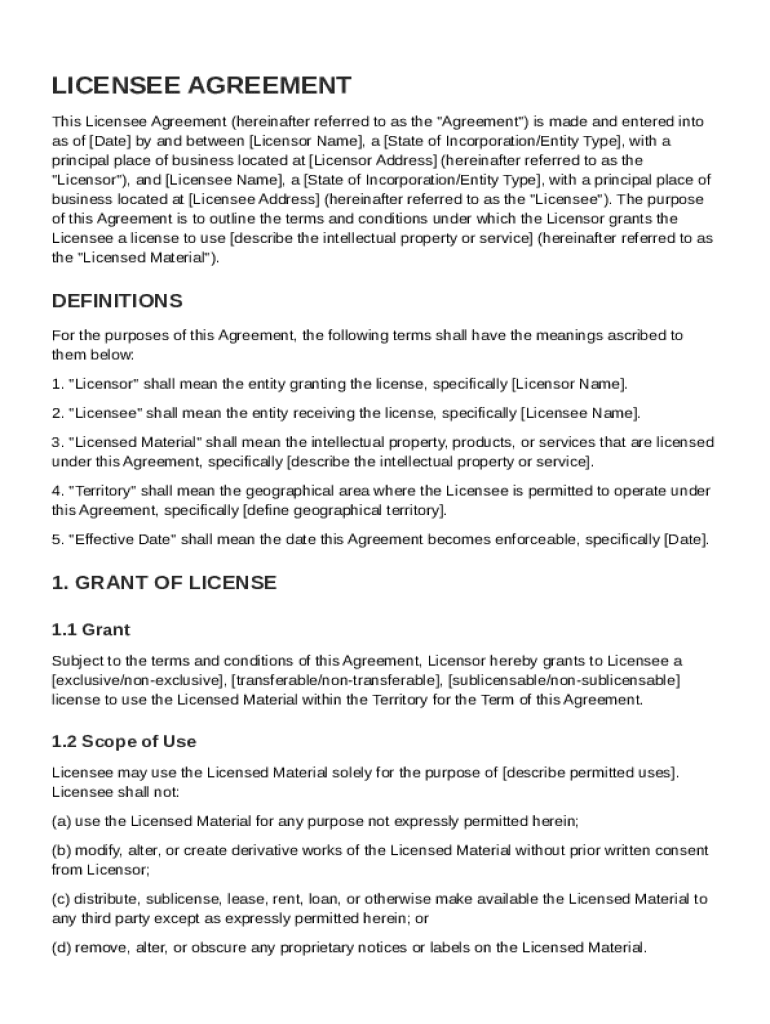







Definition & Meaning
A Licensee Agreement is a legal document that outlines the terms under which a licensor grants a licensee the right to use specified intellectual property or services. It typically includes key elements such as definitions, grant of license, payment and royalties, representations and warranties, indemnification, confidentiality, governing law, and miscellaneous provisions. The agreement specifies the scope of use for the licensed material, conditions for termination, and responsibilities regarding confidentiality and indemnification. These elements are crucial for protecting the interests of both parties involved in licensing arrangements.
Key Elements of the Licensee Agreement Template
The Licensee Agreement Template consists of several critical components designed to cover all aspects of the licensing relationship. These elements include:
-
Grant of License: Defines the rights given to the licensee, such as what intellectual property can be used and under what conditions.
-
Payment and Royalties: Details the financial obligations, including any upfront fees, ongoing royalties, or other compensation structures.
-
Confidentiality: Obligations related to the protection of sensitive information shared during the term of the agreement.
-
Indemnification: Outlines the responsibilities of each party in protecting against claims arising from the use of the licensed materials.
-
Termination Conditions: Specifies how and under what circumstances either party can terminate the agreement.
Steps to Complete the Licensee Agreement Template
Completing the Licensee Agreement Template involves a series of steps to ensure all necessary details are accurately captured:
-
Define the Scope: Clearly outline the scope of the license, including the specific intellectual property or services involved.
-
Outline Financial Terms: Specify payment terms, including any upfront fees, royalties, and payment schedules.
-
Detail Obligations and Restrictions: List the roles and responsibilities of each party, along with any limitations on the use of the licensed material.
-
Review Legal Terms: Ensure that clauses related to indemnification, confidentiality, and governing law are properly included and agreed upon by both parties.
-
Finalize and Sign: Once all sections are completed and reviewed, obtain the signatures of all involved parties to make the agreement legally binding.
Who Typically Uses the Licensee Agreement Template
The Licensee Agreement Template is commonly used by a variety of individuals and entities involved in licensing arrangements:
-
Small and Medium Enterprises (SMEs): Often use these agreements to license technology or branding needed for business operations.
-
Technology Companies: Typically require these agreements to permit the use of software or patented processes by other companies.
-
Creative Professionals and Artists: Use them to control the use of their creative works, such as music, artwork, or written content.


Legal Use of the Licensee Agreement Template
The legal use of a Licensee Agreement Template involves understanding the jurisdiction-specific requirements to ensure compliance. Key considerations include:
-
Governing Law: Clearly specify which state or federal laws govern the agreement.
-
Compliance: Ensure that the terms meet legal standards and regulations relevant to the type of intellectual property being licensed.
-
Dispute Resolution: Include provisions for how disputes will be handled, including mediation, arbitration, or litigation options.
State-Specific Rules for the Licensee Agreement Template
Different states may have specific rules and regulations that could affect licensee agreements. Considerations include:
-
State-Specific Regulations: Ensure compliance with any state laws affecting how intellectual property is licensed.
-
Local Benefits or Restrictions: Some states may offer particular advantages or impose restrictions on licensing arrangements that could impact the agreement’s execution.
-
Registration Requirements: Certain states may require the registration of specific licenses or agreements to be legally enforceable.
Examples of Using the Licensee Agreement Template
Real-world examples help elucidate the usage of Licensee Agreements:
-
Franchising: A popular fast-food chain licenses its branding and recipes to franchisees in different locations, using a well-structured license agreement.
-
Software Licensing: A tech company licenses its proprietary software to other businesses for a subscription fee, detailing the terms of use in a license agreement.
-
Music Publishing: A musician licenses the rights to their songs to a production company, allowing it to be used in films or commercials under a specific set of contractually defined conditions.
Versions or Alternatives to the Licensee Agreement Template
Various forms and versions of license agreements cater to different needs:
-
Standard vs. Custom Agreements: Standard templates may suffice for general purposes, while customized versions address specific business or legal requirements.
-
International Licensing: Specialized agreements are needed for licensing intellectual property across different countries, considering international law and trade agreements.
-
Sub-Licensing: An option where the licensee is allowed to grant licenses to third parties, requiring specific clauses to govern these relationships.