01. Edit your form online
Type text, add images, blackout confidential details, add comments, highlights and more.

Type text, add images, blackout confidential details, add comments, highlights and more.

Draw your signature, type it, upload its image, or use your mobile device as a signature pad.

Send it via email, link, or fax. You can also download it, export it or print it out.
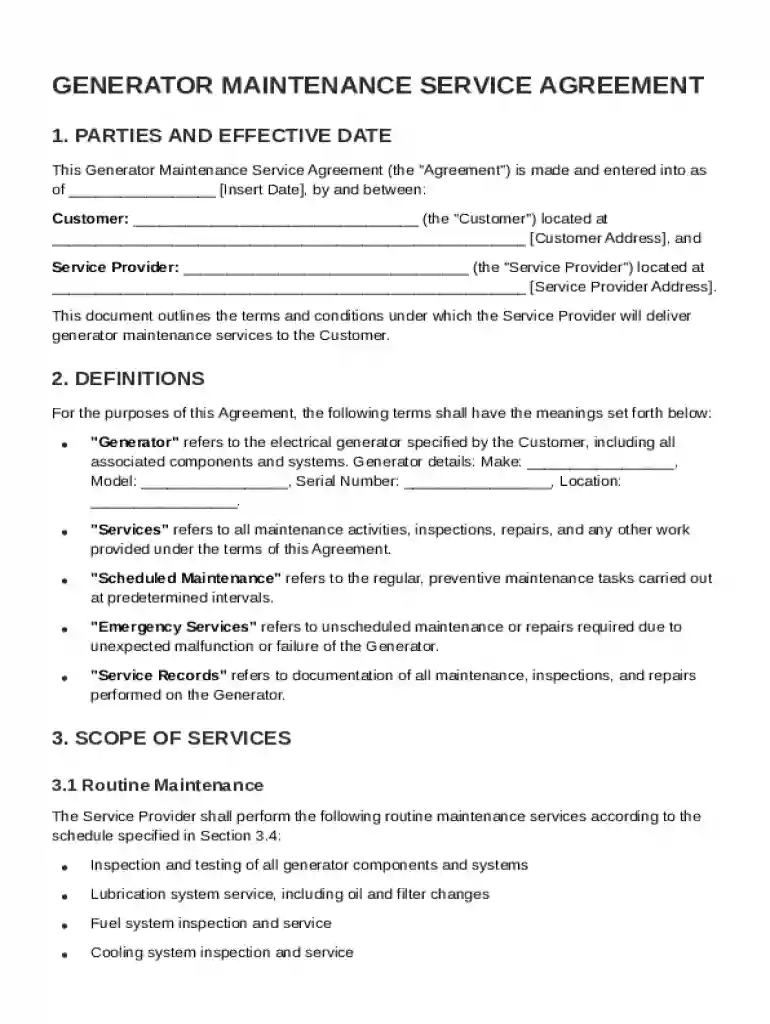
The Generator Maintenance Contract Template is a legally binding document that establishes the terms of maintenance services for a generator. It involves a service provider and a customer, defining responsibilities, services, and conditions involved in the maintenance process. This agreement ensures both parties understand their obligations, covering routine checks and emergency repairs to maintain the generator's operational efficiency and safety.
A university contracts a local maintenance company to service its campus generators. The agreement details periodic checks to be conducted monthly, emergency response times, and costs associated with different services. With this template, the university ensures consistent power supply during outages, while the service provider has a clear understanding of expectations and compensation.
Implementing the Generator Maintenance Contract Template involves several critical steps to ensure comprehensive coverage of all necessary aspects. It's essential to customize the template to reflect specific needs and arrangements between parties.
Download and Review: Obtain the template and thoroughly read each section to understand the standard terms and conditions.
Customization: Adapt the document to fit particular requirements, including inserting specific service details, payment terms, and responsibilities.
Consultation with Legal Advisors: Engage legal professionals to verify the template's compliance with regulatory standards and requirements.
Execution by Parties: Both the service provider and customer need to sign the template to formalize the agreement legally.
A hospital planning a refurbishment project includes generator maintenance in their primary contract by tailoring the template to outline specific tasks related to the infrastructural upgrades. All clauses are reviewed by their legal team to ensure they comply with healthcare facility regulations.
Completing the Generator Maintenance Contract Template requires detailed attention to each section, ensuring that all required information is accurate and precise.
Information Gathering: Collect critical details about the parties involved, including legal names, contact information, and generator specifications.
Defining Services: Outline specific maintenance services and schedules, aligning them with operational needs.
Payment Terms: Clearly define the compensation structure, including rates, payment methods, and timelines.
Signing: Secure signatures from both parties involved, making the agreement legally binding and enforceable.
Some contracts may require additional clauses to address unique situations, such as seasonal maintenance of generators used only during specific months. Adding such conditions into the template ensures enhanced relevance and clarity.
Identifying and understanding the key elements of the Generator Maintenance Contract Template helps in ensuring that the document is comprehensive and protective of both parties’ interests.
Service Scope and Frequency: Details both regular and contingency maintenance routines.
Performance Metrics: Establishes criteria for service quality and reliability standards that the service provider must meet.
Termination Provisions: Specifies conditions under which the agreement can be terminated by either party.
In cases where a generator is used in extreme conditions or environments, additional elements such as specialized inspection procedures may be necessary to improve service efficiency and longevity of the asset.
Ensuring the Generator Maintenance Contract Template complies with legal standards is crucial for enforceability and ensures it can withstand legal scrutiny.
Compliance with Regulations: The template should adhere to state and federal guidelines governing maintenance and service agreements.
Enforcement: It should be clear on remedy options in case of breach, including arbitration or litigation.
Some contracts may fail to include clauses for dispute resolution mechanisms or lack precise language in liability allocations, which can lead to misunderstandings or prolonged legal battles.
Real-world examples help elucidate how the Generator Maintenance Contract Template is effectively utilized across different industries.
Healthcare: Hospitals rely on standby generators for critical operations. Maintenance contracts ensure generators are always in operation-ready condition.
Manufacturing: Involves use of heavy-duty generators. Contracts specify regular inspections to avoid costly downtime.
A national retail chain employs the template to manage generator maintenance across various stores, ensuring uniformity in service while allowing local customizations based on specific regional power needs.
Understanding state-specific regulations can impact how a Generator Maintenance Contract Template is structured and enforced.
Licensing Requirements: Some states mandate that only certified professionals can perform generator maintenance, influencing choices of providers.
Environmental Considerations: States with strict ecological laws may require environmental impact assessments as part of the maintenance agreement.
In California, the stringent air quality laws require additional compliance steps ensuring maintenance practices do not contribute excessively to air pollution, affecting how contracts are tailored.
Familiarity with terminology used within the Generator Maintenance Contract Template enhances comprehension and ensures effective implementation.
Some parties may confuse "preventive maintenance" with "corrective maintenance," potentially leading to misinterpretation of service obligations. Proper definitions within the template can alleviate such misunderstandings.
By ensuring each of these blocks are addressed comprehensively, users can confidently implement a Generator Maintenance Contract that meets all necessary legal and operational requirements, tailored to the specific needs of each party involved.
At DocHub, your data security is our priority. We follow HIPAA, SOC2, GDPR, and other standards, so you can work on your documents with confidence.