
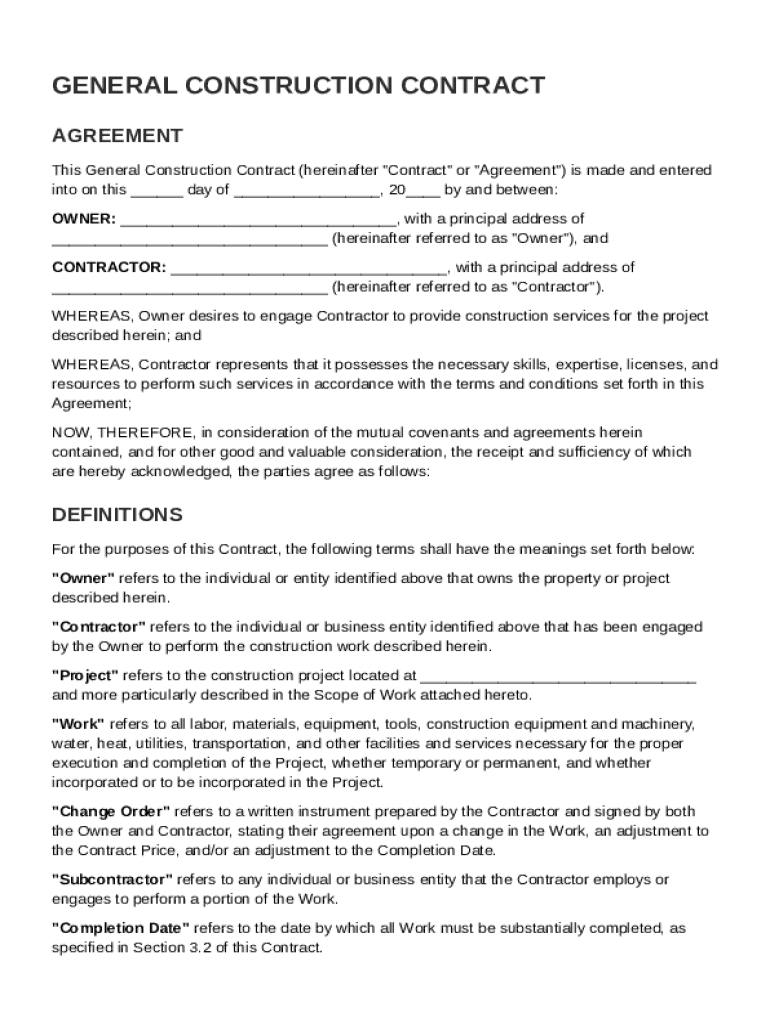







Definition and Purpose of the General Construction Contract Template
The General Construction Contract Template serves as a formal agreement between an owner and a contractor where the specific terms and conditions of construction services are outlined. This document ensures that both parties are aligned on expectations and requirements before the project commences. Contained within this contract are definitions of key terms, the scope of work, payment terms, and responsibilities for both parties. This clarity aims to minimize misunderstandings and disputes, allowing the construction project to progress smoothly.
Key Elements Within the Template
- Scope of Work: It provides a detailed description of the construction tasks to be performed, which can include milestones and deadlines.
- Payment Terms: Outlines how and when payments will be made, potentially detailing methods, schedules, and conditions for payment release.
- Responsibilities: Specifies duties of the owner and contractor, such as providing the necessary materials or ensuring that work adheres to standards.
- Timeline for Performance: Establishes time frames for project completion, including potential penalties for delay or incentives for early completion.
How to Use the General Construction Contract Template
This contract template is intended to be used by owners and contractors at the commencement of a construction project. It is essential for clearly documenting the mutual agreements and expectations. Utilizers of this template should customize it to fit the specific project by inputting relevant details, such as names, addresses, specific tasks, and agreed-upon terms.
Steps to Complete the Template
- Gather Basic Information: Collect essential data like the names and contact information of both parties.
- Delineate the Scope of Work: Clearly define the tasks and deliverables involved in the construction project.
- Establish Payment Terms: Determine the payment schedule and any conditions attached to payments.
- Outline Responsibilities: Specify roles and duties for each party, including who is responsible for certain risks or unforeseen expenses.
- Detail Project Timelines: Set clear start dates and anticipated completion dates for various project phases.
- Incorporate Change Order Processes: Discuss how changes to the original plan will be handled and documented.
- Legal Review: It is advised to have a legal expert review the completed contract to ensure compliance with state laws.
Key Elements to Include in the Template
Ensuring the contract template includes all necessary sections helps in drafting a comprehensive agreement. The following elements should be considered mandatory inclusions:
- Change Order Processes: Outline procedures for potential modifications to the project scope, including approval processes.
- Insurance Requirements: Specify the types of insurance the contractor must hold.
- Warranties: Include specifics on warranties provided by the contractor for materials and workmanship.
- Dispute Resolution Methods: Clearly state how disputes will be resolved, whether through mediation, arbitration, or litigation.
- Termination Clauses: Define conditions under which the contract can be terminated by either party.
Legal Use and Considerations for the Template
The General Construction Contract Template must adhere to U.S. legal standards. Ensuring compliance with federal, state, and local regulations is critical. This might involve recognizing labor laws, safety standards, and building codes specific to the state in which the construction takes place. It's recommended to consult with a legal professional to ensure all pertinent legal requirements are appropriately met within the contract.
State-Specific Rules and Considerations
State laws can heavily influence contract formulations, notably around licensing requirements, permit obligations, or lien waivers. It's crucial for contractors and owners to be informed about these local legalities to avoid complications.
Examples of Using the General Construction Contract Template
Real-world scenarios illustrate the practical application of this template. For instance, in residential building projects, this template can clarify terms on custom home builds. In commercial scenarios, it ensures all parties understand requirements for large-scale office renovations or retail space fit-outs.
Case Study
Consider a mid-sized office renovation where specifics like cabinet installation and painting schedules are explicitly defined within the scope of work. This contract would then detail payments upon completion of each milestone, such as the completion of electrical work or interior finishing.
Important Terms Related to the Template
Understanding specific terminologies within the contract template aids in its proper utilization.
- “Substantial Completion”: The stage where the project is sufficiently complete for the owner to use it for intended purposes.
- “Retainage”: A portion of the agreed-upon payment deliberately withheld until the contractor satisfactorily completes all aspects of the project.
- “Force Majeure”: Events outside the control of either party, such as natural disasters, which may impact the timeline or costs.
Who Typically Uses the General Construction Contract Template
This template is frequently used by real estate developers, homeowners engaging in larger renovation projects, and construction companies. It is especially useful for those who often interact with contractors to ensure all projects are adequately documented and agreed upon before work begins.


Business Types Benefiting from the Template
- Construction Firms: Engaging in contracted work for extensive or multiple projects.
- Residential Developers: Needing formal agreements for building housing developments.
- Commercial Property Owners: Managing refurbishments or new builds or sourcing out work to external contractors.
Utilizing this structured approach to contract creation facilitates smoother operations and clearer communication between parties, promoting successful project outcomes.




