
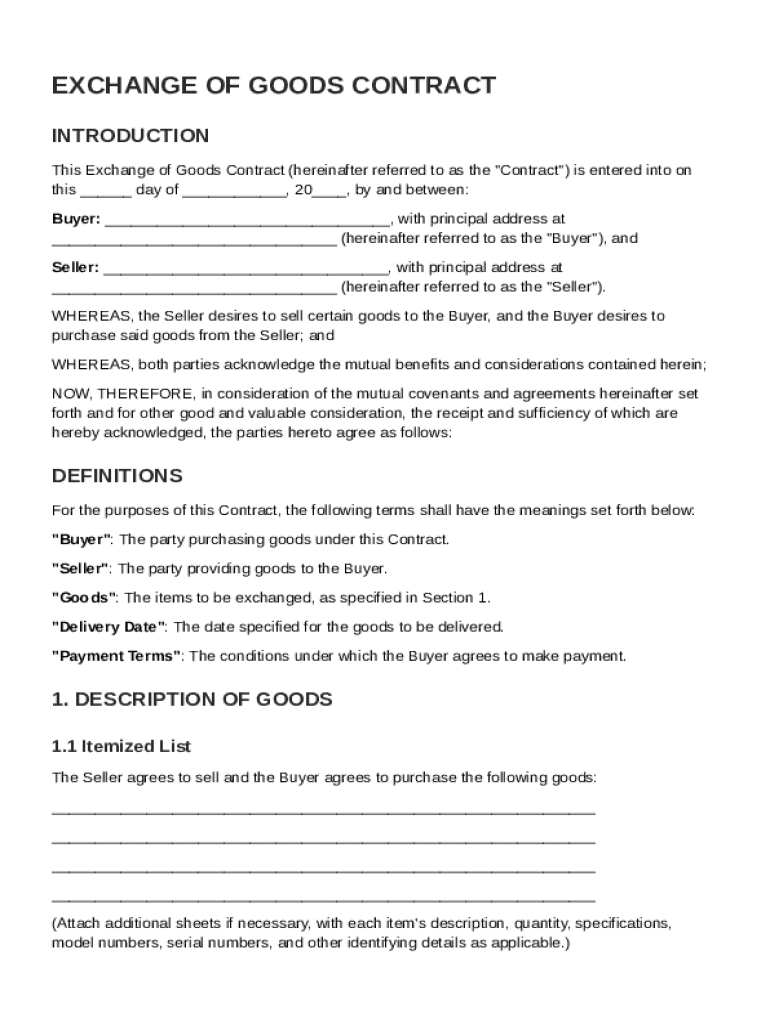







Definition and Meaning
The Exchange Of Goods Contract Template serves as a formal agreement between a buyer and a seller, detailing the terms and conditions related to the buying and selling of specified goods. This document is designed to ensure clarity and mutual understanding between both parties involved. Key elements usually include descriptions of the goods, payment terms, delivery conditions, and responsibilities of each party. It promotes transparency and accountability, reducing the risk of disputes and misunderstandings.
Core Components
- Definitions and terms: Clearly defined terminology to prevent ambiguity.
- Descriptions of goods: Specific details about the products being exchanged.
- Payment terms: Conditions under which the payment will be made.
- Delivery conditions: How and when the transfer of goods will occur.
- Responsibilities: Obligations of both seller and buyer.
- Inspection rights: Options for either party to inspect the goods.
- Warranties: Guarantees provided about the condition or performance of the goods.
How to Use the Exchange Of Goods Contract Template
Utilizing the Exchange Of Goods Contract Template involves filling out various sections to tailor the agreement to specific circumstances. This process requires attention to detail to ensure all legal obligations are met.
Step-by-Step Instructions
- Download the Template: Obtain the contract template from a reputable source, such as the DocHub platform.
- Customize Buyer and Seller Details: Enter the names, addresses, and relevant contact information for both parties.
- Detail the Goods: Clearly describe the goods, including quantity, specifications, and any relevant characteristics.
- Set Payment Terms: Outline how and when payments will be made, including any deposits or installments.
- Define Delivery Terms: Specify logistics regarding the time, location, and method of delivery.
- Clarify Inspection and Acceptance: Establish the procedures for inspecting and accepting the goods upon delivery.
- Add Warranties or Guarantees: Include any promises about the goods’ quality or performance.
- Finalize and Sign: Review the document for accuracy before having both parties sign.
Legal Use of the Exchange Of Goods Contract Template
The Exchange Of Goods Contract Template is legally binding, committing both parties to the agreed-upon terms.
Ensuring Legal Compliance
- Applicable Laws: Contracts should align with federal and state laws.
- Signatures: Signatures authenticate the agreement and the intention to be legally bound.
- Amendments: Any changes to the contract should be documented and signed by both parties.
Key Elements of the Exchange Of Goods Contract Template
Understanding the essential parts of this template can prevent future disputes and ensure a smooth transaction.
Important Contractual Elements
- Price and Payment Conditions: Explicitly detail the total purchase price and payment schedule.
- Delivery and Ownership Transfer: Clarify when the ownership of the goods transfers from seller to buyer.
- Risk Allocation: Define who assumes the risk of loss or damage to the goods at various stages of the transaction.
- Dispute Resolution: Outline the processes for resolving disagreements, such as mediation or arbitration.
State-Specific Rules for the Exchange Of Goods Contract Template
State-specific laws can affect how these contracts are structured and enforced.
Considerations for State Variations
- Sales Tax: Some states have specific requirements for sales tax disclosure.
- Language Requirements: Certain jurisdictions may require contracts to be in a particular language.
- Condition Warrants: States may have different stipulations regarding warranties and seller obligations.
Examples of Using the Exchange Of Goods Contract Template
Applying this template can vary depending on the transaction type and the goods involved.
Real-World Scenarios
- Wholesale Purchase: A retailer buying products from a distributor to sell in-store.
- Manufacturing Agreement: A company purchasing raw materials from a supplier.
- Equipment Sale: Selling machinery from one business to another.
- Online Marketplace Transactions: Facilitating sales between a seller and buyer on a platform like eBay.
Who Typically Uses the Exchange Of Goods Contract Template
Various industries and individuals can benefit from using this sort of contract to formalize transactions.


Typical Users
- Retailers and Wholesalers: To formalize purchasing agreements.
- Manufacturers: For acquiring or selling parts and materials.
- Individual Sellers: For private sales of goods.
- E-commerce platforms: For users needing legal documentation of sales.
Important Terms Related to Exchange Of Goods Contract Template
Familiarity with key terms can aid in understanding and negotiating contracts more effectively.
Glossary of Terms
- Force Majeure: Conditions under which the contract may be voided due to extraordinary events.
- Confidentiality: Prohibitions on sharing sensitive information outside the agreement.
- Force Majeure: Stipulations that relieve a party from liability due to events beyond their control.
- Indemnity: An obligation for one party to compensate the other for certain damages or losses.


