






Definition and Purpose of the Articulation Agreement Template
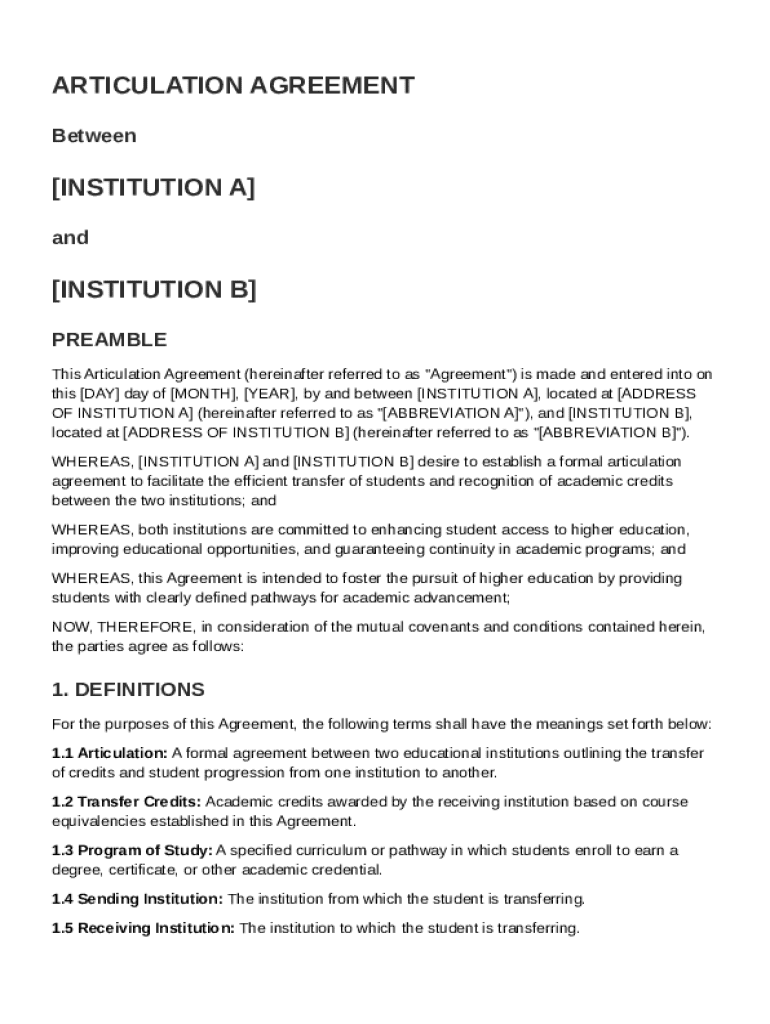
An Articulation Agreement Template serves as a formal contract between two educational institutions. It outlines the terms and conditions that facilitate the transfer of students and the recognition of academic credits. These agreements are crucial in promoting a seamless educational pathway for students transitioning between colleges or universities. By agreeing on transferable credits, institutions ensure that students do not lose time or miss out on completing their degrees due to incompatible course requirements or curricula.
Practical Examples
- A student transferring from a community college to a four-year university can benefit from an articulation agreement that ensures courses completed at the former are recognized by the latter.
- Institutions can tailor agreements to specific programs, offering clear pathways for fields like engineering or healthcare, where completed prerequisites are crucial for continued education.
How to Use the Articulation Agreement Template
Using the Articulation Agreement Template involves several steps aimed at tailoring the document to meet the specific requirements of the participating institutions.
- Identify Participating Institutions: Clearly list the names of both the sending and receiving institutions.
- Outline Credit Transfer Policies: Define how credits from one institution will transfer to another, including course equivalencies and required grades.
- Detail Program Alignment: Specify how specific programs or courses align between the institutions to ensure students meet necessary prerequisites.
- Review and Customize: Ensure all legal terms, such as duration, amendment processes, and responsibilities, accurately reflect the institutions' commitments.
By following these steps, institutions can create a cohesive agreement that supports academic success for transferring students.
Steps to Complete the Articulation Agreement Template
Completing the Articulation Agreement Template requires systematic attention to detail. Below are the key steps involved:
- Initial Consultation: Begin with meetings between representatives of both institutions. Discuss objectives, student needs, and potential obstacles.
- Draft Agreement: Populate the template with specific details about credit transfers, eligibility criteria, and program alignment.
- Legal Review: Have the drafted agreement reviewed by legal advisors from both institutions. This step ensures compliance with educational and contractual laws.
- Institutional Approval: Obtain formal approval from relevant authorities within each institution, such as the board of trustees or academic senate.
- Finalization and Signatures: Secure final signatures from designated representatives, confirming mutual consent to the terms outlined.
Key Elements of the Articulation Agreement Template
An articulation agreement must incorporate several critical components to be effective:
- Definition of Terms: Clear definitions of key terms, such as "credit hours" and "course equivalency."
- Student Eligibility Requirements: Criteria for student participation in the agreement, including GPA and completed credit hours.
- Credit Transfer Protocols: Specifics on how and when credits are transferred, ensuring clarity on equivalencies and validation processes.
- Program-Specific Provisions: Special clauses for particular programs to address unique course requirements or licensures.
Examples of Using the Articulation Agreement Template
Articulation agreements are widely used between different types of educational institutions:
- Community College to State University: Enhances opportunities for students to move from a two-year to a four-year program, often with a focus on general education credits.
- High School Dual Enrollment Programs: Agreements that allow high school students to earn college credits, smoothing their transition into post-secondary education.
- Associate to Bachelor’s Programs: For fields such as nursing, where students first complete an Associate Degree in Nursing (ADN) before transitioning to a Bachelor of Science in Nursing (BSN).
State-Specific Rule Considerations
Different states may have varying regulations governing articulation agreements, necessitating state-specific adjustments to templates:
- California: Known for its extensive statewide community college-to-university transfer system, where agreements are heavily structured and standardized.
- Texas: Institutions may include specific legislative requirements relevant to the state's higher education policies.
- Florida: Often mandates inclusion of particular courses as part of the transfer curriculum to meet state educational standards.
Legal Use and Compliance
Ensuring legal compliance in the use of an Articulation Agreement Template involves:
- Adherence to Federal Education Laws: Such as the Family Educational Rights and Privacy Act (FERPA), which governs the handling of students' educational records.
- Institutional Accreditation Requirements: Only institutions with recognized accreditation should engage in articulation agreements to maintain academic standards.
- Regular Review and Updates: Agreements must be periodically reviewed to ensure compliance with changing educational policies and institutional goals.
Eligibility Criteria for Participation
Determining who can benefit from an articulation agreement involves assessing several criteria:
- Minimum GPA Requirements: Often a critical factor for eligibility, ensuring that only qualified students participate.
- Program Specific Requisites: Some agreements may require completion of specific coursework or standardized testing.
- Enrollment Status: Only students enrolled or planning to enroll in participating institutions are eligible.


Who Typically Uses the Articulation Agreement Template?
Articulation Agreement Templates are used by:
- Educational Administrators: Those involved in curriculum planning and inter-institutional coordination.
- Admissions Departments: To manage student transitions and maintain enrollment records.
- Academic Advisors: To provide accurate advice and guidance to students considering a transfer.
These agreements are pivotal for those looking to foster smoother transitions and ensure academic goals are met efficiently.

Versions or Alternatives to the Articulation Agreement Template
While standardized templates are common, alternative versions may exist:
- Customized Agreements for Specific Disciplines: Tailored agreements to address nuanced criteria of specific fields such as business or the arts.
- Regional Articulation Agreements: Where institutions within a geographic area form coalitions to promote student mobility.
- International Articulation Agreements: Designed to facilitate the transfer of credits for students studying abroad, ensuring overseas educational experiences are recognized.
These variations accommodate differences in institutional policies or regional education strategies, enhancing relevance and applicability of the agreements.