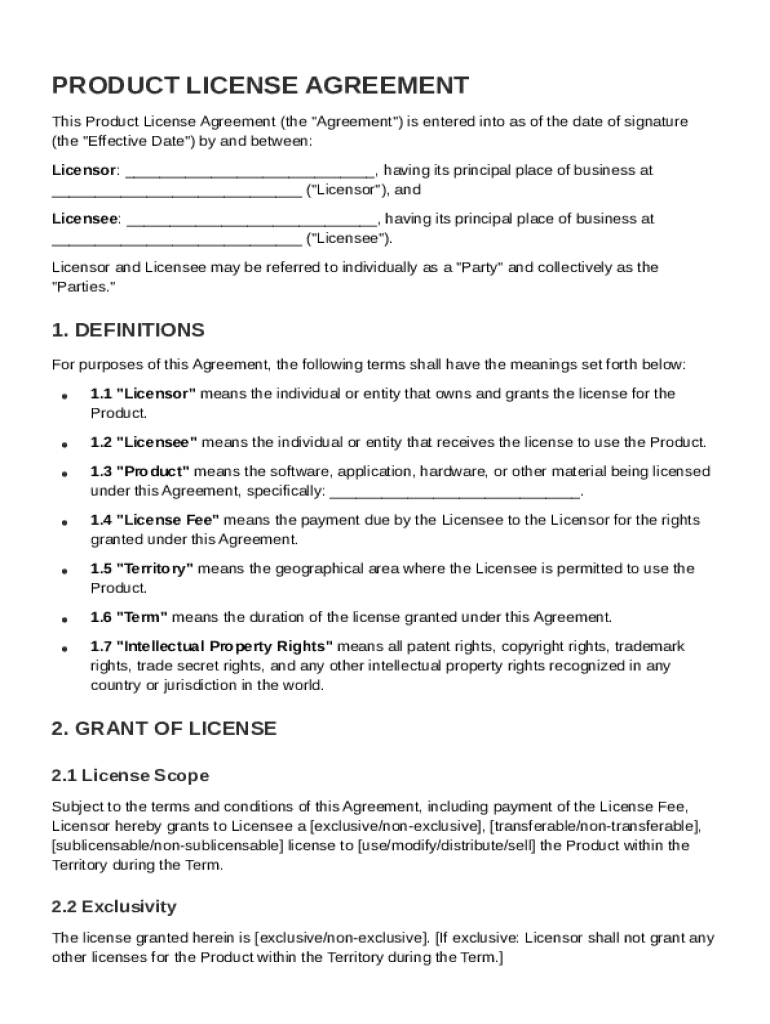







Definition and Meaning of a Product License Agreement
A Product License Agreement is a legal document that outlines the terms under which a Licensor grants a Licensee the rights to use, modify, and distribute a specified product. This agreement serves to formalize the relationship between the entities involved, specifying the rules and obligations of each party. Key terms defined within the agreement ensure clear understanding and assist in preventing potential disputes. The agreement typically includes definitions related to the scope of usage, duration, specific rights granted, and any limitations imposed on the Licensee. For instance, if a software company licenses its application to another business, the agreement will detail whether the application can be modified or distributed further.
Steps to Complete the Product License Agreement Template
Completing a Product License Agreement Template involves several crucial steps designed to ensure that all necessary information is correctly captured and legal requirements are met. Begin by filling in the basic details of the Licensor and Licensee, such as names, addresses, and contact information. Next, specify the product being licensed, including any unique identifiers or versions. Clarify the scope of the license by outlining what the Licensee is permitted to do with the product. This section should address permissions such as usage rights, modification capabilities, and distribution terms. Follow this with the financial details, specifying any fees or royalties due. Conclude by detailing the agreement's duration and conditions for termination. Signatures from both parties finalize the agreement.
Key Elements of the Product License Agreement
A comprehensive Product License Agreement includes several essential elements that safeguard the interests of both parties. These elements typically comprise:
- Definitions and Interpretations: Clear definitions of key terms used throughout the document.
- Grant of License: Details the rights granted to the Licensee, including any limitations or restrictions.
- Financial Terms: Spells out payment obligations, including upfront fees, royalty percentages, and payment schedules.
- Duration and Termination: Specifies the length of the agreement and the conditions under which it can be terminated.
- Intellectual Property Rights: Establishes the ownership of the product and outlines the rights of each party concerning trademarks, copyrights, and patents.
- Confidentiality Obligations: Protects sensitive information disclosed during the term of the agreement.
- Liability and Indemnification: Limits the liability of the Licensor and specifies indemnification obligations.
Who Typically Uses a Product License Agreement Template
Product License Agreements are utilized by various entities that wish to formalize the commercial use of their intellectual property. Typically, businesses operating within the software industry frequently use these agreements when licensing software or applications. Similarly, companies that develop patented technology or innovative products may use these templates to license their inventions to manufacturers or distributors. Beyond the tech industry, content creators, like authors or musicians, could also leverage these agreements to license their works, such as e-books or music tracks, to publishers or distributors.
Legal Use of the Product License Agreement
The legal use of a Product License Agreement involves ensuring that the document complies with relevant laws and regulations. This agreement must align with contract law principles, requiring both parties to have legal capacity and consent to the terms voluntarily. It's essential to ensure the contract adheres to any specific laws applicable to the product being licensed, such as software licensing regulations or intellectual property laws. Moreover, having legal professionals review the agreement can help in identifying and mitigating potential legal risks. Such measures ensure that the agreement is enforceable in a court of law, providing legal recourse for both parties in the event of a breach.
Important Terms Related to the Product License Agreement
Understanding key terminology is fundamental to comprehending the implications of a Product License Agreement. Terms such as "Licensor" and "Licensee" define the parties involved, while "License Grant" describes the rights provided to the Licensee. "Intellectual Property" refers to the legally protected creations of the mind, including inventions, literary works, and symbols. "Royalty" signifies the payment made to the Licensor based on usage or sales, while "Indemnification" involves the Licensee agreeing to compensate the Licensor for any losses resulting from specified actions. Clarity on these terms enables both parties to engage in informed discussions and negotiations regarding the agreement.
State-Specific Rules for the Product License Agreement
While federal law covers many aspects of intellectual property and contract law, individual states may have specific legal requirements that affect Product License Agreements. For example, certain states might impose additional consumer protection regulations or have unique licensing statutes, particularly regarding software or digital goods. Businesses should ensure the agreement complies with the governing state's laws, which is often specified within the agreement. Consulting with a lawyer familiar with state-specific regulations can be invaluable in tailoring the agreement to meet jurisdictional requirements and avoid potential legal pitfalls.
Examples of Using the Product License Agreement
Real-world examples of using a Product License Agreement illustrate its practical applications. A tech firm may license its proprietary software to another company for integration into a new product line, specifying usage terms and royalty payments. Similarly, a pharmaceutical company could license a patented drug formula to a manufacturer for production, detailing the licensing fees and distribution terms. In the entertainment industry, a musician might use a licensing agreement to authorize a streaming service to include their songs in playlists, thus expanding their reach while retaining ownership of their music. These examples highlight the versatility of Product License Agreements in various industries.