






Definition & Meaning
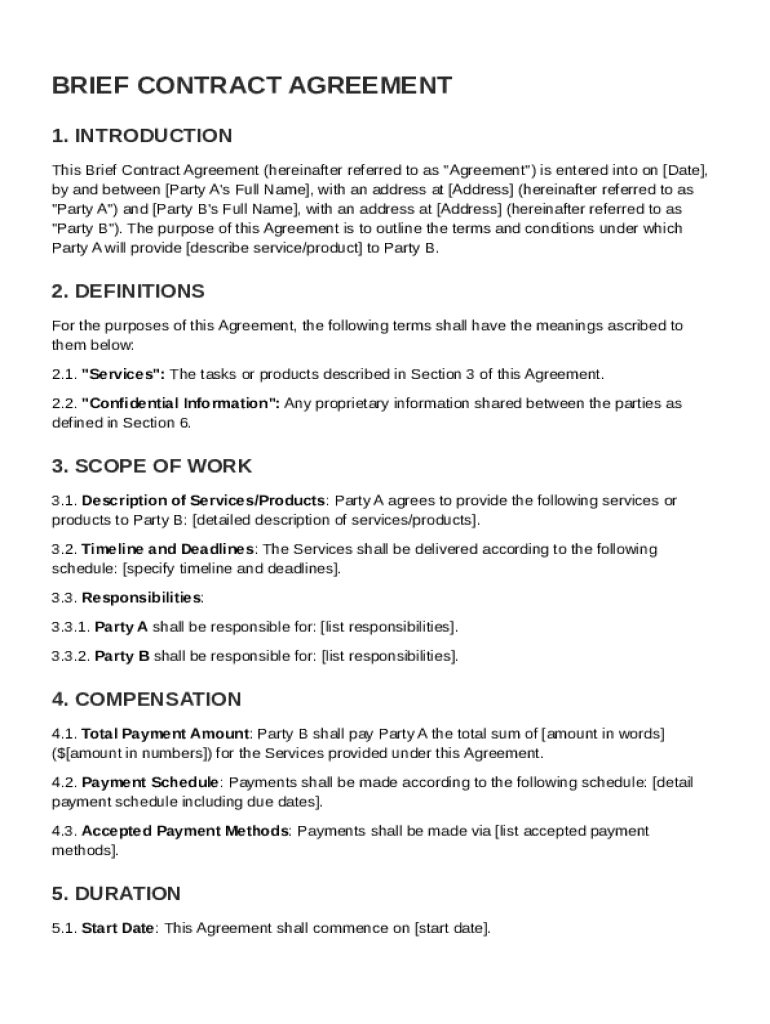
A Brief Contract Template is a standardized document designed to outline the essential terms and conditions between two parties, often referred to as Party A and Party B. This type of contract typically includes sections such as definitions, scope of work, compensation, duration, confidentiality, liability, governing law, dispute resolution, amendments, and miscellaneous provisions. The primary purpose is to ensure mutual understanding and agreement regarding the responsibilities and expectations of each party involved. The template serves as a foundational tool that can be customized to fit the specific needs of a particular business agreement.
Key Features
- Definitions: Clarifies the terms used throughout the contract.
- Scope of Work: Details the services or products to be provided.
- Compensation: Outlines payment terms and conditions.
- Duration: Specifies the contract's start and end dates.
Using a Brief Contract Template simplifies the contract creation process, ensuring that essential clauses are not overlooked. It standardizes the contract language, making it easier to understand and enforce. Each section is crafted to address common issues that could arise in the business relationship.
How to Use the Brief Contract Template
Using a Brief Contract Template involves several key steps that ensure the document is both comprehensive and specific to the parties' needs. First, it is crucial to review each section of the template to understand its purpose and content. This understanding is essential to appropriately modify any clauses to fit the particular situation or industry standards.
Step-by-Step Instructions
- Review Each Section: Familiarize with the template’s sections, such as compensation, confidentiality, and governing law.
- Customize Information: Insert specific details pertaining to the parties involved and the particular business transaction.
- Consult Legal Expertise: Consider obtaining guidance from a legal professional to ensure the template complies with relevant laws.
- Confirm Mutual Agreement: Both parties should review and agree on the terms before signing.
When using a Brief Contract Template, consider the unique elements of the business relationship, such as any industry-specific regulations or potential risks not covered in the standard language. Adapting these elements ensures that the contract fully protects all parties involved.
Key Elements of the Brief Contract Template
The key elements of a Brief Contract Template are designed to cover all critical aspects of a business agreement. Each section plays a specific role in defining the rights and responsibilities of the involved parties. A well-structured template can help prevent conflicts by clearly stating terms and conditions.
Core Components
- Confidentiality Clause: Protects sensitive information from being disclosed.
- Liability Limitations: Defines the extent of legal responsibilities and penalties.
- Amendments: Procedures for modifying the contract after it is signed.
- Dispute Resolution: Methods for resolving conflicts, such as mediation or arbitration.
Including these elements ensures comprehensive coverage of potential issues that may arise. The template acts as a preventative measure, guiding the parties through a smooth business relationship by pre-empting common pitfalls.
Important Terms Related to Brief Contract Template
Understanding the terminology used in a Brief Contract Template is fundamental to drafting an effective agreement. Terms are often legally binding, and their definitions can significantly affect the interpretation and enforcement of the contract.
Essential Terms
- Indemnification: A promise to compensate the other party for any loss or damage.
- Breach of Contract: Occurs when one party fails to fulfill its obligations.
- Force Majeure: Circumstances beyond control that relieve parties from liability.
- Severability: Ensures the rest of the contract is valid even if a part is found unenforceable.
Having a clear understanding of these terms is vital to ensure that both parties are fully aware of their rights and responsibilities. It minimizes the risks of misunderstandings and provides clarity in case of legal disputes.
Legal Use of the Brief Contract Template
The legal use of a Brief Contract Template involves ensuring that the agreements comply with local, state, and federal laws. This aspect is crucial for lawful enforceability and protection against potential legal issues.
Compliance Checks
- Check Governing Law: Specify which jurisdiction's law will apply to the contract.
- Consult Legal Advisors: Seek advice for specific clauses that may raise legal concerns.
- Regular Updates: Keep the contract template updated with current legal standards and practices.
Ensuring the legal soundness of a Brief Contract Template protects both parties by providing a clear, enforceable agreement. Regular legal review is recommended, especially when changes in law occur or new legal precedents are set.
State-Specific Rules for Brief Contract Template
Contract laws can vary significantly from one state to another, influencing how a Brief Contract Template should be adapted for compliance. Understanding these differences is crucial to avoid legal ramifications.
State-by-State Considerations
- Contract Enforcement: Check specific clauses required by local jurisdiction for enforceability.
- Statutory Requirements: Be aware of any mandatory disclosures or formats.
- Common Law Variations: Understand subtle differences in interpretation and enforcement.
Tailoring the contract to align with state-specific legal requirements is essential to avoid disputes and ensure that the agreement is recognized as valid and binding by local courts.
Examples of Using the Brief Contract Template
Providing examples of how a Brief Contract Template can be utilized helps illustrate its versatility and practical applications in various business contexts. These instances highlight the template's adaptability to meet diverse needs.
Real-World Scenarios
- Service Provider Agreements: Detailing deliverables, deadlines, and payment terms.
- Supply Contracts: Outlining quantity, prices, and delivery schedules.
- Partnership Agreements: Specifying roles, profit-sharing, and exit strategies.
These examples demonstrate the wide applicability of the template across industries and business sizes. Customizing the template for each scenario ensures that all unique aspects of the business relationship are addressed comprehensively.
Steps to Complete the Brief Contract Template
Completing a Brief Contract Template involves a series of deliberate and informed steps to ensure the document effectively represents the agreement between parties. This process is critical for creating a thorough and legally binding contract.
Completion Process
- Fill in Basic Information: Enter the names and contact details of the involved parties.
- Define the Agreement Scope: Specify the services or products to be provided.
- Agree on Terms: Negotiate and finalize each section with the other party.
- Review for Accuracy: Double-check all entries for accuracy and completeness.
- Legal Review: Have a legal professional examine the draft for compliance.
- Obtain Signatures: Both parties should sign and date the contract to make it official.
By following these detailed steps, parties ensure that the contract is comprehensive and legally enforceable. Each step is designed to build a solid foundation for a successful business relationship.