






Definition and Meaning
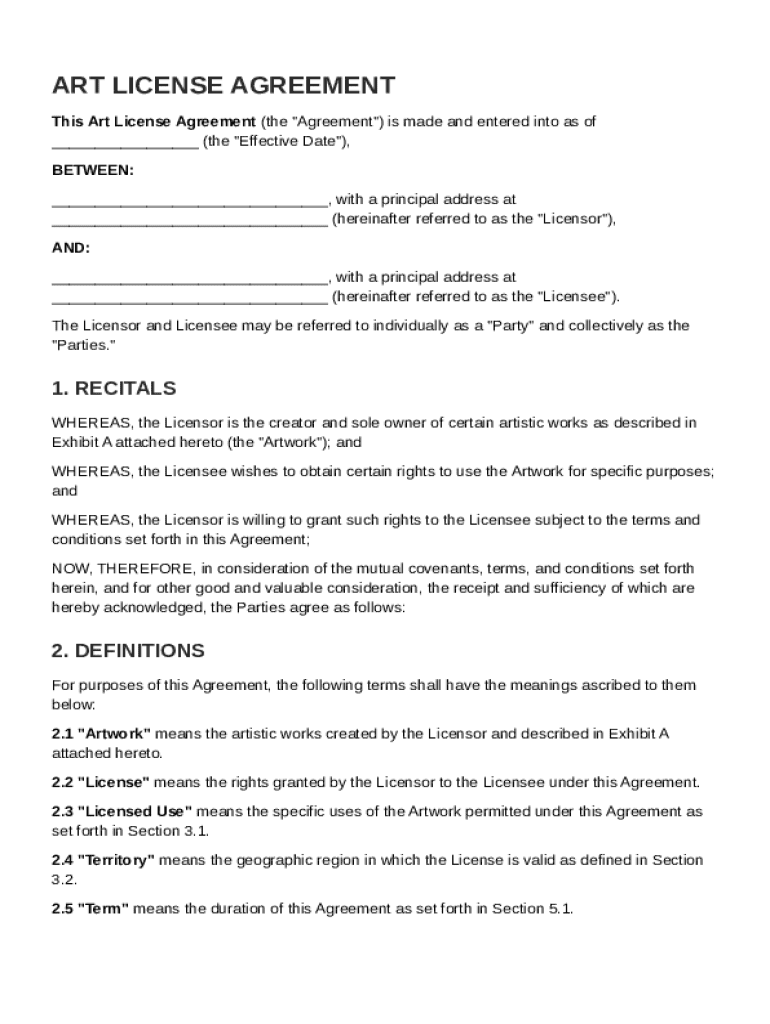
The Art License Contract Template is a legal document that outlines the terms and conditions under which the owner of an artistic work, the licensor, grants permission to another party, the licensee, to use their art. This template serves as a customizable framework for managing and protecting intellectual property rights. It sets clear expectations for how the artwork can be utilized, whether it be for reproduction, display, or adaptation, and helps prevent misuse or unauthorized exploitation of the artwork. Typical elements of this contract include the scope of the license, financial compensation, duration of the agreement, and responsibilities of each party.
Key Parties Involved
- Licensor: The original creator or rights holder of the artwork.
- Licensee: The individual or organization seeking permission to use the artwork under specified conditions.
Typical Scenarios for Use
- Publishing houses acquiring rights to use illustrations in books.
- Companies licensing art for product design or marketing.
- Galleries seeking to display artworks temporarily.
Key Elements of the Art License Contract Template
Licensor and Licensee Details
Both parties must be clearly identified, including legal names and contact information. This section ensures accountability and sets the foundation for clear communication throughout the license period.
Grant of License
This element specifies the extent of the rights being conveyed to the licensee. It details the type of license granted—exclusive or non-exclusive—and whether it permits reproduction, distribution, public display, or creation of derivative works. A well-defined grant clause eliminates ambiguity and prevents potential disputes over rights usage.
Compensation and Payment Terms
The contract outlines how the licensee will compensate the licensor. This may include a one-time payment, royalties, or a mix of both. Payment terms such as deadlines, acceptable methods, and conditions for issuing invoices are also included to provide structure and clarity.
Important Terms Related to the Art License Contract Template
Intellectual Property Rights
The contract includes details on how intellectual property rights are maintained and enforced. It assures the licensor that their creation remains protected under laws such as the U.S. Copyright Act and sets the terms for how these rights can be licensed out.
Indemnification Clauses
Indemnification clauses require the licensee to assume responsibility for legal claims that arise from the use of the artwork. Such clauses protect the licensor from legal liabilities stemming from unauthorized use or copyright infringement by the licensee.
Termination and Renewal
Contracts specify conditions under which the agreement can be terminated before the end of its term, such as breach of contract or mutual consent. Renewal terms are also included to outline how the agreement can be extended, usually requiring a written notice within a specified period.
Steps to Complete the Art License Contract Template
- Gather Necessary Parties: Ensure both parties are available to negotiate and agree upon terms.
- Detail Artwork: Precisely describe the artwork being licensed, including title, medium, dimensions, and any other identifiers.
- Define License Scope: Clearly articulate the rights being granted and any usage limitations.
- Agree on Compensation: Negotiate and document the financial terms and payment structure.
- Draft Additional Clauses: Include any specific clauses necessary for the particular agreement, such as geographic limitations.
- Review Legal Terms: Both parties should review for understanding and make necessary adjustments.
- Sign and Execute: Both parties sign the document, officially putting the contract into effect.
State-Specific Rules for the Art License Contract Template
Laws governing art licensing can vary between states, particularly regarding contract enforcement and intellectual property rights. Some states may require specific formalities for contracts to be recognized, such as notarization or the inclusion of certain clauses.
Variations by State
- California: Emphasizes additional protections for the moral rights of artists, especially in visual art.
- New York: Encourages detailed disclosures in commission agreements to safeguard artists' rights.
Legal Use of the Art License Contract Template
The legal enforceability of the Art License Contract Template is grounded in contract law principles and intellectual property regulations. The template must comply with laws like the Digital Millennium Copyright Act and the Visual Artists Rights Act to ensure protection and legitimate use of the artistic work.
Compliance Considerations
- Ensure all clauses comply with federal and state copyright laws.
- Include dispute resolution methods, such as arbitration, to handle conflicts amicably.
Examples of Using the Art License Contract Template
Example 1: Publishing Industry
A publishing house acquires a license to use illustrations in a new book series, with terms covering reproduction rights and royalties based on book sales.
Example 2: Corporate Marketing
A corporation licenses artwork for use in a high-profile advertising campaign to give their product a unique and artistic touch. The license is non-exclusive and time-limited to align with the campaign duration.
Example 3: Art Galleries
A gallery licenses a set of artworks to be displayed over a two-month exhibition, agreeing to conditions regarding the display environment and security measures.
State-By-State Differences
While the Art License Contract Template serves as a standardized starting point, adaptations may be necessary to address variations in state laws that could impact how the contract is executed or enforced.
Key Considerations
- Adapt the template to accommodate state-specific legislation that influences copyright enforcement.
- Consult a local legal expert to ensure that all regional legal requirements are met within the contract.