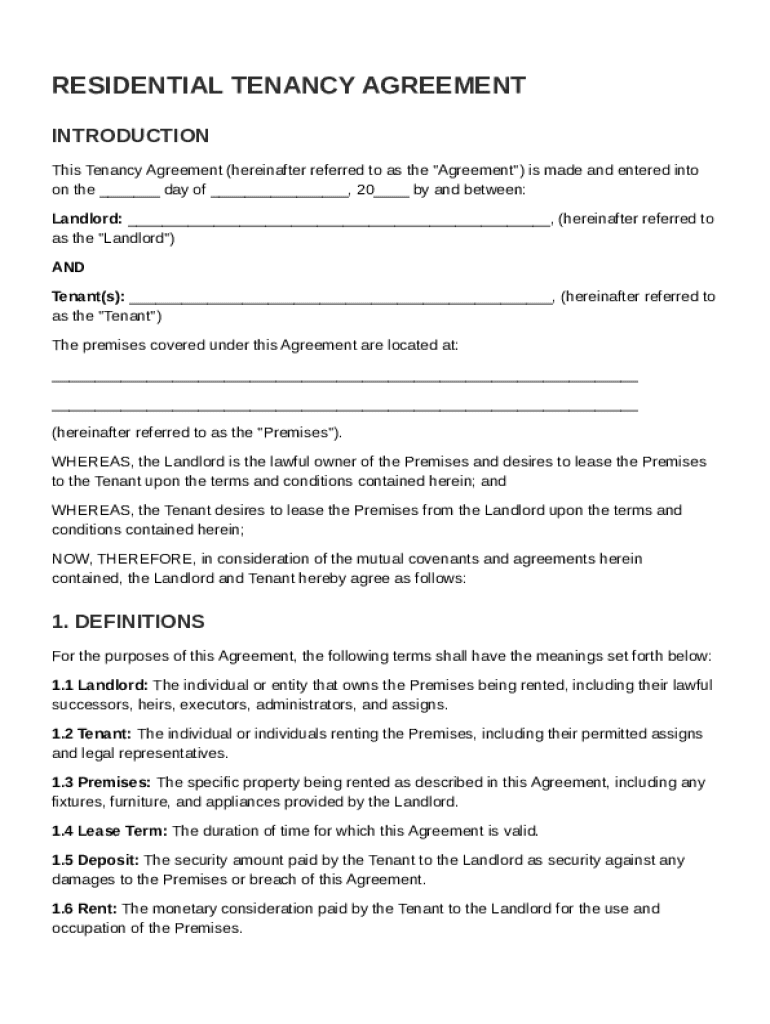







Definition & Meaning
A "Tenancy Agreement Template" is a pre-formatted document that outlines the terms and conditions under which a landlord leases a residential property to a tenant. It serves as a legally binding contract that establishes clear expectations and legal protections for both parties involved in the rental arrangement. This template provides a structured format that includes essential elements such as property details, lease duration, rent payment obligations, and tenant and landlord responsibilities. Using a template helps ensure that all necessary legal clauses are covered, reducing the potential for disputes.
Key Elements of the Tenancy Agreement Template
The core components of a tenancy agreement template encompass several crucial factors:
- Property Details: Includes the full address and description of the rental property.
- Lease Duration: Specifies the start and end dates of the lease agreement and any renewal options.
- Rent Payment Obligations: Outlines the amount of rent, payment due dates, and acceptable payment methods.
- Security Deposit Requirements: Details the amount of the security deposit, conditions for its return, and allowable deductions.
- Maintenance Responsibilities: Divides maintenance duties between landlord and tenant, clarifying expectations for repairs and upkeep.
- Utility Payments: Assigns responsibility for payment of utilities and other property expenses.
- Permitted Uses of the Property: Defines how the tenant can use the premises and any restrictions on conducting business or making alterations.
- Termination Procedures: Establishes the terms for terminating the lease, including notice periods and grounds for eviction.
- Governing Law and Miscellaneous Provisions: Cites the applicable state laws and includes any additional clauses relevant to the specific rental arrangement.
How to Use the Tenancy Agreement Template
The tenancy agreement template is designed for ease of use, simplifying the process of creating a tailored lease agreement:
- Download the Template: Obtain the template from a reliable source like DocHub, which ensures it includes all necessary legal provisions.
- Customize the Template: Fill in the specific details pertinent to your rental agreement, including personal details, property description, rent amounts, and terms.
- Review with Legal Counsel: Although templates are comprehensive, it's wise to consult with an attorney to confirm compliance with local laws.
- Sign and Date: Once reviewed, both parties should sign and date the agreement to make it legally binding.
- Distribute Copies: Provide copies to all stakeholders involved, ensuring each party has a complete, signed version for their records.
Legal Use of the Tenancy Agreement Template
In the United States, tenancy agreements are subject to federal and state regulations, which govern their enforceability and scope. A template should incorporate all standard legal requirements, including fair housing regulations, security deposit laws, and tenant rights. However, landlords should be aware of state-specific variations and ensure the agreement adheres to local legislation to avoid potential legal challenges.
- Federal Standards: Must comply with the Fair Housing Act and the Uniform Residential Landlord and Tenant Act (URLTA).
- State-Specific Regulations: Each state may have unique laws, such as limits on security deposits or required disclosures.
State-Specific Rules for the Tenancy Agreement Template
Tenancy laws can vary greatly by state, affecting how agreements are structured:
- California: Cap on security deposits to two months’ rent for unfurnished properties.
- New York: Requires landlords to provide a rent receipt if paid in cash.
- Texas: Allows for specific clauses regarding the repair of air conditioning systems during hot weather.
Important Terms Related to Tenancy Agreement Template
Understanding key terms in a tenancy agreement is crucial for both landlords and tenants:
- Lessee: The tenant who rents the property under the lease.
- Lessor: The landlord who owns the property and leases it to the tenant.
- Habitability: The requirement that the rental property meets basic living standards.
- Eminent Domain: Clause detailing potential government acquisition of the leased property.
- Subletting: The act of the tenant assigning some or all of the leased property to another party.
Steps to Complete the Tenancy Agreement Template
Completing a tenancy agreement template involves the following methodical steps:
- Gather Information: Collect all personal and property details and any necessary legal information.
- Fill Out the Template: Insert information into designated sections of the template.
- Frequent Review: Regularly review each section to ensure accuracy and completeness.
- Legal Verification: Check with legal counsel that all sections comply with local law.
Examples of Using the Tenancy Agreement Template
Several scenarios can illustrate the effectiveness of using a tenancy agreement template:
- New Tenants: A young couple moving from out of state uses the template to understand lease terms clearly.
- Short-Term Leasing: A landlord provides a template to a tenant for a six-month lease, which includes early termination clauses.
- Commercial Adaptation: The template is adapted for use in a residential property with additional clauses for a home business operation.