
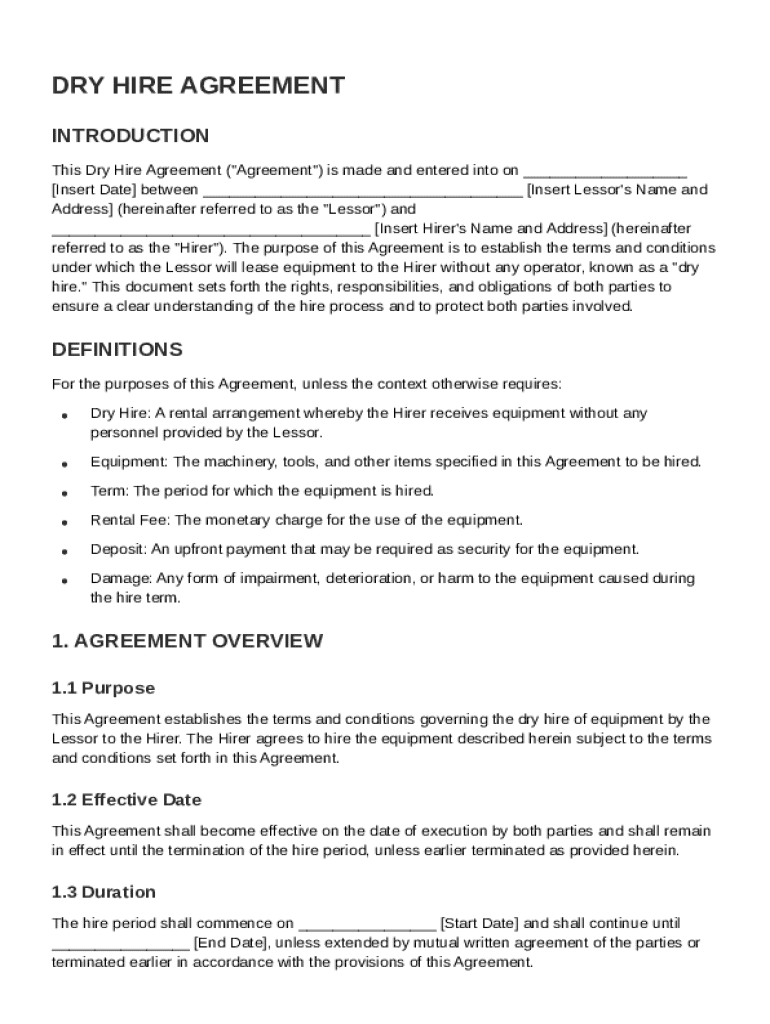







Definition and Meaning
The Dry Hire Agreement Template is a standardized legal document that outlines the terms under which equipment is leased without the inclusion of an operator. This agreement governs the relationship between the lessor, who owns the equipment, and the hirer, who rents it for a specified duration. Central to this agreement are components such as rental fees, payment schedules, use responsibilities, maintenance obligations, and liability for damages. It also includes provisions that address termination, insurance requirements, and the jurisdiction governing the agreement. This document is essential for businesses engaging in short-term equipment rental, allowing clear understanding and enforcement of rights and responsibilities for both parties involved.
Key Components of a Dry Hire Agreement
- Rental Fees and Payment Schedules: Define the cost of rental and the timeline for payments, ensuring clarity in financial obligations.
- Equipment Use and Maintenance: Specify how the equipment is to be used and maintained, including who bears responsibility for routine upkeep and repairs.
- Liability for Damages: Outline the responsibilities of each party in the event of equipment damage, including procedures for reporting and rectifying such events.
Steps to Complete the Dry Hire Agreement Template
Completing a Dry Hire Agreement Template involves several key steps to ensure that both parties' interests are protected and that the agreement holds up legally. Here's how to navigate this process:
- Review the Template: Thoroughly read the template to understand each section and its implications.
- Customize Terms: Adjust the agreement’s terms to suit the specific needs of both parties, such as rental period and specific equipment details.
- Fill in Details: Enter relevant information such as the names of the lessor and hirer, description of the equipment, rental period, and financial terms.
- Add Insurance Clauses: Include requirements for liability insurance to protect both parties from unforeseen circumstances.
- Sign and Date: Both parties should sign and date the agreement to make it legally binding.
- Retain Copies: Ensure both the lessor and hirer retain a copy for their records.
Important Points to Consider
- Insurance Requirements: Verify that sufficient insurance coverage is in place, suitable for the specific equipment hired.
- Legal Review: It may be wise to have the document reviewed by a legal professional to ensure compliance with local laws.
Key Elements of the Dry Hire Agreement Template
Understanding the essential elements of a Dry Hire Agreement ensures all necessary details are covered for legal compliance and clarity for both parties. The key elements typically include:
- Identification of Parties: Details of the lessor and the hirer, clearly stating who is involved in the contract.
- Term and Termination Conditions: Length of the lease and the conditions under which it can be terminated.
- Responsibilities: Definitions of each party's responsibilities regarding equipment use and maintenance.
- Payment and Fees: Detailed description of payment structure, including any security deposits.
- Indemnification Clause: Protects the lessor against liabilities incurred during the hire period.
Additional Terms
- Confidentiality: Any confidentiality agreements that might apply to the transaction.
- Force Majeure: Provisions in case of unavoidable delays or events outside the control of the parties.
Legal Use of the Dry Hire Agreement Template
The legal usage of the Dry Hire Agreement Template ensures compliance with regional and national laws, providing protection for lessors and hirers across jurisdictions.
Legal Essentials
- Governing Law: The document should specify the legal jurisdiction that will oversee any disputes.
- Binding Effect: Establishes that the agreement is enforceable and binds both parties to its terms.
- Amendment Procedures: Outlines how any future amendments to the agreement will be handled.
Real-World Application
- Dispute Resolution: Provisions for mediation or arbitration as preferred methods for resolving disputes, avoiding lengthy litigation.
- Insurance Compliance: Ensuring all parties adhere to necessary insurance requirements as stipulations for enforcement.
State-Specific Rules for the Dry Hire Agreement Template
The inclusion of state-specific rules in the Dry Hire Agreement is critical for adherence to local laws and regulations. Variances by state can affect several components of the agreement.
Key State Variations
- Tax Requirements: Some states may have specific tax implications for rental transactions, which need to be addressed.
- Warranty of Fitness: Variances in laws concerning the fitness and suitability of equipment for hire.
- Lien Laws: Differences in how security interests in the hired equipment might be enforced.
Compliance Tips
- Local Legal Advice: Consult with a local attorney for guidance on any specific state regulations that impact the agreement.
- State-Specific Language: Include appropriate language in the agreement that is compliant with the legal standards of the state.
Important Terms Related to Dry Hire Agreement Template
Certain terminology is foundational to understanding and drafting the Dry Hire Agreement, ensuring clarity for both lessor and hirer.
Core Terms
- Lessee and Lessor: Lessee refers to the hirer, while the lessor is the owner of the equipment.
- Indemnification: A clause that specifies one party will reimburse the other for certain costs.
- Default: Circumstances under which the agreement can be breached and consequences thereof.
Nuances and Definitions
- Hold Harmless: An agreement by one party not to hold the other party liable for risk or damages.
- Sublease Rights: If applicable, defines whether the lessee has the right to sublet the equipment.
Versions or Alternatives to the Dry Hire Agreement Template
Given the varied nature of equipment and industries involved, there are several alternative versions or adaptations of the Dry Hire Agreement to consider.
Alternative Templates
- Industry-Specific Agreements: Tailored versions designed for specific sectors such as construction, events, or agriculture.
- Short vs. Long-Term Hire: Agreements that vary based on the rental duration.
- Multi-Party Agreements: For scenarios involving multiple lessors or hirers with shared equipment use.
Enhancements for Versatility
- Modular Templates: Templates that allow easy addition of specific clauses pertinent to different equipment types.
- Digital Agreements: Tools for electronic completion and signing, enabling faster and paperless processes.
Understanding these aspects allows businesses and individuals to effectively use the Dry Hire Agreement Template tailored to their specific needs and legal requisite.


