






Definition & Meaning
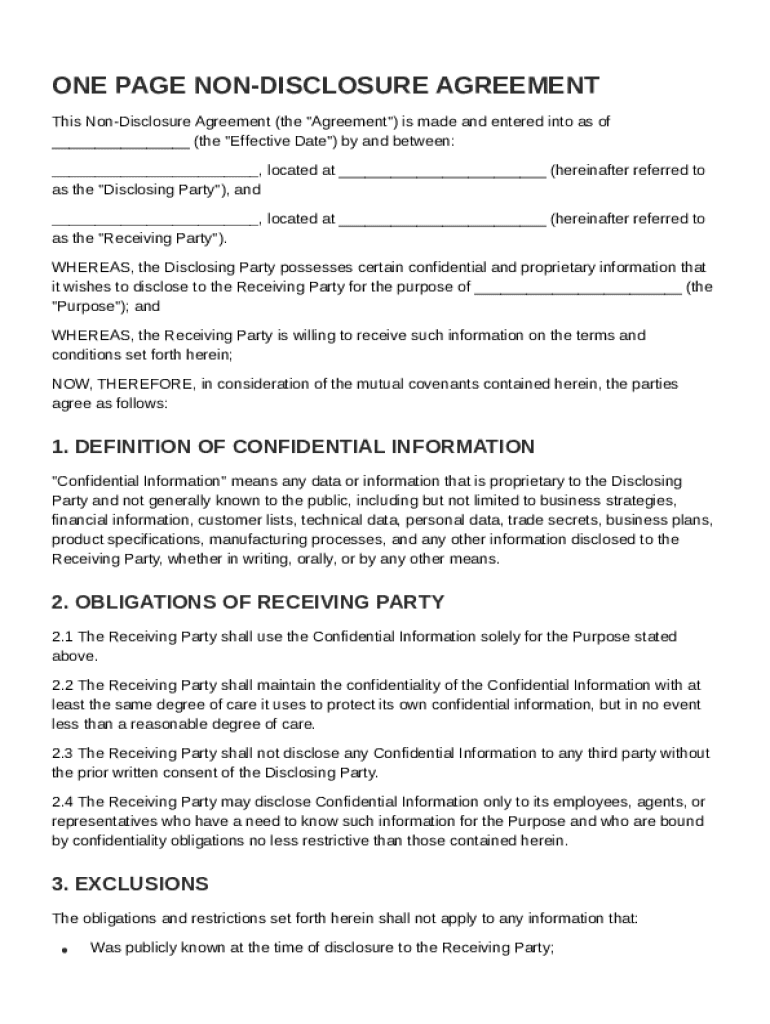
The One Page Non Disclosure Agreement Template serves as a legal contract between two parties: the Disclosing Party and the Receiving Party. It establishes the terms for sharing confidential information, ensuring that sensitive data is protected. The agreement defines what is considered 'Confidential Information' and outlines the Receiving Party's obligations to maintain the confidentiality of such information. Additionally, the agreement specifies exclusions where the information is not considered confidential, such as data already in the public domain. A key aspect is the duration of the confidentiality obligations, which dictates how long the Receiving Party must keep the information confidential.
Key Elements of the One Page Non Disclosure Agreement Template
The template consists of several critical components that form the foundation of the agreement:
-
Parties Involved: Identifies the Disclosing Party, who shares the information, and the Receiving Party, who is obligated to protect it.
-
Confidential Information: Provides a detailed description of what constitutes confidential information.
-
Obligations: Outlines the responsibilities of the Receiving Party to maintain the confidentiality and prevent unauthorized disclosure.
-
Exclusions: Lists circumstances under which the information is not protected, such as it being publicly known or independently developed by the Receiving Party.
-
Duration: Specifies the time frame during which confidentiality must be maintained.
-
Intellectual Property Rights: States that sharing information does not transfer any intellectual property rights.
Steps to Complete the One Page Non Disclosure Agreement Template
Filling out the template involves several straightforward steps to ensure that all necessary elements are addressed:
-
Identifying Parties: Clearly name the Disclosing and Receiving Parties.
-
Defining Confidential Information: Explicitly state what information is considered confidential.
-
Setting Obligations: Detail the obligations of the Receiving Party, focusing on how the information will be protected.
-
Outlining Exclusions: Specify any exclusions that apply to the confidentiality obligations.
-
Determining Duration: Agree on the time period for which the information must remain confidential.
-
Signing the Agreement: Both parties must sign the document to make it legally binding.
Legal Use of the One Page Non Disclosure Agreement Template
The legal enforceability of the template ensures that confidential information shared between parties remains protected. Under the ESIGN Act, electronic signatures on the document are recognized as legally binding. This enables businesses and individuals to confidently share sensitive information, knowing that legal remedies are available in case of a breach. Additionally, the agreement is governed by the laws of the specified state, which may impact its interpretation and enforceability.
Who Typically Uses the One Page Non Disclosure Agreement Template
The template is commonly used across a broad spectrum of sectors, not limited to specific industries. Typical users include:
-
Businesses: Companies involved in partnerships, mergers, or collaborations often use NDAs to protect proprietary information.
-
Entrepreneurs and Startups: Innovators share business plans or ideas with potential investors or partners under a confidentiality agreement.
-
Individuals: Freelancers and consultants who need to protect client information or intellectual property during projects.


Why Use a One Page Non Disclosure Agreement Template
There are several compelling reasons for using this streamlined template:
-
Simplicity: The concise, one-page format covers essential terms without unnecessary complexity.
-
Efficiency: It saves time while ensuring that both parties understand and agree to the confidentiality terms quickly.
-
Ease of Use: Particularly useful for situations requiring a quick turnaround without sacrificing legal protection.
Important Terms Related to One Page Non Disclosure Agreement Template
Understanding specific terms within the agreement is crucial:
-
Disclosing Party: The entity sharing the confidential information.
-
Receiving Party: The entity that receives and is responsible for protecting the information.
-
No Disclosure Obligation: Indicates that the Receiving Party has no obligation to protect information not specified as confidential.
-
Return of Materials: Refers to the requirement for the Receiving Party to return or destroy confidential documents upon termination of the agreement.
-
Governing Law: Specifies the jurisdiction’s laws that will apply to the agreement.
Examples of Using the One Page Non Disclosure Agreement Template
There are various scenarios that demonstrate the practical use of the NDA template:
-
Business Negotiations: Companies often use NDAs during talks about mergers to prevent leaks of strategic plans.
-
Research and Development: Protects sensitive research findings shared with external partners for commercialization.
-
Collaboration with Freelancers: Ensures that freelancers maintain confidentiality about proprietary designs or strategies shared for project execution.