






Definition and Meaning
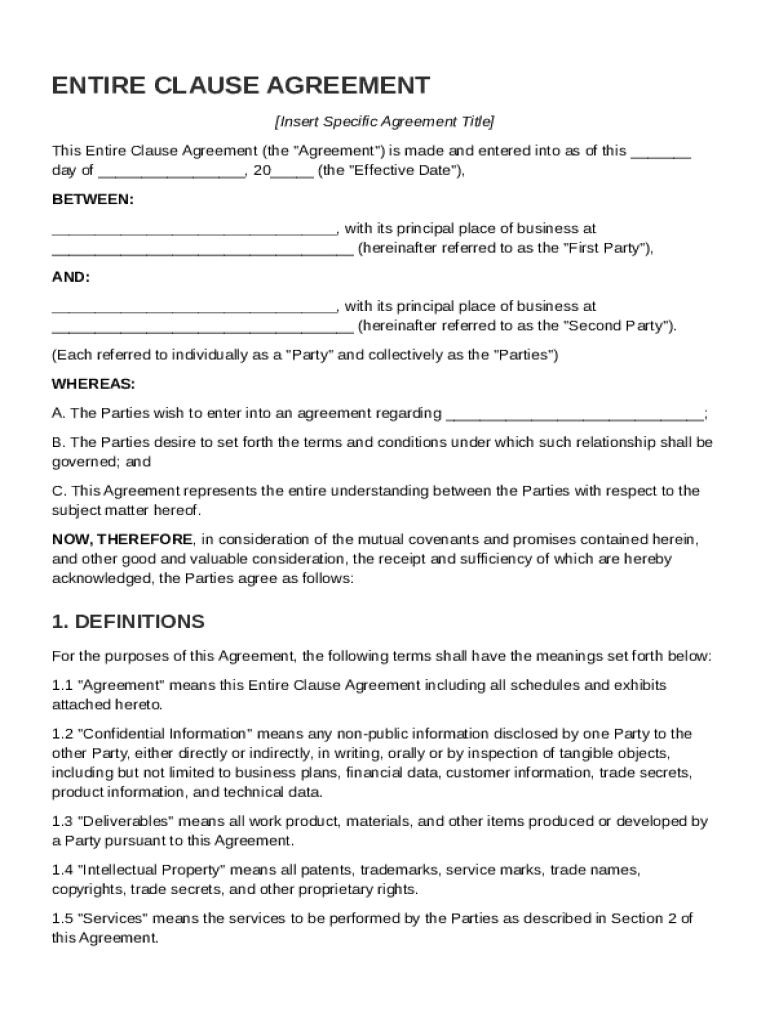
An Entire Clause Agreement Template is a legal document designed to comprehensively outline the terms and conditions between two parties regarding a specific agreement. This template serves as a structured framework, ensuring that all relevant aspects of the agreement, such as definitions, scope of work, payment terms, and confidentiality obligations, are clearly stated. By using this template, both parties can avoid misunderstandings and safeguard their interests.
Key Components of the Template
- Definitions: Precise terms are defined to avoid ambiguity.
- Scope of Work: Detailed descriptions of obligations and deliverables.
- Payment Terms: Specifies amounts, schedules, and methods.
- Confidentiality Obligations: Keeps sensitive information protected.
- Intellectual Property Rights: Clarifies ownership and usage rights.
- Duration and Termination: Specifies the contract’s timeframe and termination conditions.
- Liability and Indemnification: Outlines responsibilities and protections.
- Dispute Resolution: Provides a process for resolving disagreements.
- Governing Law: Specifies the applicable legal framework.
- Miscellaneous Provisions: Includes any additional agreements.
How to Use the Entire Clause Agreement Template
Using the Entire Clause Agreement Template involves several steps to tailor it to your specific needs. This template is ideal for parties entering into formal agreements, providing a reliable structure to capture all significant elements.
- Review the Template: Familiarize yourself with the sections and ensure you understand each component.
- Customize Definitions: Edit the definitions to match the specific terminology relevant to your agreement.
- Specify Roles and Responsibilities: Clearly define what each party is responsible for and any deliverables involved.
- Detail Payment Terms: Include payment schedules, amounts, and acceptable methods.
- Adjust Confidentiality and IP Clauses: Protect sensitive information and define intellectual property rights.
- Finalize Term and Termination Conditions: Determine the duration of the agreement and conditions for termination.
- Include Dispute Resolution Methods: Decide on mediation, arbitration, or litigation options.
- Review and Finalize: Seek legal advice if necessary, then finalize and sign the agreement.
Real-World Example
A tech company and a freelance software developer may use this template to outline their project agreement. The company would use the template to clearly define the project's scope, the developer’s responsibilities, payment schedules, and confidentiality obligations regarding the company’s proprietary software.
Key Elements of the Entire Clause Agreement Template
Understanding the critical elements of the Entire Clause Agreement Template is essential for ensuring that it serves its purpose effectively. These elements collectively form the backbone of a well-defined agreement.
Detailed Examination of Key Elements
- Definitions: Providing clarity, these include terms that may require specific legal or contextual understanding.
- Scope of Work: Details on what is expected from both parties, including timelines and deliverables.
- Payment Terms: Clear articulation of financial arrangements, which helps prevent disputes.
- Confidentiality: Protects sensitive information shared during and after the agreement.
- Intellectual Property: Clarification on the ownership of creations and inventions.
- Duration and Termination: Establishes the start and end of the agreement and conditions that could lead to early termination.
- Liability: Outlines liabilities in the case of breach or other issues, protecting both parties.
- Governing Law: Ensures that the agreement is enforceable under specified legal jurisdiction.
Steps to Complete the Entire Clause Agreement Template
Completing the Entire Clause Agreement Template involves careful customization and review to ensure it accurately captures the agreed terms of the involved parties.
Step-by-Step Guide
- Gather Necessary Information: Obtain all details about the parties involved and the nature of the agreement.
- Customize Template Sections: Fill out each section with the specific details pertinent to your agreement.
- Review Legal Terminology: Ensure understanding of legal terms or consult a lawyer if necessary.
- Ensure Mutual Agreement on Terms: Both parties should be involved in the review process to ensure clarity and mutual consent.
- Conduct Final Review: Check every section for completeness and accuracy.
- Sign and Store Safely: Both parties should sign the document, and copies should be securely stored.
Considerations
When completing the form, consider state-specific legal requirements that may impact clauses such as governing law and dispute resolution methods.
State-Specific Differences
State laws can impact several aspects of the Entire Clause Agreement Template, from governing law clauses to liability limits. Tailoring the template to align with relevant state-specific rules is crucial for legality and enforceability.
Examples of State-Specific Rules
- Governing Law Clauses: Some states have distinct laws that must be acknowledged in contracts affecting how disputes are resolved.
- Limits on Liability: State laws may differ in terms of liability caps and indemnification rules.
- Confidentiality Agreements: Vary in stringency and enforcement based on state.
Tailoring the Template
- Research state laws related to contracts to ensure compliance.
- Adapt the governing law section to reference specific state statutes.
- Consult with a legal professional for state-specific legal compliance.
Why Use the Entire Clause Agreement Template
The Entire Clause Agreement Template provides a structured approach to formalizing an agreement between parties, particularly beneficial for businesses and freelancers.
Benefits
- Comprehensive Framework: Ensures all relevant aspects of the agreement are covered.
- Risk Mitigation: Clearly defined terms help mitigate legal disputes.
- Time Efficiency: Using a template saves time compared to drafting a contract from scratch.
- Flexibility: The template is adaptable to suit various business arrangements.
Practical Applications
Businesses engaging with freelancers, vendors, or partners often use this template to establish a clear understanding and a legally binding agreement, reducing the risk of future disagreements.
Legal Use of the Entire Clause Agreement Template
Legal enforceability and protection are primary reasons to utilize the Entire Clause Agreement Template. This document ensures that both parties have a clear understanding of their rights and obligations under applicable law.
Legal Considerations
- Enforceability: Ensures the agreement complies with state and federal laws, making it legally binding.
- Protection: Safeguards both parties by explicitly detailing legal liabilities and responsibilities.
- Addressing Disputes: Includes dispute resolution processes aligned with legal standards.
Tips for Legal Compliance
- Consult legal experts to address complex agreement scenarios.
- Regularly update the template to reflect current legal standards and practices.
- Ensure clarity and simplicity in language to avoid misinterpretation.
Examples of Using the Entire Clause Agreement Template
Different industries and scenarios can benefit from using the Entire Clause Agreement Template. It is versatile and can be adapted to various business and legal needs.
Industry-Specific Examples
- Technology: Software companies use the template to legally bind agreements with developers or vendors, specifying IP rights and project scope.
- Manufacturing: Manufacturers may use it to detail agreements with suppliers, covering payment terms and delivery obligations.
- Creative Industries: Artists and designers utilize it to define client work parameters, including deliverables and payment schedules.
Case Scenarios
- A startup and a graphic designer outline their project terms, ensuring payment schedules and IP ownership are clearly defined.
- A law firm engages a freelance writer, using the template to specify the writer’s services, payment, and confidentiality obligations.
Utilizing the template can prevent misunderstandings and secure legally enforceable agreements, providing peace of mind to all involved.