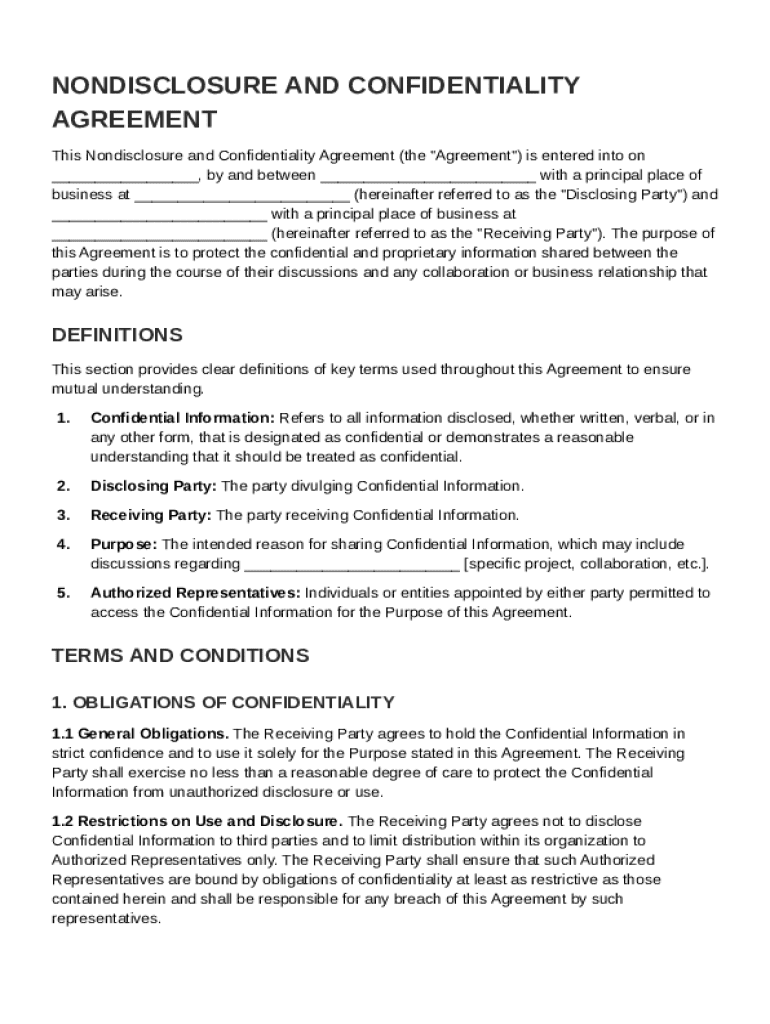







Definition & Meaning
A Nondisclosure and Confidentiality Agreement (NDA) is a legally binding contract establishing a confidential relationship between a Disclosing Party and a Receiving Party. The primary purpose of this agreement is to protect confidential and proprietary information shared during business discussions. The content of the agreement includes definitions of key terms to ensure both parties have a shared understanding of what constitutes confidential information. It is essential for safeguarding sensitive information that might be critical to a party's operations, strategy, or competitiveness.
Key Elements of the Nondisclosure Confidentiality Agreement Template
The agreement comprises several crucial components designed to ensure comprehensive protection of confidential information. These elements typically include:
- Definitions: Specifies what constitutes confidential information.
- Obligations of Confidentiality: Outlines the responsibilities of the Receiving Party to keep the information confidential.
- Exclusions: Identifies information that is not considered confidential, such as publicly available information or data obtained independently.
- Duration: Sets the time period during which confidentiality must be maintained.
- Return or Destruction of Information: Details procedures for handling confidential information after termination of the agreement.
- Legal Provisions: Includes indemnification clauses and governing law to handle any breaches and disputes.
How to Use the Nondisclosure Confidentiality Agreement Template
Using the template involves a series of steps that ensures all parties understand their roles and obligations.
- Review and Customize: Examine the template to ensure it aligns with your specific needs. Customize sections such as definitions, obligations, and exclusions as required by your business context.
- Fill In Details: Input the necessary personal or business information for both the Disclosing and Receiving Parties.
- Check Legal Compliance: Consult a legal professional to verify that the customized agreement complies with relevant laws.
- Execute the Agreement: Ensure both parties sign the agreement. This can be done electronically using platforms like DocHub for convenience and legality.
Steps to Complete the Nondisclosure Confidentiality Agreement Template
Completing the NDA requires careful attention to detail to avoid any ambiguity or legal loopholes.
- Input Parties' Information: Start by writing the full legal names of both Disclosing and Receiving Parties.
- Define Confidential Information: Clearly outline what information is considered confidential.
- Specify Disclosure Purpose: Describe why the information is being disclosed.
- Set the Duration: Determine how long the confidentiality obligations will last.
- Include Legal Jurisdiction: Specify the governing law and legal jurisdiction for any disputes.
- Signature Section: Ensure there is space for signatures and date of agreement execution.
Who Typically Uses the Nondisclosure Confidentiality Agreement Template
The NDA is commonly used by businesses and individuals engaging in activities involving sensitive information.
- Startups: To protect their innovative ideas during discussions with potential investors or partners.
- Corporations: For securing proprietary business information during mergers and acquisitions.
- Freelancers and Consultants: When dealing with client-sensitive information.
- Research and Development Teams: To safeguard new technologies or processes during collaborations.


Legal Use of the Nondisclosure Confidentiality Agreement Template
The NDA serves as a legal shield to protect confidential data and can be enforced in a court of law if breached. Key legal uses include:
- Preemptive Protection: Serve as a deterrent against data leaks by defining strict legal consequences.
- Evidence of Agreement: Acts as proof of a mutual understanding concerning confidentiality obligations.
- Litigation Tool: Provides a legal foundation for action if confidential information is disclosed unlawfully.
Important Terms Related to Nondisclosure Confidentiality Agreement Template
Having a clear grasp of key terms is crucial for understanding and effectively using an NDA.
- Confidential Information: Specific data or information categorized as secret.
- Disclosing Party: The entity releasing the confidential information.
- Receiving Party: The entity receiving the confidential information.
- Third Party: Any external entity not considered part of the agreement.
Software Compatibility
The Nondisclosure Confidentiality Agreement Template is compatible with various digital tools and can be edited using popular software like DocHub. It's supported across multiple formats including PDF, DOC, and TXT, allowing for easy integration with software like Google Workspace for seamless editing and signing. This ensures users can handle agreements efficiently and securely on desktop or mobile devices, promoting flexible and versatile document management.
Versions or Alternatives to the Nondisclosure Confidentiality Agreement Template
While the NDA template is broadly applicable, variations or alternatives can be used depending on specific needs.
- Mutual Nondisclosure Agreements: Developed when both parties expect to disclose confidential information to each other.
- Unilateral Nondisclosure Agreements: Used when only one party shares confidential information.
- Non-compete Agreements: Combine elements of NDAs to prevent parties from using shared information to compete directly.
These alternatives should be considered based on the type and scope of disclosure, ensuring the agreement is tailored effectively for the intended purpose.