
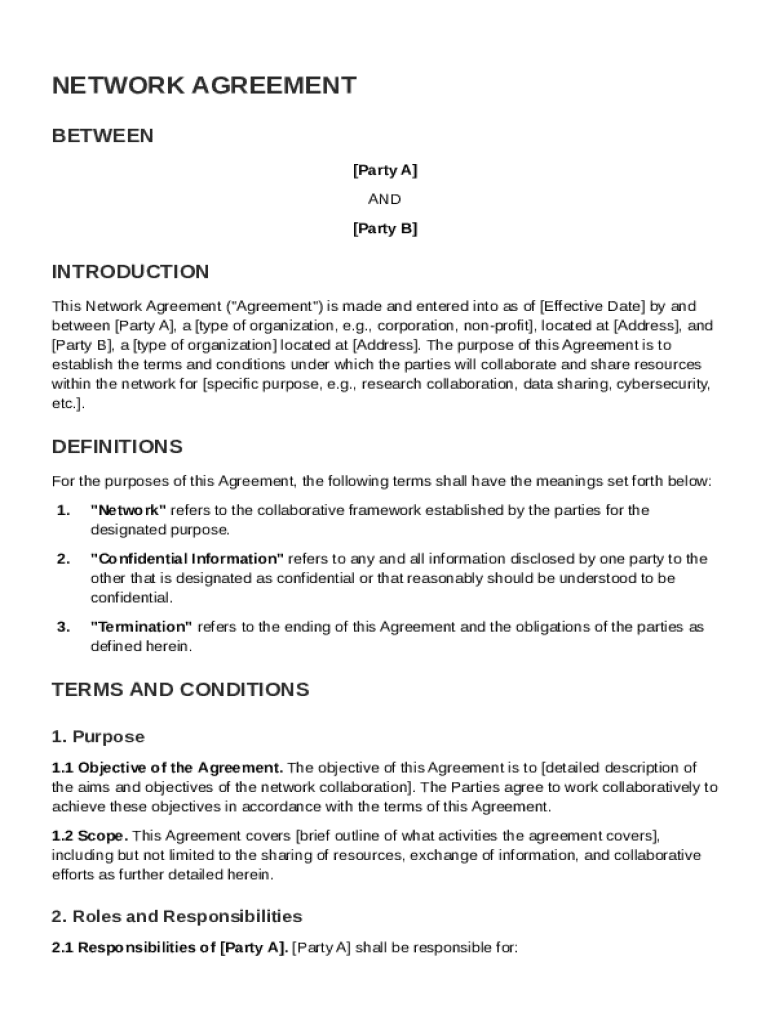







Definition and Purpose of a Network Agreement Template
A Network Agreement Template is a legally-binding document utilized by two or more parties, often organizations or businesses, to outline the terms and conditions for their collaboration and resource sharing. This template serves multiple purposes, such as defining roles and responsibilities, financial contributions, and confidentiality obligations. By providing a structured framework, it ensures clarity and understanding among parties, thus reducing potential disputes. The template is designed to cater to various network agreements, whether for joint ventures, strategic alliances, or collaborative projects. Its enforceability depends on the comprehensive inclusion of all essential clauses relevant to the specific collaboration.
Key Elements in a Network Agreement
Roles and Responsibilities
The template clearly defines the roles and responsibilities of each party involved. This section ensures that every party understands their obligations and contributions towards the network partnership. It is imperative for maintaining accountability and ensuring that the goals of the collaboration are met efficiently. For instance, if one party is responsible for technical infrastructure while another provides marketing expertise, these roles are explicitly detailed.
Financial Contributions and Resource Sharing
Financial commitments and the sharing of resources are critical elements addressed within the template. By detailing each party’s financial responsibilities and the manner of resource distribution, the agreement minimizes ambiguities. Examples include the proportionate sharing of costs associated with joint activities and accessing shared technologies or data. This section often includes specific payment terms, schedules, and consequences for non-compliance.
Confidentiality and Data Protection
Confidentiality clauses in a network agreement protect sensitive information shared between the parties. These provisions ensure that proprietary information, trade secrets, or any critical data are not disclosed without consent. Legally binding obligations related to data protection highlight the importance of safeguarding information, especially when third-party interactions or external collaborations are necessary. This section aligns with U.S. data protection laws and standards, offering guidelines for handling breaches or unauthorized disclosures.
Steps to Complete the Network Agreement Template
- Identify Parties Involved: Clearly list each entity involved, including full legal names and addresses.
- Define Objectives and Scope: Outline the objectives and the scope of the agreement to ensure all parties have a unified understanding of expected outcomes.
- Draft Roles and Responsibilities: Specify clear duties for each party, covering operational and strategic expectations.
- Financial Contributions: Detail the financial commitments from each party, including payment structures and timelines.
- Confidentiality Clauses: Establish rules on the use and sharing of sensitive information.
- Dispute Resolution: Agree on a process for resolving any disagreements, such as mediation or arbitration procedures.
- Termination Conditions: Describe the conditions under which the agreement can be terminated and the process involved.
- Review and Sign: Conduct a thorough review and legal vetting before signing.
Important Terms Related to the Network Agreement Template
- Term: The duration for which the agreement is applicable.
- Confidential Information: Data deemed confidential and protected from unauthorized disclosure.
- Breach: Failure to fulfill any obligation under the agreement.
- Termination: Conditions under which the agreement may be ended prior to its term.
- Indemnity: Assurance that damages or losses will be compensated by the responsible party.
Who Typically Uses a Network Agreement Template
Network agreement templates are frequently utilized by various types of organizations and entities. Businesses entering strategic alliances, tech companies collaborating on software development, and universities engaging in joint research projects are typical users. The document is particularly beneficial for industries that require detailed collaboration governance, such as telecommunications, healthcare, and IT consulting. It ensures that all parties have a clear understanding of each other's expectations and legal obligations, fostering a productive partnership.
Legal Use and Compliance Considerations
In the United States, the legal enforceability of a network agreement rests on its alignment with state and federal laws. This includes adherence to contract law principles such as mutual consent, capacity, and consideration. Additionally, confidentiality and data protection clauses must comply with regulations like the Electronic Signatures in Global and National Commerce Act (E-SIGN Act) for electronic agreements. Legal review is recommended to ensure the document’s validity and enforceability, considering variations in state laws that might impact contractual terms.
State-Specific Considerations for Network Agreements
State-specific laws and regulations may influence the formation and enforcement of network agreements. While federal laws provide a common framework, states may have additional requirements regarding partnership disclosures, dispute resolutions, or specific industry regulations. For example, data protection laws in California may impose stricter confidentiality conditions compared to other states. It is essential to gather relevant legal advice to tailor the agreement in compliance with both the local jurisdiction and industry standards.
Real-World Scenarios and Examples
Example 1: Joint Research Project
In academia, two universities may use a network agreement template to collaborate on a research project. The agreement would outline shared resources, funding distribution, data sharing protocols, and publication rights. Confidentiality is crucial in protecting preliminary research findings and intellectual property developed during the collaboration.
Example 2: Technology Partnership
A tech company and a telecom provider might enter into a network agreement to develop a new communication platform. Specific responsibilities, such as software development and infrastructure support, would be detailed in the agreement. Financial arrangements and profit-sharing models are also key components, ensuring transparent financial dealings.
These scenarios highlight the versatility of network agreements across different sectors, emphasizing the importance of clear and comprehensive documentation for successful collaborations.




