






Definition and Meaning
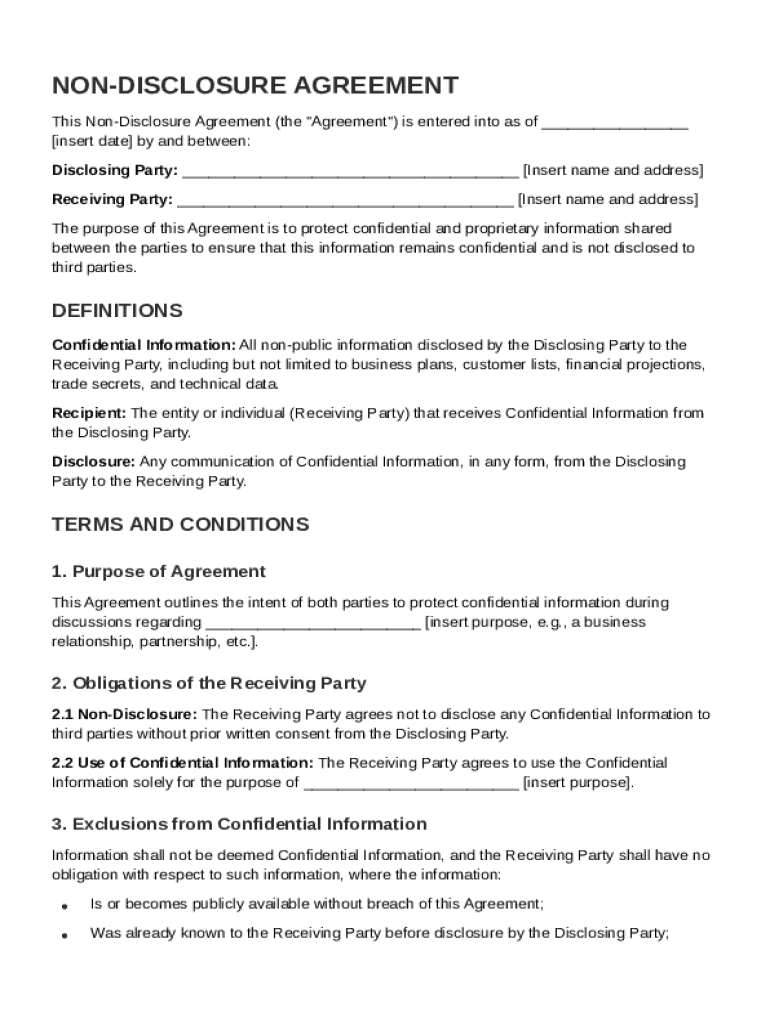
A Draft Non-Disclosure Agreement (NDA) Template is a preliminary legal framework designed to facilitate the protection of confidential and proprietary information shared between parties. This document outlines the rights and responsibilities of both the Disclosing Party, who shares the information, and the Receiving Party, who gains access to it. It is vital in safeguarding sensitive data, preventing misuse, and maintaining competitive advantage. The NDA typically specifies what constitutes 'Confidential Information,' sets obligations for handling this information, and includes provisions for its return or destruction after use.
Key Concepts in the NDA
- Confidential Information: Describes the type of information that must remain undisclosed.
- Disclosing and Receiving Party: Identifies the parties involved in the NDA.
- Term of Confidentiality: Defines how long the information must remain confidential.
- Exclusions: Outlines information that is not considered confidential.
Key Elements of the Draft Non-Disclosure Agreement Template
Draft Non-Disclosure Agreements share common essential elements that ensure effectiveness and enforceability. These elements include:
- Purpose: The reason for sharing confidential information should be clearly outlined.
- Mutual or Unilateral: Indicates whether both parties exchange information or just one party.
- Obligations of the Receiving Party: Details how the receiving party must protect the confidentiality of the information.
- Exclusions from Confidentiality: Information that is publicly known or rightfully obtained without breach should be excluded.
- Legal Jurisdiction: Specifies which laws govern the agreement.
- Consequences of Breach: Describes legal remedies or actions in case of a breach.
How to Use the Draft Non-Disclosure Agreement Template
Using a Draft NDA Template involves customizing the document to fit the specific needs of the parties involved. Here’s a step-by-step guide:
- Identify the Parties: Clearly define the Disclosing and Receiving Parties.
- Outline Confidential Information: Specify what information is considered confidential.
- Set a Purpose: State why the information is being shared.
- Determine the Duration: Establish how long the information should remain confidential.
- List Exclusions: Specify what is not covered under confidentiality.
- Include Legal Terms: Add necessary legal provisions such as jurisdiction.
- Review and Edit: Ensure that the template meets all specific needs and legal requirements.
Important Terms Related to Draft Non-Disclosure Agreement Template
Understanding key terminology is critical for using the NDA effectively. Important terms include:
- Proprietary Information: Unique data or information owned by the Disclosing Party.
- Breach of Contract: Failure to observe the terms of the NDA by any involved party.
- Rescission: The right to cancel the agreement under specific conditions.
- Indemnity: Security against loss or damage, typically a stipulated compensation for breach.
Steps to Complete the Draft Non-Disclosure Agreement Template
Completing a Draft NDA Template requires attention to detail. Here are the general steps:
- Fill in Party Information: Include names, addresses, and roles.
- Specify Confidential Information: Clearly describe the type and scope.
- Define Scope of Use: Explain how the information can be used.
- Agree on Duration: Decide on the time span of the confidentiality.
- Include Terminations Conditions: Outline scenarios where the agreement can be ended.
- Consult Legal Experts: Have the draft reviewed by a legal professional before finalizing.
- Signatures: Ensure both parties sign the NDA to make it binding.
Legal Use of the Draft Non-Disclosure Agreement Template
The Draft NDA serves legal purposes by outlining a structured process to secure confidential exchanges. It provides a legal basis for protecting sensitive information within business dealings, during negotiations, or in employment settings. Legal use of the NDA involves making sure that the terms comply with state laws and federal regulations, which aids in preventing unauthorized disclosure and aiding legal recourse in the event of a violation.
Examples of Using the Draft Non-Disclosure Agreement Template
Organizations employ NDAs in various scenarios, such as:
- Business Partnerships: Before collaborating on joint projects or mergers.
- Employee Onboarding: When new employees access proprietary company systems.
- Vendor Agreements: When outsourcing services that involve sensitive data processing.
- Product Development: During innovation stages where protecting intellectual property is crucial.
Examples illustrate that NDAs are flexible tools for ensuring information protection across numerous business environments.
Versions or Alternatives to the Draft Non-Disclosure Agreement Template
While standard NDAs are widely used, there are variations and alternatives:
- Mutual NDA: Both parties agree to disclose and protect information mutually.
- Unilateral NDA: Only one party provides the information that requires protection.
- Non-Compete Clauses: Supplementary agreements preventing competition with shared information.
- Confidentiality Agreement: Similar to an NDA but can be broader or more general in scope.
These alternatives highlight the adaptable nature of confidentiality agreements to suit different contexts and needs.