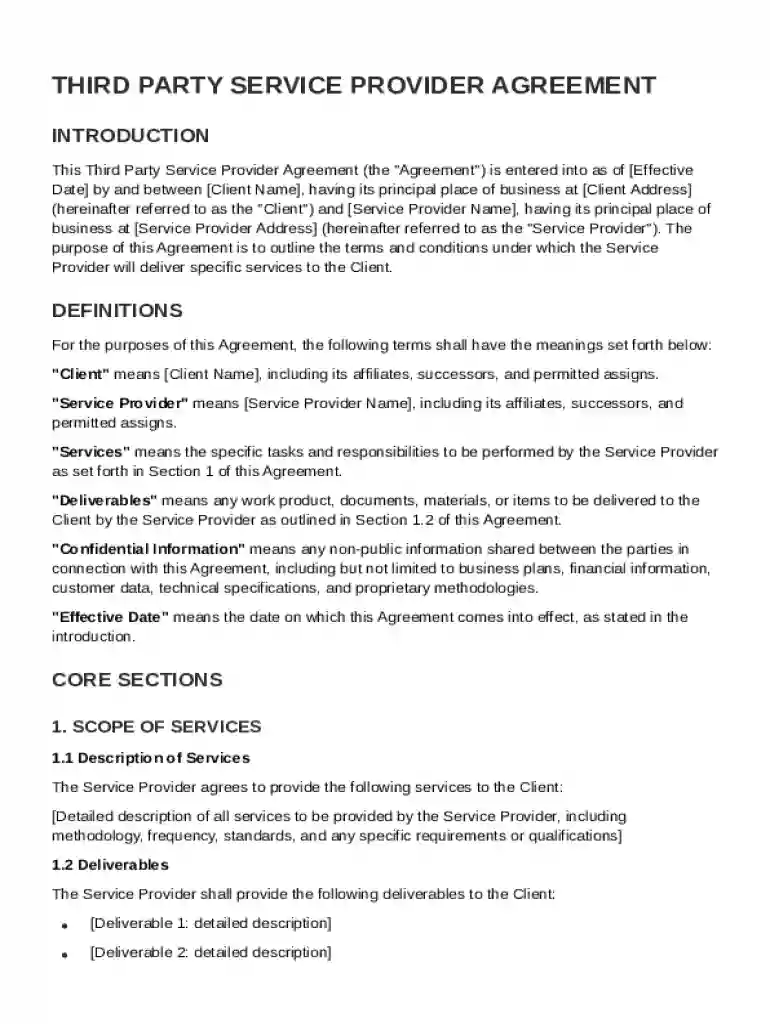
Definition & Purpose of Third Party Service Provider Agreement Template
A Third Party Service Provider Agreement Template is a legally binding document that establishes terms between a service provider and a client for specific services. It defines roles such as independent contractors and includes key terms, scope of services, compensation, confidentiality obligations, and ownership of deliverables. The agreement also outlines indemnification, liability limitations, governing law, and dispute resolution processes.
Key Elements of the Agreement
- Scope of Services: Defines the specific services the provider will deliver, including deliverables or products.
- Compensation Terms: Details payment structure, methods of billing, and timelines for payments.
- Confidentiality: Addresses how sensitive information must be handled and protected by both parties.
- Ownership and Rights: Specifies ownership of deliverables created during the contract term.
- Indemnification and Liability: Limits liability and outlines indemnity obligations of each party to protect against potential losses.
- Legal Compliance: Identifies the governing laws applicable to the agreement and outlines methods for dispute resolution.
Steps to Complete the Third Party Service Provider Agreement Template
Gather Required Information:
- Names and contact details of both parties.
- Detailed description of services offered.
- Any specific client requirements or stipulations.
Define Services and Terms:
- Clearly describe the scope of services to be provided.
- Set terms for compensation, including rates and payment schedules.
Draft and Review Confidentiality Clauses:
- Outline how each party is expected to handle confidential information.
- Include terms related to non-disclosure and breach repercussions.
Establish Ownership Clauses:
- Clarify who owns the rights to the work created and any intellectual property issues.
Address Indemnification & Liability:
- Identify how indemnification will be handled and limit liability where necessary.
Sign the Agreement:
- Obtain signatures from authorized representatives of both parties to execute the agreement.
- Keep a signed copy for records.
Legal Use of the Third Party Service Provider Agreement Template
The agreement must comply with legal standards to ensure validity and enforcement.
- ESIGN Compliant: Ensures electronic signatures meet legal requirements.
- Governing Law: Specifies which jurisdiction's laws apply to the contract.
- Dispute Resolution: Outlines mechanisms like mediation or arbitration for conflicts.
Variants and Alternatives
- Custom Contracts: Tailored agreements for unique business needs.
- Standardized Templates: Used for common services scenarios, available through legal service providers.
Software Compatibility for Agreement Management
Using platforms like DocHub can streamline contract management through:
- Integration with Cloud Services: Such as Google Drive and Dropbox for easy document access.
- Online Signature Capability: Facilitates electronic signatures, making agreements valid and enforceable.
- Security Features: Enhances confidentiality with state-of-the-art encryption and access controls.
Digital vs. Paper Version
- Digital: Easier to manage, with capabilities for tracking changes and gathering electronic signatures.
- Paper: Traditional method, still valid but less efficient than digital due to handling and storage requirements.
Business Types That Benefit Most
These agreements are crucial across multiple industries that rely on service providers:
- Technology Companies: For outsourcing software development projects.
- Healthcare Providers: Engaging services for medical billing.
- Construction Firms: Utilizing independent contractors for various building projects.
- Education Institutions: Contracting third-party services for training or curriculum development.
Important Considerations for Specific States
While a general template is broadly applicable, individual states may have unique contract law nuances.
- State-Specific Clauses: Some jurisdictions may require additional clauses focusing on employment or labor conditions.
- Compliance Requirements: Ensure the agreement complies with local laws on contract enforceability and labor practices.
Key Takeaways
- Comprehensive Coverage: The agreement covers essential areas critical for establishing a clear service relationship.
- Legal Safeguard: Protects both parties through well-defined terms and compliance with applicable laws.
- Flexible Use: Suitable for various industries, tailored to specific needs through templates or customized drafts.
- Streamlined Management: Utilizing online platforms like DocHub enhances efficiency and security in contract handling.