
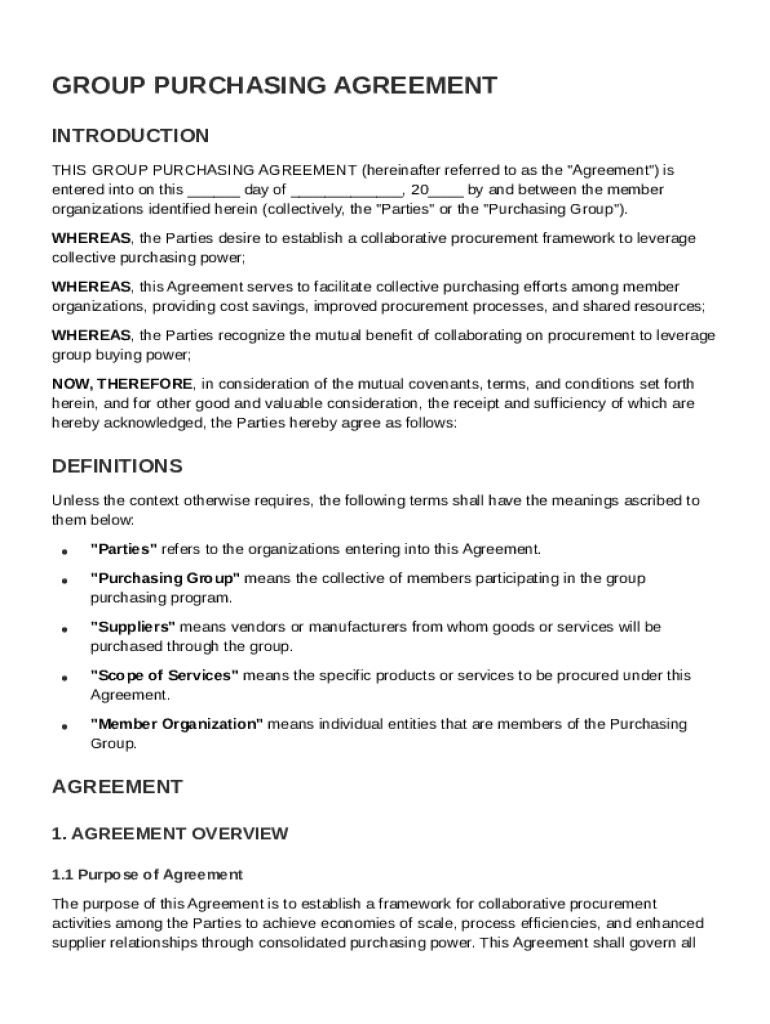







Definition & Meaning
A Group Purchasing Agreement Template is a structured document used to establish a procurement framework where multiple organizations unite to leverage their collective buying power. This document outlines essential components such as the roles and responsibilities of each participant, procurement procedures, pricing structures, and payment terms. By forming a cooperative purchasing consortium, organizations aim to achieve cost savings and enhance procurement efficiency. The template serves as a foundational tool to define the scope of services and products to be procured and includes important sections on confidentiality, compliance, and resolution of disputes.
Practical Applications
To understand its utility, consider how non-profit groups or small businesses use these templates to aggregate demand and negotiate better pricing than they could individually. This common strategy is particularly prevalent in industries such as healthcare, where hospitals might band together to purchase medical supplies.
Key Elements of the Group Purchasing Agreement Template
Each group purchasing agreement is comprised of several critical elements that ensure efficacy and legal compliance:
- Roles and Responsibilities: Details the specific duties of each party involved, ensuring clarity and accountability.
- Procurement Scope: Specifies the range of products or services covered under the agreement.
- Pricing and Payment Terms: Establishes the agreed pricing, discounts, and payment schedules, vital for financial planning.
- Termination Conditions: Outlines the scenarios under which the agreement may be dissolved, protecting stakeholders from unforeseen circumstances.
Example Components
While the template may vary, an effective agreement should include sections detailing confidentiality agreements, indemnification clauses, and data protection responsibilities. For instance, intellectual property secured during the venture must be appropriately managed and protected.
How to Use the Group Purchasing Agreement Template
Using a group purchasing agreement template involves several straightforward steps to customize it for your specific needs:
- Identify Participants: Determine the organizations involved and assess the collective purchasing needs.
- Customize the Template: Adjust the template's terms to accurately reflect your collaborative objectives and procurement requirements.
- Legal Review: It's advised to consult with legal experts to ensure compliance with relevant laws and regulations.
Practical Implementation
An example of implementation includes environmental advocacy groups joining forces to procure sustainable materials for use in public projects. This allows them to gain competitive advantages not only through pricing but also by negotiating terms for ethical sourcing.
Legal Use of the Group Purchasing Agreement Template
Ensuring that a group purchasing agreement is legally binding requires adherence to relevant laws, particularly with regard to contract and procurement regulations. In the U.S., these agreements must comply with the Uniform Commercial Code (UCC) which governs commercial transactions.
Compliance Requirements
- Confidentiality and Data Protection: Obligations to protect proprietary information.
- Dispute Resolution: Clearly defined processes to manage conflicts that may arise.
Who Typically Uses the Group Purchasing Agreement Template
This template is predominantly utilized by organizations that benefit from collective procurement strategies, including:
- Healthcare Institutions: Hospitals and clinics that purchase medical supplies.
- Educational Bodies: Schools and universities acquiring educational materials and services.
- Government Agencies: Municipalities looking to stretch budgetary allocations.


Specific User Scenarios
Small businesses might use the agreement to join purchasing co-ops that allow them to compete with larger corporations through improved purchasing terms.
Business Types That Benefit Most from Group Purchasing Agreement Template
Businesses that experience frequent procurement activities related to their operations are well-suited to use group purchasing agreements. Entities such as hospitals, non-profit organizations, and manufacturing companies can significantly reduce costs through these agreements.
Industry-Specific Benefits
For instance, in the healthcare sector, hospitals engage in group purchasing to access state-of-the-art medical equipment and pharmaceuticals at lower rates.
Important Terms Related to Group Purchasing Agreement Template
Understanding key terminology is crucial to effectively using the agreement:
- Leverage: Using collective buying power to negotiate better terms.
- Arbitration: A method of resolving disputes outside the courts, often stipulated in agreements to expedite conflict resolution.
- Amendment Clause: A section of the contract that allows for adjustments to the agreement as circumstances change.
Examples of Usage
Consider legal jargon used in contexts such as "force majeure," which gives parties leeway if certain unforeseen events affect contract fulfillment.
State-Specific Rules for the Group Purchasing Agreement Template
While the template is a versatile tool, procurement laws can vary significantly from state to state in the U.S., influencing the terms of these agreements:
State Regulations
- California: Requires disclosure of environmental policies in procurement agreements.
- New York: Mandates strict guidelines for confidentiality and data security in contracting.
Tailoring for State Compliance
Each agreement must be tailored to meet the regulatory requirements of the specific state in which it is executed to ensure full legal compliance.




