






Key Elements of the Software Development Partnership Agreement Template
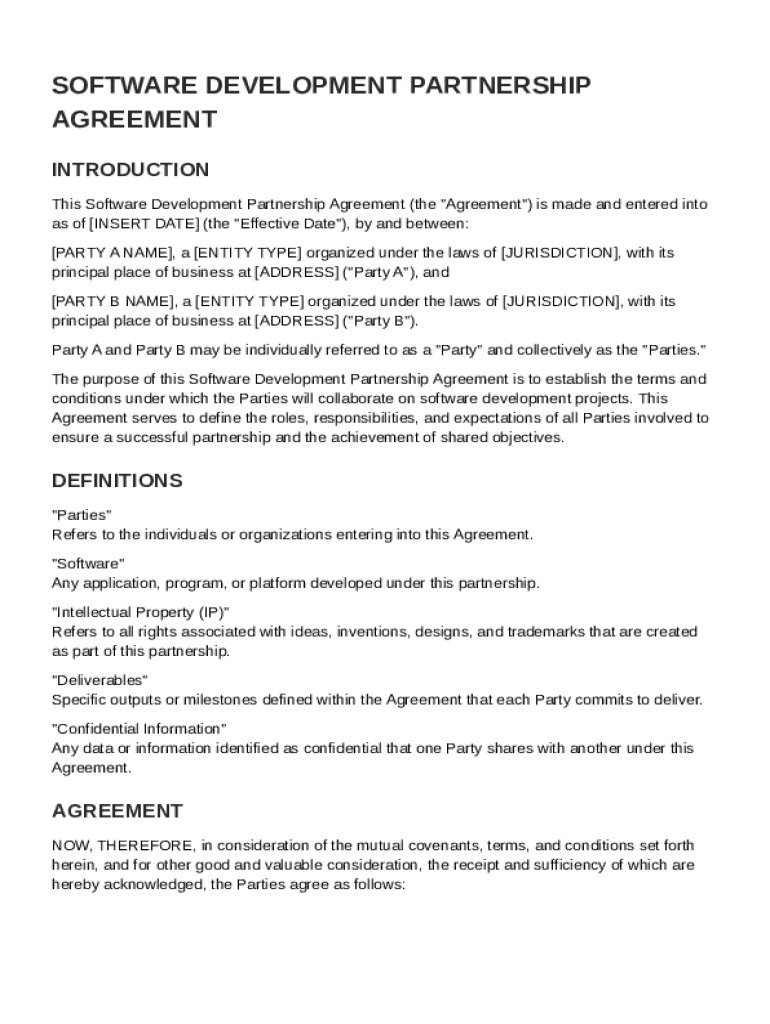
The Software Development Partnership Agreement Template is a crucial document that delineates the essential components of a collaborative software development project. This type of agreement establishes the roles and responsibilities of each party involved, known as Party A and Party B. This ensures clarity in terms of who is accountable for specific aspects of the project. Key elements include:
- Roles and Responsibilities: Clearly defined duties for each partner to avoid overlaps or conflicts.
- Intellectual Property Rights: Specifies ownership of developed software, source code, and related assets.
- Compensation Structures: Details about payment schedules, reimbursement policies, and financial obligations.
- Confidentiality Obligations: Requirements to protect sensitive information shared during the partnership.
- Termination Conditions: Circumstances under which the agreement can be dissolved.
- Dispute Resolution: Procedures for resolving conflicts, such as mediation or arbitration.
This comprehensive outline helps ensure that the partnership operates smoothly and that both parties have aligned expectations.
Steps to Complete the Software Development Partnership Agreement Template
Following a structured approach to fill out the Software Development Partnership Agreement Template ensures completeness and accuracy. Here’s a step-by-step guide:
- Review the Template: Familiarize yourself with the entire document to understand its scope and requirements.
- Identify Parties: Specify full legal names and addresses of Party A and Party B.
- Define Project Scope: Detail the work to be performed, including timelines and deliverables.
- Establish Compensation Terms: Clearly outline how and when payments will be made.
- Clarify Intellectual Property Terms: Specify who will own the developed software and any pre-existing materials.
- Include Confidentiality Clauses: Ensure sections related to data protection and non-disclosure are filled accurately.
- Detail Termination Processes: Outline how the agreement can be terminated by either party.
- Final Review and Approval: Both parties should review the agreement thoroughly before signing.
Careful completion of the template helps mitigate potential misunderstandings and disputes.
Who Typically Uses the Software Development Partnership Agreement Template
The Software Development Partnership Agreement Template serves a variety of users in the tech industry. Typically, the following entities find it essential:
- Tech Startups looking to collaborate with development firms to create innovative software solutions.
- Established IT Companies entering into joint ventures for large-scale software projects.
- Independent Software Developers partnering with businesses to bring a product to market.
- Non-Tech Businesses venturing into new software initiatives needing collaboration with IT experts.
- Consultants and Freelancers acting as intermediaries to facilitate deals between two major development parties.
This agreement acts as a safeguard for all parties involved by formally establishing project guidelines and expectations.


Why You Should Use a Software Development Partnership Agreement Template
Using a Software Development Partnership Agreement Template is essential for protecting the interests of every participant. Here’s why:
- Enhanced Clarity: It reduces ambiguity by clearly documenting expectations, roles, and contributions of each partner.
- Risk Mitigation: Outlines risk management strategies and dispute resolution processes, minimizing potential conflicts.
- Protection of Intellectual Property: Ensures that intellectual property rights are agreed upon upfront, preventing ownership issues.
- Legal Compliance: Helps in complying with applicable laws and standards, reducing legal liabilities.
- Professionalism: Signals a professional approach to partner relationships and project management.
Adopting a formalized agreement ensures that all parties have a documented point of reference throughout the partnership’s lifecycle.
Examples of Using the Software Development Partnership Agreement Template
Real-world scenarios demonstrate how the Software Development Partnership Agreement Template can be applied effectively:
-
Example 1: A fintech startup partners with an experienced software development firm to build a financial app. This agreement stipulates timelines, technical requirements, and financial terms, ensuring both parties meet project objectives successfully.
-
Example 2: Two tech companies collaborate to develop a custom CRM solution for a mutual client. The agreement outlines each party’s responsibilities, compensation models, and client engagement policies, guaranteeing seamless project execution.
-
Example 3: An educational institution partners with a software developer to create an online learning platform. The agreement lays out ownership of educational content and software, securing both parties' rights and contributions.
These scenarios highlight the agreement's versatility across different contexts within the tech industry.
Legal Use of the Software Development Partnership Agreement Template
To ensure the Software Development Partnership Agreement Template serves its purpose legally, it must meet several criteria:
- Governing Law: The agreement should specify which state laws govern its terms, making legal recourse predictable.
- Compliance with Acts: Aligns with acts such as the Uniform Partnership Act, ensuring legality and enforceability.
- Signature Requirements: The agreement must be duly signed by both parties to hold legal validity.
- Consideration Clauses: Include legal consideration for the agreement, signifying an exchange of value.
Legal compliance is crucial in making sure that the terms of the agreement are enforceable and protect both parties’ legal interests.
Important Terms Related to Software Development Partnership Agreement Template
Proper understanding of terminologies used in the Software Development Partnership Agreement Template is vital:
- Confidential Information: Data that is protected from unauthorized disclosure per the agreement terms.
- Force Majeure: Circumstances beyond the control of the parties that may exempt them from fulfilling contract obligations.
- Indemnification: A clause that provides protection against certain legal actions or claims.
- Scope of Work: A detailed description of the tasks and deliverables to be accomplished.
- Third-Party Vendors: External parties that may be involved in the project, whose roles or rights must be defined.
Grasping these terms prevents misinterpretations and fosters clear communication between parties.
State-Specific Rules for the Software Development Partnership Agreement Template
Different states may impose unique rules and nuances that impact a Software Development Partnership Agreement Template:
- California: Requires compliance with specific contract laws and employee classification regulations.
- Texas: May have particular statutes regarding confidentiality clauses and non-compete agreements.
- New York: Often involves strict regulations on trade secrets and intellectual property rights.
Understanding state-specific regulations is paramount for ensuring that the agreement is not only valid but also robust against state law-related challenges.
How to Use the Software Development Partnership Agreement Template
Effectively leveraging the Software Development Partnership Agreement Template requires strategic usage:
- Customization: Tailor the template to fit the specific project needs and industry standards.
- Consultation: Work with legal advisors to ensure conformity with current laws and regulations.
- Review Process: Both parties should thoroughly examine the terms before mutual agreement.
- Document Management: Use tools like DocHub for efficient editing, sharing, and signing of the agreement.
Strategic use of the template facilitates a balanced and mutually beneficial partnership arrangement.