






Definition & Meaning
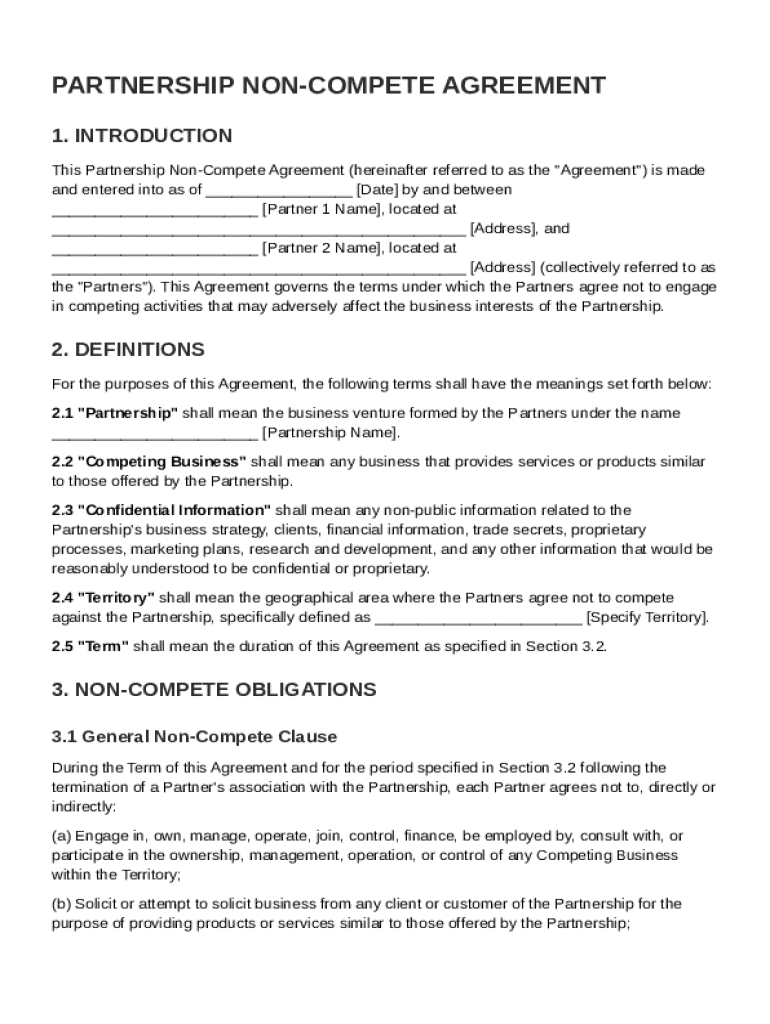
A "Partnership Non-Compete Agreement Template" is a legally binding document used by partners in a business arrangement to define terms that prevent them from engaging in competing activities that could undermine their joint business interests. This agreement is integral to protecting sensitive information, maintaining business integrity, and ensuring that partners' efforts are not diluted by conflicting interests. The document typically includes key definitions such as 'Partnership', 'Competing Business', and 'Confidential Information' to clarify the nature and scope of the restrictions imposed.
Key Elements of the Partnership Non-Compete Agreement Template
The "Partnership Non-Compete Agreement Template" comprises several critical components that ensure comprehensive coverage:
- Definitions: Clarifying key terms such as 'Partnership', 'Competing Business', and ‘Confidential Information’.
- Non-Compete Obligations: Outlining prohibitions against engaging in rival business activities both during and after the partnership.
- Confidentiality Clauses: Provisions to safeguard trade secrets and sensitive information.
- Permitted Activities: Specific activities that are not considered competitive and are therefore allowed.
- Remedies for Breaches: Legal consequences and remedial actions available if the agreement is violated.
- Miscellaneous Clauses: Additional legal stipulations, such as governing law and amendment protocols.
How to Use the Partnership Non-Compete Agreement Template
Using the template primarily involves customization to suit the specific needs of the partnership:
- Review and Understand: Partners should thoroughly review the template to ensure an understanding of all clauses.
- Customize: Edit sections to reflect the specific business terms and competitive restrictions relevant to the partnership.
- Consult Legal Advice: Obtain legal counsel to ensure all terms and conditions comply with local laws.
- Finalize and Sign: Once customized and legally verified, partners should sign the document to formalize the agreement.
Steps to Complete the Partnership Non-Compete Agreement Template
Completing the template efficiently entails:
- Identify Participants: Clearly state the names of the partners involved.
- Define Arrangement: Specify the roles, responsibilities, and expectations pertinent to the partnership.
- Detail Restrictions: Clearly outline non-compete obligations and any permissible exceptions.
- Include Confidentiality Measures: Define what constitutes confidential information and the rules for its protection.
- Outline Terms of Enforcement: Describe the duration of non-compete obligations and any geographical limitations.
- Finalize: Confirm all partners agree to the terms, and document their consent with signatures.
Legal Use of the Partnership Non-Compete Agreement Template
This template serves as a protective measure for partners looking to safeguard their business interests. It is legally enforceable, provided that:
- Reasonable Terms: The restrictions imposed are fair and necessary to protect legitimate business interests.
- Compliance with Local Laws: The agreement adheres to the state and federal laws governing non-compete clauses.
- Consent: All parties voluntarily sign the agreement without coercion.
State-Specific Rules for the Partnership Non-Compete Agreement Template
Each state within the U.S. has unique laws surrounding non-compete agreements:
- California: Generally prohibitive of non-compete clauses, emphasizing employee mobility.
- Texas: Allows non-compete agreements if they are ancillary to an otherwise enforceable agreement and reasonable in scope.
- New York: Enforces non-competes if they protect legitimate interests and are not harmful to public policy.
Partners should conduct state-specific research to ensure compliance with local legal standards.
Who Typically Uses the Partnership Non-Compete Agreement Template
This template is often utilized by:
- Business Partners: To prevent partners from engaging in direct competition post-partnership.
- Joint Ventures: Where two or more entities collaborate temporarily and seek to protect proprietary information.
- Franchises: To maintain uniformity and control within franchised operations.


Examples of Using the Partnership Non-Compete Agreement Template
Several scenarios illustrate the importance of this template:
- Tech Startups: Partners collaborate on developing software, entering a non-compete to safeguard novel algorithms.
- Retail Ventures: A joint store owners' agreement to prevent opening competitive stores within a set radius.
- Healthcare Providers: Two medical professionals join forces under a non-compete to prevent poaching of patients.
These examples highlight how the agreement supports strategic business alliances while mitigating risks.