






Definition & Meaning
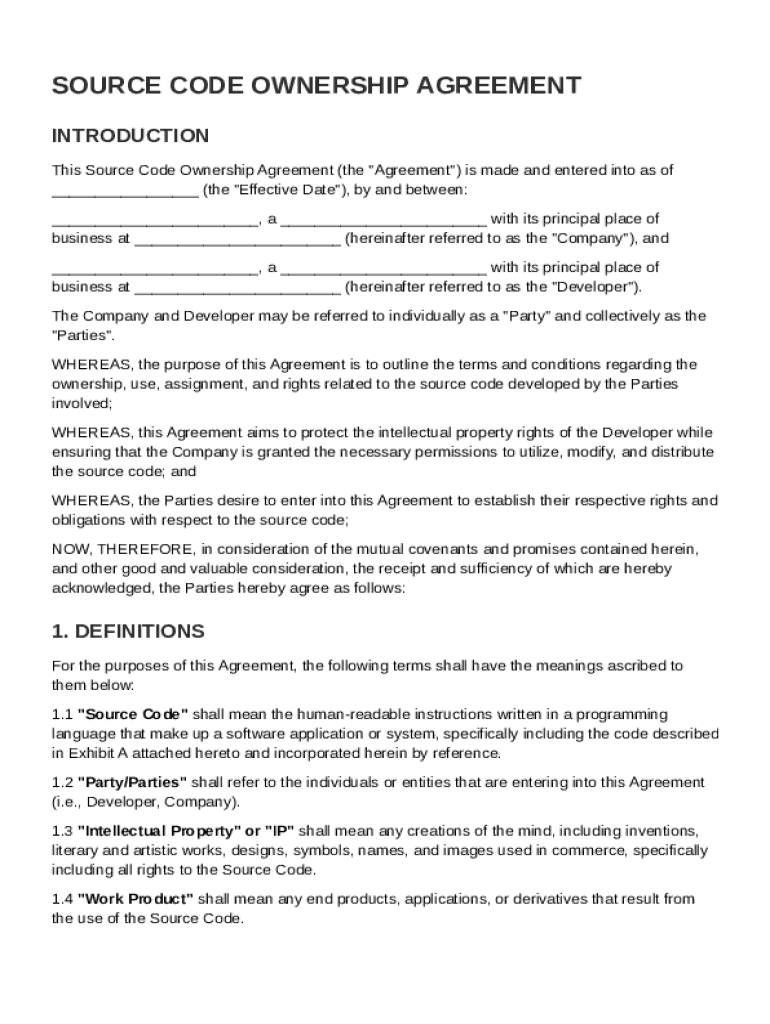
A Source Code Ownership Agreement Template serves as a formal document that outlines the terms regarding the ownership, usage, rights, and responsibilities related to the source code between a Company and a Developer. The primary goal of this agreement is to establish clear guidelines for intellectual property rights to ensure there is no ambiguity regarding who owns the source code originally developed by the Developer and under what conditions it may be transferred or licensed to the Company. This agreement is crucial for protecting intellectual property and preventing disputes.
How to Use the Source Code Ownership Agreement Template
To effectively use the Source Code Ownership Agreement Template, the parties involved—typically a Company and a Developer—must fill out all relevant sections with accurate and complete details. The template acts as a blueprint to draft a customized agreement that matches specific requirements. Key steps include:
- Identifying the Parties: Clearly define the Company and the Developer involved.
- Detailing Ownership Rights: Specify the rights of the Developer in terms of retaining or transferring ownership to the Company.
- Setting Terms and Conditions: Describe the conditions under which the source code can be used, modified, or redistributed.
- Securing Intellectual Property: Outline measures for protecting the code from unauthorized use.
This template ensures consistency and thoroughness in drafting agreements, minimizing the risk of legal pitfalls.
Key Elements of the Source Code Ownership Agreement Template
The Source Code Ownership Agreement Template is composed of several critical elements that ensure comprehensive coverage of all aspects related to the ownership and management of source code. These include:
- Ownership Rights: Clarification of who initially owns the source code and under what conditions ownership can be transferred.
- License Provisions: Details on licensing arrangements, if applicable, including scope and limitations.
- Confidentiality Clauses: Establishment of confidentiality obligations to protect proprietary information.
- Termination Conditions: Stipulations regarding how and under what circumstances the agreement can be terminated.
- Dispute Resolution: Provisions outlining procedures for resolving conflicts related to the agreement.
Each element is designed to provide clarity and prevent misunderstandings between parties.
Steps to Complete the Source Code Ownership Agreement Template
Filling out the Source Code Ownership Agreement Template involves a series of steps to ensure all necessary information is accurately documented:
- Gather Information: Collect all relevant data regarding both parties and the specific source code.
- Customize Legal Terms: Adapt the template terms to fit the particular circumstances and needs of the parties involved.
- Review Contract Terms: Thoroughly review ownership rights, licensing, and confidentiality clauses.
- Sign the Agreement: After finalizing the details, both parties must sign the document to make it legally binding.
Ensuring completeness and accuracy in these steps is crucial for the validity of the agreement.
Important Terms Related to Source Code Ownership Agreement Template
Understanding essential terms is critical when working with the Source Code Ownership Agreement Template. These terms include:
- Intellectual Property (IP): Refers to the creations of the mind, such as inventions or proprietary code, protected by law.
- Licensing: The act of granting permission to use the source code under defined conditions.
- Assignment: The transfer of rights or ownership from one party to another.
- Warranty: A promise that certain facts about the software or agreement will remain true.
- Indemnification: Security against legal responsibility for one's actions or conditions.
Recognizing these terms helps in comprehending the template's implications and executing it effectively.
Who Typically Uses the Source Code Ownership Agreement Template
The Source Code Ownership Agreement Template is widely utilized by several entities, typically including:
- Software Development Companies: To establish ownership rights for code developed by freelance or in-house developers.
- Freelance Developers: To protect their intellectual property when collaborating with companies.
- Tech Startups: To clarify legal standing over newly created software without dispute.
Such agreements are vital in any professional environment where software development and intellectual property are involved.


Legal Use of the Source Code Ownership Agreement Template
The legal use of the Source Code Ownership Agreement Template involves ensuring compliance with relevant laws and regulations to maintain its enforceability:
- Adherence to IP Law: The agreement must align with national and state intellectual property laws in the U.S.
- Compliance with Contract Law: It should meet the legal requirements of a binding contract, including offer, acceptance, consideration, capacity, and legality.
- Consideration of ESIGN Act: For digital agreements, compliance with the ESIGN Act ensures that electronically signed agreements hold the same validity as paper ones.
Proper legal application of the template protects the parties' rights and minimizes the risk of disputes.
State-Specific Rules for the Source Code Ownership Agreement Template
While the Source Code Ownership Agreement Template is designed for nationwide use, certain state-specific rules may affect its application:
- California: Stronger protections around independent contractor agreements and non-compete clauses.
- New York: Specific guidelines for electronic signature acceptance and enforceability.
- Texas: Particular attention to confidentiality and non-disclosure agreements.
Understanding these nuances can be pivotal in tailoring the agreement to meet specific legal standards of the state in which the parties operate.