
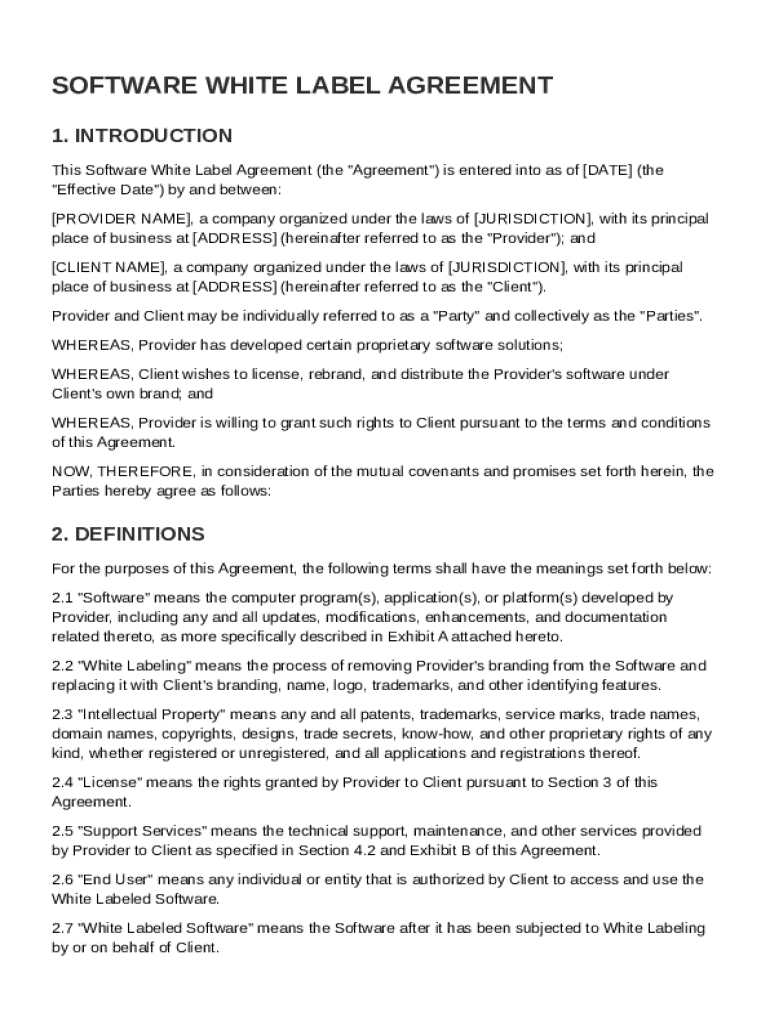







Definition & Meaning
A Software White Label Agreement is a legal document outlining the rights and responsibilities between a software provider and a client. It permits the client to rebrand and distribute the software under their own name, as if they were the original creators. This agreement typically includes fundamental definitions such as “Provider,” “Client,” and “Software,” ensuring both parties understand the context and scope of their relationship. By establishing these definitions, the agreement prevents potential misunderstandings.
For example, the “Provider” refers to the original software developer, while the “Client” is the company purchasing the rebranding rights. Understanding these terms is crucial for interpreting the specific permissions and obligations outlined in the contract.
Key Elements of the Software White Label Agreement Template
A comprehensive Software White Label Agreement Template should encompass several key sections to ensure clarity and legal protection.
-
Licensing Terms: This section should define the scope of the client's rights to use, modify, and distribute the software. It specifies whether the license is exclusive or non-exclusive and details any geographical or temporal limitations.
-
Intellectual Property Rights: Outlines who retains ownership of the software. Typically, the provider maintains rights to the underlying code, while the client gains rights to the branding or packaging they develop.
-
Confidentiality Obligations: This part mandates both parties to protect proprietary information and specifies the duration that the confidentiality must be maintained.
-
Liability Limitations: Sets boundaries on the legal responsibilities of each party, often including disclaimers for indirect damages and cap limits for direct liabilities.
-
Termination Conditions: Defines scenarios under which the agreement can be prematurely ended, such as breach of contract or mutual consent, along with the consequences of termination.
Including these key elements ensures the agreement is robust and can withstand legal scrutiny if disputes arise.
Steps to Complete the Software White Label Agreement Template
Fulfilling a Software White Label Agreement Template involves careful attention to detail and a structured approach. Here’s a step-by-step guide:
-
Review Definitions: Start by understanding all defined terms within the agreement to ensure clarity.
-
Fill in Parties' Information: Enter the legal names and contact details of both the provider and client. Precise information is crucial for legal identification and notification purposes.
-
Customize Licensing Parameters: Tailor the licensing terms according to the specific business arrangement, including exclusivity, duration, and territorial limits.
-
Specify Payment and Reporting Procedures: Clearly define the financial arrangement, including fee structures, payment schedules, and any required reporting intervals.
-
Outline Support Services: Detail the level and scope of support the provider will offer, such as updates, customer service, and training.
-
Draft Confidentiality Clauses: Integrate bespoke confidentiality obligations to safeguard sensitive information.
-
Finalize Liability Clauses: Agree on the limits of liability for each party, documenting any negotiated cap limits on damages.
-
Establish Termination Terms: Define the conditions and process for terminating the agreement, ensuring both parties have an exit strategy.
Conduct a final review once these steps are completed to ensure consistency and compliance with any relevant regulations or standards.
Important Terms Related to Software White Label Agreement Template
Understanding relevant terminology within the Software White Label Agreement Template aids in clarifying legal and operational expectations. Key terms typically include:
- Branding Rights: Refers to the client's power to market the software as their own by applying custom branding.
- Source Code: The original code of the software, which remains the intellectual property of the provider, unless otherwise stated.
- Software Patches: Updates or fixes provided by the provider, which are critical for maintaining the software’s performance.
- Indemnity Clause: A contractual agreement securing one party from legal responsibilities incurred by the other.
Familiarity with these terms allows both the provider and client to navigate the agreement with confidence and understanding.
Legal Use of the Software White Label Agreement Template
For the Software White Label Agreement Template to be legally enforceable, it should conform to applicable laws and regulations. The agreement typically:
- Respects intellectual property laws, ensuring rights are properly transferred and protected.
- Adheres to data protection regulations, especially if personal information is processed.
- Complies with contract laws, necessitating clear mutual consent and lawful purpose.
It’s advisable for both parties to consult legal professionals to verify the agreement meets all necessary legal requirements.
Business Types That Benefit Most from Software White Label Agreement Template
Several business models find the Software White Label Agreement Template particularly advantageous:
- Startups: Leverage established software products for rapid market entry without developing their own solutions.
- Marketing Agencies: Use rebranded software to expand service offerings and enhance their value proposition to clients.
- Software Resellers: Capitalize on branding opportunities to diversify product lines and increase revenue streams.
For these businesses, the template provides a structured way to access robust, branded software solutions that can be marketed as custom offerings.
Examples of Using the Software White Label Agreement Template
Practical applications of the Software White Label Agreement Template vary across industries:
- A financial service startup creates a branded financial planning tool using a white-labeled budgeting software platform to attract new clients.
- An educational company rebrands an e-learning software, integrating it into their suite of educational resources to supplement traditional learning methods.
- A healthcare provider distributes a white-labeled patient management software under their own brand to enhance operational capabilities and patient interactions.
These examples highlight the customizable nature of the template and its potential to drive business growth.
Versions or Alternatives to the Software White Label Agreement Template
While the Software White Label Agreement Template serves a specific need, other variations or contracts might suit particular circumstances:
- OEM Agreements: Focus on the manufacturing sector, allowing a client to integrate software into hardware products.
- Reseller Agreements: Suitable for businesses focusing primarily on redistribution rather than rebranding.
These alternatives offer varied terms that might align better with certain business strategies or sectors. Assessing the benefits and limitations of each option can ensure an optimal contractual fit for business objectives.




