
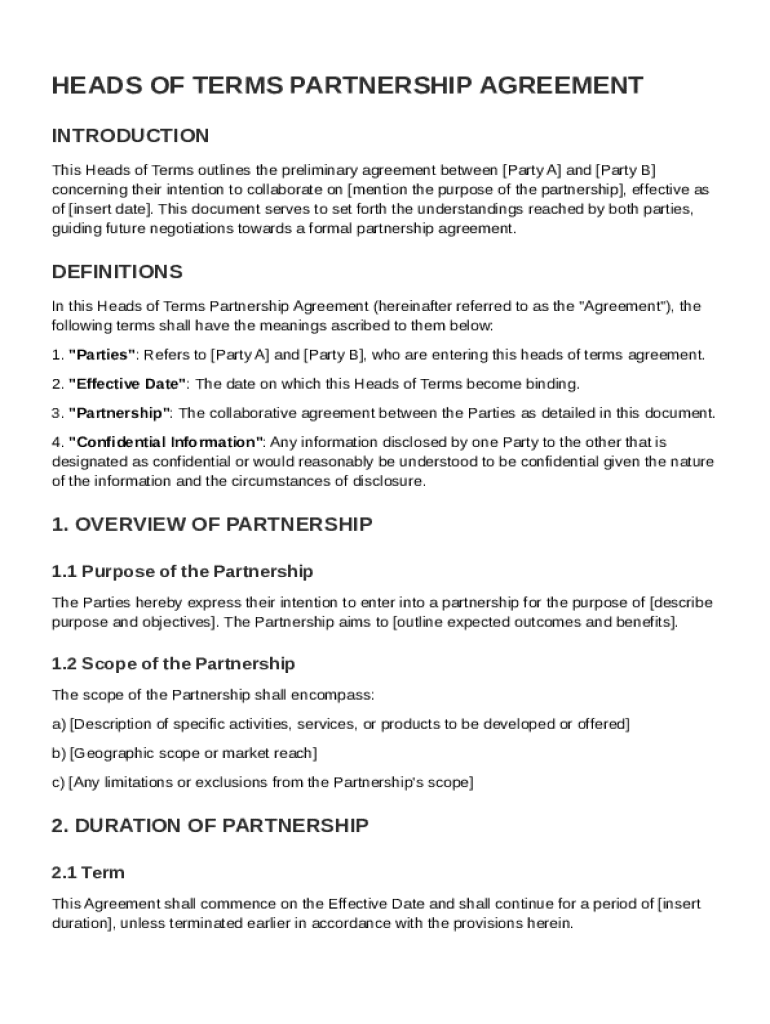







Definition & Meaning
The Heads of Terms Partnership Agreement Template serves as a preliminary document outlining the essential terms and conditions agreed upon by two or more parties who intend to enter into a partnership. This document sets the stage for more detailed negotiations by capturing the key aspects of the intended partnership, including its objectives, duration, and the contributions each party will make. This template is instrumental in providing clarity and alignment among parties before drafting a comprehensive formal agreement.
Key Aspects Covered
- Scope and Purpose: Describes the partnership’s main goals and activities.
- Duration: Defines the timeframe within which the partnership will operate.
- Contributions: Details what each party brings to the partnership, including resources, finances, and expertise.
Key Elements of the Heads of Terms Partnership Agreement Template
The template includes several crucial elements that ensure a comprehensive outline of the partnership agreement. Understanding these elements is vital for creating a robust agreement that addresses all parties’ interests.
Essential Components
- Management Structure: Specifies how decisions will be made and who will manage operations. This includes detailing roles and responsibilities within the partnership.
- Confidentiality Obligations: Outlines how sensitive information will be protected, ensuring that proprietary or sensitive information isn’t disclosed without permission.
- Intellectual Property Rights: Addresses ownership and usage rights for any intellectual property created or used within the partnership.
Steps to Complete the Heads of Terms Partnership Agreement Template
Completing the Heads of Terms Partnership Agreement Template involves a series of steps designed to ensure all relevant details are captured accurately. Each step should be approached with thorough consideration and precision.
- Identify Parties Involved: Clearly list the names and roles of each party in the partnership.
- Define Objectives and Scope: Outline the partnership’s goals and the activities it will encompass.
- Set Contributions and Responsibilities: Specify what each party will contribute and their responsibilities.
- Establish Confidentiality Terms: Detail the measures for protecting any shared confidential information.
- Outline Dispute Resolution: Agree on mechanisms for resolving any disagreements that arise.
Considerations During Completion
- Legal Review: Seek legal counsel to ensure the agreement is comprehensive and compliant with relevant laws.
- Custom Modifications: Adjust the template to meet specific needs or circumstances of the parties involved.
How to Use the Heads of Terms Partnership Agreement Template
The template offers a structured approach to drafting a preliminary partnership agreement. It can be employed by various entities seeking to establish the groundwork for a formal agreement.
Utilization Steps
- Customize the Template: Tailor the document to fit the unique aspects of the intended partnership.
- Facilitate Discussion: Use the template as a discussion tool to gain consensus on key terms among parties.
- Draft Initial Agreement: Compile the agreed-upon terms into the heads of terms document for further negotiation and refinement.
Practical Tips
- Consult with Stakeholders: Engage all relevant stakeholders in discussions to ensure all perspectives are considered.
- Keep a Record: Maintain a version history of the document to track changes and agreements made during discussions.
Who Typically Uses the Heads of Terms Partnership Agreement Template
This template is commonly utilized by various organizations and business entities during the early stages of forming a partnership.


Typical Users
- Entrepreneurs: Individuals launching joint ventures or startups.
- Corporations: Companies forming strategic alliances or joint projects.
- Nonprofits: Charitable organizations collaborating on shared missions.
Versions or Alternatives to the Heads of Terms Partnership Agreement Template
While the Heads of Terms Partnership Agreement is a popular choice, there are alternatives and variations that might suit different partnership types.
Common Alternatives
- Memorandum of Understanding (MoU): A similar preliminary agreement used to express the intention to formalize a contract.
- Letter of Intent (LoI): A document outlining a preliminary commitment to do something, between two or more parties.
Legal Use of the Heads of Terms Partnership Agreement Template
The legal standing of the Heads of Terms Partnership Agreement Template varies depending on its use and the parties involved. It typically acts as a non-binding document, outlining agreed intentions that will guide further negotiations.
Legal Considerations
- Binding vs. Non-Binding: While often non-binding, certain provisions (such as confidentiality) may be enforceable by law.
- Legal Counsel: It is advisable to seek legal advice to clarify which parts of the document may be legally enforceable.
Important Terms Related to Heads of Terms Partnership Agreement Template
Understanding the terminology within the Heads of Terms Partnership Agreement Template is crucial for effective negotiation and drafting.
Terms to Know
- Affiliates: Entities that are related to one of the parties, often through ownership.
- Effective Date: The date from which the terms outlined become applicable.
- Termination Clause: Conditions under which the agreement can be ended.




