




01. Edit your form online
Type text, add images, blackout confidential details, add comments, highlights and more.

Type text, add images, blackout confidential details, add comments, highlights and more.

Draw your signature, type it, upload its image, or use your mobile device as a signature pad.

Send it via email, link, or fax. You can also download it, export it or print it out.
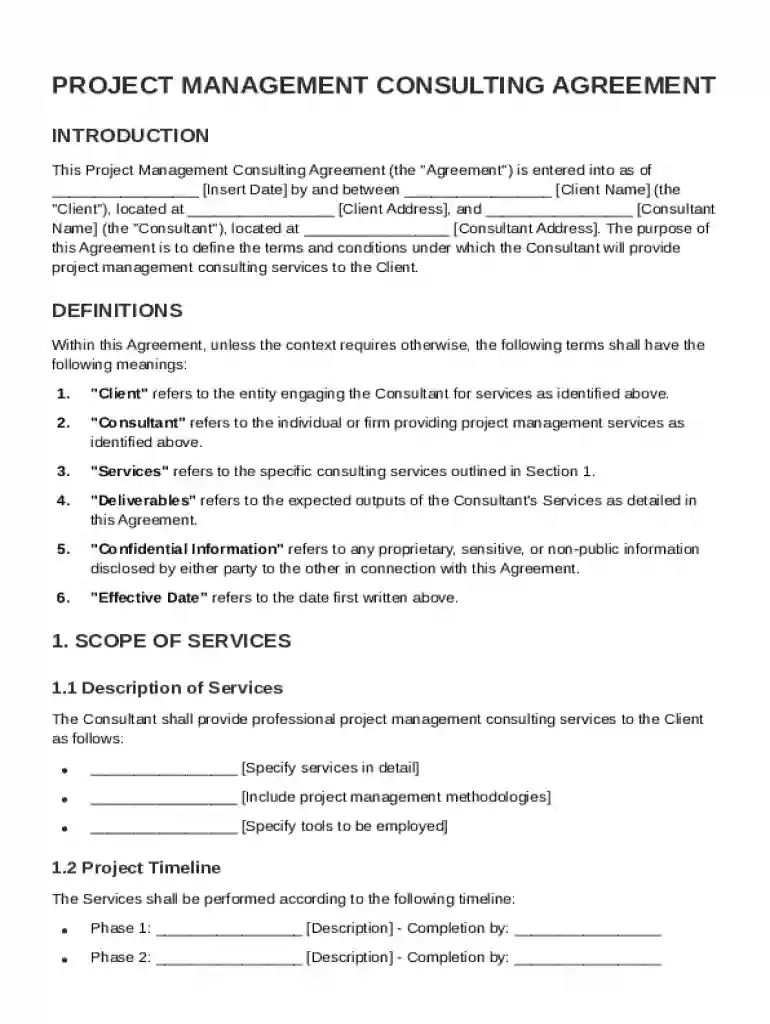
The Project Management Consulting Agreement Template is designed to establish a clear framework for the relationship between a Consultant and a Client. This template covers essential components to ensure both parties understand their obligations and expectations. Key elements include:
Scope of Services: Defining the specific tasks and deliverables expected from the Consultant helps in setting clear expectations. The scope should be detailed enough to avoid any ambiguities that might lead to disputes.
Compensation Structure: This section outlines how the Consultant will be paid. It may include hourly rates, fixed fees, or performance-based incentives, along with payment schedules and associated terms.
Confidentiality Obligations: To protect sensitive information, this part of the agreement specifies the types of information deemed confidential and how such information should be handled by both parties.
Ownership of Work Products: Clarifies which party will own the intellectual property rights to the work products resulting from the collaboration. This is crucial in industries where IP can be highly valuable.
Termination Clause: Outlines the conditions under which either party can terminate the agreement, including required notice periods and any penalties for early termination.
Dispute Resolution: Describes processes for resolving disagreements, whether through mediation, arbitration, or litigation, and may specify jurisdictions for legal proceedings.
Limitation of Liability: Caps the amount of liability one party may hold over the other, often to protect the Consultant from excessive claims beyond the value of the contract.
Understanding the specific language used in a Project Management Consulting Agreement is crucial for clarity and legal precision. Important terms often include:
Consultant: The individual or firm providing project management services.
Client: The entity receiving the services rendered by the Consultant.
Deliverables: Specific outputs that the Consultant is required to provide as per the agreement.
Milestones: Key stages or checkpoints in the project that help track progress and trigger payments based on completion.
Force Majeure: Events beyond control that can affect contractual obligations, often include natural disasters, strikes, and other major disruptions.
Filling out the Project Management Consulting Agreement Template involves a series of detailed steps to ensure accuracy and comprehensiveness:
Identify Parties: Clearly state the full legal names of the Client and Consultant, including contact information and relevant identifiers (e.g., company registration numbers).
Define Scope of Services: Outline the services to be provided in detail, including timelines and specific deliverables.
Set Compensation Terms: Determine the method and schedule of payment, including any conditions under which additional fees may apply.
Address Confidentiality: Insert clauses that detail the types of information that are confidential and the obligations of each party in protecting this information.
Ownership Rights: Specify what rights the Consultant retains and what is transferred to the Client, especially concerning intellectual property.
Include Termination Conditions: Detail the procedures for early termination, including notice requirements and potential penalties.
Incorporate Dispute Resolution Steps: Decide on a preferred method for resolving disputes, ensuring it aligns with the governing laws and is acceptable to both parties.
Review & Finalize: Thoroughly review the document for errors or omissions before signing, possibly involving legal counsel for a final check.
While the template provides a general framework, it's important to consider specific state regulations that might influence the agreement:
Governing Law: Agreements often include a choice of law clause stating which state's laws will govern the terms. The choice can impact how disputes are settled and what provisions are enforceable.
Licensing Requirements: Certain states may require Consultants to have specific licenses to offer project management services, which should be verified and documented.
Data Protection Regulations: Compliance with state-specific laws regarding data privacy and protection (e.g., California Consumer Privacy Act) may necessitate additional provisions in the agreement.
For the template to hold up legally, ensure:
Compliance with Federal Acts: It must align with federal laws such as the ESIGN Act for electronic signatures if executed digitally.
Precision in Language: Ambiguities in language can lead to unenforceability, so clarity is paramount.
Mutual Assent: Both parties must willingly agree to the terms without misunderstandings or coercion.
Technology Sector: Consulting to manage software development projects may require specific clauses addressing technology ownership and software licenses.
Construction Industry: Used to engage project managers for overseeing construction timelines, budgets, and subcontractor coordination.
Marketing Agencies: In managing campaigns, the agreement may outline deliverables such as strategies, reports, and analyses, with confidentiality being key due to proprietary marketing techniques.
Different scenarios may require alternative versions of the template:
Short-Term Projects: A simplified version may suffice for smaller, less complex projects, focusing on core deliverables and payment terms.
Long-Term Engagements: More elaborate agreements with detailed milestone tracking, performance metrics, and auditing processes.
International Consulting: May include additional sections addressing cross-border legal requirements, currency exchange, and international arbitration.
This template is utilized by various parties across industries. Examples include:
Consultants: Independent contractors or firms providing project management expertise to multiple clients simultaneously.
Businesses Seeking Efficiency: Companies looking to streamline projects might engage external project managers to leverage specialized skills and perspectives.
Legal Departments: Corporate legal teams often develop and customize these agreements to meet specific business needs or industry practices.


At DocHub, your data security is our priority. We follow HIPAA, SOC2, GDPR, and other standards, so you can work on your documents with confidence.


The agreements can be used to decide on the main terms and conditions such as payment terms, travel expenses, or confidentiality terms.
This Consulting Agreement, The Company has engaged Consultant to provide services in connection with the Companys [summary of the project or business of the


